

Key Takeaways
A topic cluster strategy organizes your content around connected themes, signalling genuine expertise to search engines and building compounding organic traffic over time.
- A topic cluster strategy groups a broad pillar page with focused cluster pages through internal links, giving search engines a clear signal of deep topical expertise rather than scattered keyword coverage.
- Every cluster page passes authority back to the pillar through internal links, and research shows that a proper internal linking structure can boost search rankings by up to 40%.
- Structured topical coverage improves both traditional Google rankings and the likelihood of appearing in AI generated answers, making it a compounding investment for long term organic growth.
- Begin by auditing existing content to find cluster worthy pages, identify subtopic gaps your audience is already searching for, and build depth in one area before expanding outward.
- Topic clusters and paid search serve different timelines; paid traffic delivers immediate leads while a content cluster strategy builds organic authority that compounds over months and years.
If your website has a growing library of blog posts but organic traffic still feels unpredictable, the problem is rarely the quality of individual articles. It is almost always the absence of structure. A topic cluster strategy organises your content around connected themes rather than isolated keywords, and that structural shift is precisely what search engines have come to reward most consistently. For businesses in competitive markets like Vancouver, where industries from real estate and professional services to trades and tech are all vying for the same search visibility, building that structure deliberately is now one of the clearest paths to sustainable organic growth.
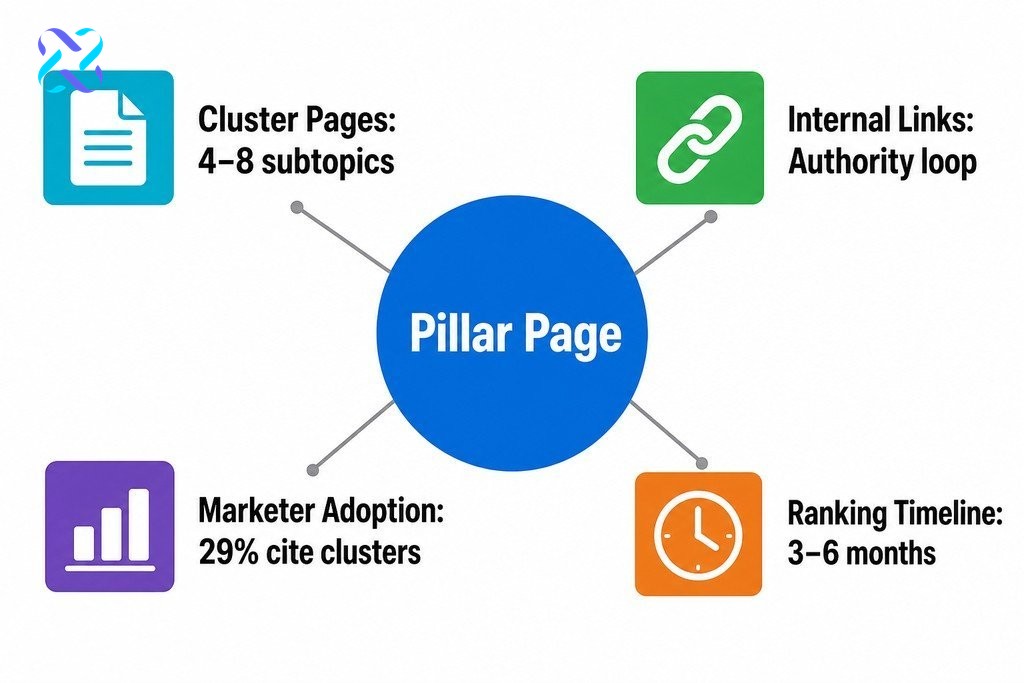
According to the HubSpot 2024 State of Marketing and Trends Report, 29% of marketers identify topic clusters as one of the most effective SEO tactics currently in use, based on a survey of over 1,400 global B2B and B2C marketers. That figure reflects how widely the industry has recognised this approach, not as a trend, but as a foundational shift in how content earns authority online.
What Is a Topic Cluster Strategy?
A topic cluster strategy is a content structure built around one broad “pillar” page and several focused “cluster” pages that each cover a related subtopic. Every cluster page links back to the pillar, and the pillar links out to each cluster. This web of internal connections signals to search engines that your content collectively represents deep, genuine knowledge on a subject rather than a scattered collection of unrelated posts.
The result is stronger topical authority, more consistent rankings, and compounding organic traffic over time.

Why Google Rewards Topic Clusters Over Isolated Blog Posts
Search engines have moved well past the era of rewarding individual pages stuffed with target keywords. Google now evaluates whether an entire website demonstrates genuine knowledge of a subject, examining patterns across multiple pages to determine whether a domain has earned the right to rank for a given topic.
A single well-written post about lead generation might perform adequately on its own. But when it sits alongside ten other pages that explore related subtopics in depth and link back to a central resource, Google reads that network as a signal of real expertise.
This shift matters enormously for businesses building an SEO content strategy from the ground up. A scattered collection of blog posts, each written for a different keyword with no connective tissue between them, sends a weak signal. It tells search engines that a site touches on many subjects without deeply understanding any of them. The result is inconsistent rankings, unpredictable traffic, and missed opportunities on exactly the queries your customers are already searching for.
What a Topic Cluster Actually Looks Like
The pillar-cluster model is simpler than it sounds. At its core, the structure works as follows:
- One pillar page covers a broad core topic comprehensively and serves as the authoritative hub.
- Several cluster pages each address a specific subtopic within that broader theme.
- Internal links connect every cluster page back to the pillar, and the pillar links out to each cluster.
Consider a home services company operating across Vancouver and the surrounding Lower Mainland. Their pillar page might cover home renovation broadly, from planning and budgeting to contractor selection. Surrounding that pillar would be cluster pages on specific areas: bathroom renovation costs, kitchen remodelling timelines, permits for structural changes, and so on. Each cluster page earns its own search traffic from more specific queries, while consistently pointing visitors and search engine crawlers back to the central pillar. The structure reinforces itself over time.
What Makes a Strong Pillar Page?
A strong pillar page is not simply a long blog post or a standard service description. It provides a wide-angle view of the entire topic, answering the most common questions a reader might have and signalling clearly that this is the authoritative hub for everything related to that subject.
The depth is intentional. It covers enough ground to demonstrate comprehensive knowledge without duplicating the specific detail that each cluster page handles on its own. A well-built pillar page strategy creates a destination that earns links, keeps visitors engaged, and gives search engines a clear anchor for the whole content cluster.
How Cluster Pages Support the Pillar
Cluster pages each target a specific subtopic and a more focused search query, which means they often capture long-tail traffic the pillar page alone would never reach. More importantly, every cluster page passes authority back through its internal links to the pillar.
This is the mechanism at the heart of why topic clusters work so well for SEO. Research from Authority Hacker, drawn from an analysis of over one million websites, found that a proper internal linking strategy can improve search rankings meaningfully. That finding underscores why the linking architecture between cluster pages and the pillar is not optional. It is the engine of the entire system.
| Page Type | Scope | Primary Role | Linking Direction | Traffic Type |
|---|---|---|---|---|
| Pillar Page | Broad core topic | Authoritative hub for the entire subject | Links out to all cluster pages | Broad, high-volume queries |
| Cluster Page | Specific subtopic | Supports pillar with focused depth | Links back to the pillar | Focused, long-tail queries |

How Topic Clusters Signal Expertise to Search Engines
When pages across a site consistently reference, define, and interlink the same set of concepts and entities, search engines begin to model the site as genuinely knowledgeable on that subject. It is the difference between a site that mentions a topic and one that teaches it across multiple dimensions.
This matters beyond traditional search results as well. The HubSpot State of AEO 2026 identified that pages featuring outbound links, statistics, author bios, and a visible last-updated date tend to earn more citations across AI Overviews, Gemini, and Perplexity. Structured topical coverage directly supports those on-page signals, which means a well-built topic cluster can improve Google rankings and increase the likelihood of appearing in AI-generated answers.
“Those optimizing new websites should prioritize building authority around a single topic or service line to see the best results,” said Nathan Gotch, AI SEO practitioner, Semrush Blog. That guidance applies equally to established Vancouver businesses that have been publishing broadly without a coherent topic structure in place.
How to Build Your First Topic Cluster
Building a topic cluster does not require starting from scratch. Follow these steps to get the structure right:
- Choose a focused core topic. Pick something specific enough to be ownable given your current domain authority, and closely tied to what your business actually offers.
- Audit your existing content. Many businesses already have cluster-worthy pages scattered across their site. They just have not been organised or linked correctly.
- Identify content gaps. Map out the subtopics your audience searches for that you have not yet covered.
- Build or restructure your pillar page. Create a comprehensive hub page that covers the core topic broadly and links out to every cluster page.
- Connect everything through internal links. Every cluster page should link back to the pillar. This is what activates the authority-building loop.
| Step | Action | What to Watch For |
|---|---|---|
| 1 | Choose a focused core topic | Too broad = hard to rank; ensure it aligns with your services |
| 2 | Audit existing content | Identify pages that can be repurposed or consolidated into cluster assets |
| 3 | Identify content gaps | Map subtopics your audience searches for that you have not yet covered |
| 4 | Build or restructure your pillar page | Must cover the core topic broadly and link out to every cluster page |
| 5 | Connect everything through internal links | Every cluster page must link back to the pillar to activate the authority loop |
A common mistake at this stage is choosing a pillar topic so broad it becomes impossible to rank for, or building clusters around subjects so disconnected from your core services that the authority signals never compound. Every cluster page should address something your actual customers want to know, not just something that generates search volume in the abstract.
How to Choose the Right Pillar Topic
The strongest pillar topics emerge from the intersection of what your customers are already searching for and what your business genuinely knows how to deliver. Keyword research is a useful starting point, but it tells only part of the story.
Understanding the problems, questions, and decisions your audience faces at different stages of their journey is what turns a list of keywords into a coherent content architecture. For Vancouver businesses offering multiple services, it usually makes sense to build one cluster at a time, achieving real depth in a single area before expanding outward. This focused approach tends to build authority faster and produce measurable ranking improvements sooner than spreading effort across too many topics at once.
Topic Clusters vs. Paid Traffic
Topic clusters and paid channels like Google Ads are not competing strategies. They serve different timelines and different business needs.
Topic clusters take several months to gain traction, but the authority accumulates gradually and compounds over time, producing organic traffic that does not stop when you stop paying. Paid traffic, by contrast, generates leads immediately but stops the moment your budget does.
For businesses that need pipeline now, Google Ads fills that gap while the content infrastructure matures. For businesses building long-term organic value, a topic cluster strategy is one of the stronger investments available. Research cited by Whitehat SEO, based on work with over 200 UK B2B businesses, found that structured topic cluster approaches can drive meaningfully more organic traffic and AI citations compared to unstructured content. That kind of compounding return is what makes organic content infrastructure worth the investment horizon it requires.

What to Confirm Before Building Your Content Structure
Before committing to a content cluster strategy, confirm these foundational conditions are in place:
- Technical health: A site with significant crawlability issues, slow page speeds, or duplicate content problems will not fully benefit from cluster architecture until those issues are resolved.
- Content inventory: An audit of existing content can reveal assets worth repurposing, pages that need consolidation, and gaps that represent clear cluster opportunities.
- Sufficient search demand: Confirm that your niche has enough specific search volume to support multiple cluster pages. Some specialised industries do not have the subtopic demand needed to justify a full cluster structure.
When the technical foundation is solid and the demand signals are there, working with an SEO and content specialist can accelerate the process considerably. The decisions around pillar selection, cluster mapping, and internal link architecture have compounding consequences. Getting them right from the start matters more than moving fast.
How Leadsagna Builds Smarter Content Systems for Vancouver Businesses
At Leadsagna, content is treated like any other engineered system: designed with a measurable outcome in mind, built to specifications, and evaluated against real performance data. Rather than producing volume for its own sake, the focus is on identifying where a client’s topic cluster can realistically win, where existing content can be repurposed into cluster assets, and how internal linking architecture can be structured to transfer authority efficiently across the site.
AI-informed analysis plays a central role in that process, helping identify cluster opportunities faster and track the performance of content investment with the same rigour applied to paid campaigns.
Pages within three clicks of the homepage tend to generate significantly more SEO traffic than deeper pages, according to a My Rankings Metrics 2024 to 2025 analysis. That architectural principle shapes how content clusters are mapped and structured, ensuring every cluster page is positioned close enough to the pillar to benefit from its authority rather than buried where crawlers rarely venture.
If you are ready to build a content structure that earns compounding organic results and turns search visibility into real leads, we would be glad to show you exactly how that system works for your business.
Frequently Asked Questions About Topic Cluster Strategy
What is the difference between a pillar page and a cluster page?
A pillar page covers a broad core topic comprehensively and serves as the authoritative hub for an entire subject area. Cluster pages each address a specific subtopic, targeting more focused search queries. Every cluster page links back to the pillar, and the pillar links out to each cluster, creating a reinforcing network of internal authority.
How long does it take for a topic cluster strategy to improve rankings?
Most businesses begin to see measurable ranking improvements within three to six months of publishing and interlinking a complete cluster. The timeline depends on your current domain authority, the competitiveness of your target topic, and the technical health of your site. Early clusters also tend to support the performance of new ones built later.
How many cluster pages does a topic cluster need?
A functional cluster typically includes at least four to eight cluster pages supporting one pillar. The right number depends on how many subtopics your audience genuinely searches for within the core subject. Adding pages without real search demand behind them dilutes rather than strengthens authority.
Can a small Vancouver business benefit from topic clusters, or is this only for large sites?
Small businesses often benefit more from topic clusters than large ones. Focused topical authority allows a site with modest domain authority to compete on specific subjects rather than broad ones. Starting with a single, tightly scoped cluster and achieving genuine depth before expanding is the most practical approach for businesses with limited content resources.
Does a topic cluster strategy help with AI-generated search results?
Structured topical coverage with clear internal linking, outbound references, and consistent use of relevant entities can increase the likelihood of appearing in AI Overviews, Gemini, and Perplexity responses. Pages that demonstrate comprehensive subject-matter knowledge across a cluster are more readily recognised by AI indexing systems as credible sources worth surfacing.


