

Key Takeaways
Vancouver businesses can stop wasting time and budget on the wrong platforms by matching social channel decisions to clear business goals and real audience behaviour.
- Start with your business goal before evaluating any platform. A local service business in Metro Vancouver has very different social channel needs than a B2B company targeting procurement managers across Canada.
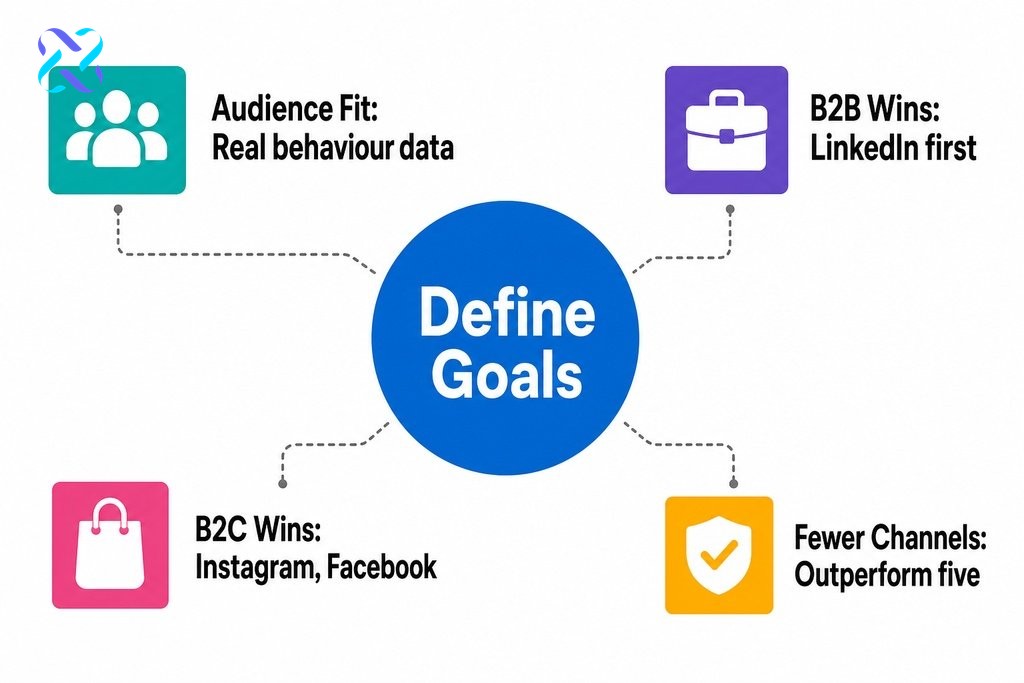
- Match platforms to goals with intention. LinkedIn leads for B2B prospecting, Facebook and Instagram drive B2C discovery, and TikTok or Instagram Reels offer strong organic reach for businesses that can commit to short video content consistently.
- One or two well managed platforms outperform five neglected ones. A consistent, engaged presence builds more trust and visibility than spreading effort thin across channels your team cannot sustain.
- Account for format capacity before committing to a channel. TikTok and YouTube require genuine video production, LinkedIn rewards well written thought leadership, and Instagram demands strong visual content. If your team cannot sustain the format, the platform will underperform regardless of audience fit.
- Review your platform strategy on a regular basis. Algorithms shift, audience behaviour evolves, and your business goals change. A structured quarterly review prevents you from investing in channels out of habit rather than evidence.
Choosing social media platforms for your business is one of the most consequential decisions a marketing strategy involves, yet most businesses treat it as an afterthought. They sign up for every major channel, post inconsistently across all of them, and wonder why nothing moves. Platform selection is a strategic investment decision, and getting it right from the start saves significant time, budget, and energy. According to Sprout Social, platforms like TikTok, Instagram, and YouTube collectively account for over 60% of product discovery, surpassing Google. That figure signals how seriously Canadian businesses need to approach social channel decisions. This article walks through how to make that decision with clarity, from aligning platforms to your actual business goals to recognising when it is time to bring in professional support.
Why Platform Selection Is More Strategic Than Most Businesses Realise
The most common mistake businesses make when building a social presence is letting personal familiarity drive the decision. The founder uses Facebook personally, so the business gets a Facebook page. The marketing coordinator loves Instagram, so that becomes the default channel. Neither of these is necessarily wrong, but neither is a strategic reason.
Platform selection needs to start with a different question: where do your actual customers spend their time online, and what are they doing when they get there? Social media now functions as a full discovery and research tool, not simply a broadcast channel. GWI 2024 consumer research cited via DataReportal found that nearly 30% of internet users discover new brands through social media ads, and a further 23% find them through peer recommendations and comments on social platforms. Those discovery paths look very different depending on the platform. Framing platform selection as a business investment, with expected returns and measurable outcomes, is the shift that separates a focused social strategy from a scattered one.
Start With Your Business Goals, Not the Platform
Before evaluating any channel, get precise about what you need social media to accomplish. Common goals include generating leads from a cold audience, building brand awareness in a specific region such as Metro Vancouver, retaining existing customers through community and communication, and supporting local discovery so nearby buyers can find you. Each of these goals has a different shape, and that shape points toward different platforms. Skipping this step is the most common reason social efforts stall within the first few months.
A local service business in the Lower Mainland has very different platform needs than a B2B software company trying to reach procurement managers across Canada. Without a clearly defined goal, every platform seems equally relevant, which leads to spreading effort across too many channels at once. The goal also determines what content you need to produce, how frequently, and what a meaningful result actually looks like.
Matching Goals to Platform Strengths
Different platform capabilities align with different business objectives in predictable ways. For lead generation and B2B prospecting, LinkedIn is the dominant platform for reaching professionals, decision-makers, and procurement audiences. A dedicated linkedin content strategy for business consistently outperforms other channels for companies selling to other businesses. For brand awareness and consumer engagement, Facebook and Instagram lead for B2C discovery and consideration. Research cited by Dreamgrow found that 80% of Instagram users say the platform helps them decide whether to buy a specific product or service, making it a high-intent consideration channel. For community building and local visibility, Facebook Groups and neighbourhood-focused features still hold genuine value for local service providers, whether operating in East Vancouver, the North Shore, or the Fraser Valley, looking to build trust within a defined geography. For short-form content and younger demographics, TikTok and Instagram Reels offer strong organic reach potential for businesses that can produce engaging short video content consistently.
| Business Goal | Best-Fit Platform(s) | Why It Works |
|---|---|---|
| B2B lead generation and prospecting | Reaches professionals, decision-makers, and procurement audiences; suited to thought-leadership content | |
| Brand awareness and consumer engagement | Facebook, Instagram | High-intent discovery channel; 80% of Instagram users report it influences purchase decisions |
| Community building and local visibility | Facebook (Groups and local features) | Builds trust within a defined geography such as East Vancouver, the North Shore, or the Fraser Valley |
| Short-form content and younger demographics | TikTok, Instagram Reels | Strong organic reach potential for businesses that can produce engaging short video consistently |
Know Your Audience Before You Commit to a Channel
Platform demographics shift constantly, and assumptions based on age group or industry alone are frequently outdated. The idea that LinkedIn is only for executives, or that TikTok is only for teenagers, no longer holds up. The more reliable approach is to research where your specific audience is currently active, using existing customer data, analytics from your own channels, and direct observation of competitor behaviour.
If you already have a customer list, look for patterns: which platforms do your best customers mention, and where do they engage with similar brands? If you are starting fresh, look at where competitors with strong engagement are building their audiences and what content formats seem to be working for them. For Vancouver businesses in particular, it is worth paying attention to how local competitors in your sector, whether retail, trades, professional services, or hospitality, are showing up online and where their engagement is genuinely happening. When targeting decisions are built on real behavioural data rather than assumptions, the right platform choices become much clearer.

Industry Fit and Format Capacity Matter as Much as Demographics
A platform is only as useful as your ability to show up on it consistently with content your audience finds valuable. TikTok and YouTube require a genuine video production commitment. LinkedIn rewards longer-form, thought-leadership content that takes time to write well. Instagram is a visual medium that demands strong photography or graphic design. If your business genuinely cannot sustain those formats, those platforms will underperform regardless of how well their audience demographics match yours.
Industry context matters too. A 2024 global survey reported by Statista and Social Media Examiner found that 51% of B2C marketers ranked Facebook as their most important platform, while 44% of B2B professionals ranked LinkedIn first. These are not arbitrary preferences. They reflect where meaningful audience engagement consistently happens for each business model.
| Platform | Best Business Model | Content Format Required | Production Effort |
|---|---|---|---|
| B2B (ranked first by 44% of B2B marketers) | Longer-form written posts, thought leadership | Medium — writing time required | |
| B2C (ranked first by 51% of B2C marketers) | Mixed: text, images, video, community groups | Low to medium | |
| B2C, visual industries, local services | High-quality photography, graphics, Reels | Medium to high — visual production needed | |
| TikTok | B2C, younger demographics | Short-form video, trend-responsive content | High — consistent video production required |
| YouTube | B2B and B2C, education-driven brands | Long-form video | High — filming and editing commitment |
Where to Post Online When Resources Are Limited
For businesses that cannot realistically manage five channels at once, the answer is almost always to start with one or two platforms and do them well. A consistent, engaged, well-branded presence on two platforms will outperform a dormant or irregular presence across five, every time. This is also where social media management tools for small teams become relevant. Tools that help schedule content, monitor engagement, and consolidate reporting across channels make it far more feasible for lean teams to maintain a focused presence without burning out. Prioritising the right platform and supporting it with the right tools is a more sustainable foundation than overextending across channels you do not have the capacity to manage properly.
The Hidden Costs of Being on Too Many Platforms
There is a real reputational cost to maintaining a weak presence across multiple channels, and most businesses do not fully account for it. A profile that has not posted in four months, or one that reposts content clearly designed for a different platform, signals to potential customers that the business is not engaged or attentive. That impression can undermine trust before a prospect ever visits your website.
With an estimated 5.24 billion social media users worldwide as of 2025, according to Dreamgrow, the competitive landscape on social is genuinely dense, and Vancouver’s market is no exception. Standing out requires depth of engagement on fewer, better-chosen channels rather than surface-level activity spread thin. A clear platform strategy also helps businesses make this argument internally, particularly when stakeholders assume that more channels automatically means more visibility. The data does not support that assumption.

What a Platform Strategy Should Actually Include
A functional platform strategy is more than a list of channels your business plans to use. It should define posting frequency per channel, the content types you will consistently produce, how you will engage beyond publishing, including responding to comments, joining conversations, and monitoring mentions, and the performance benchmarks that tell you whether a platform is working. Without these elements in place, platform decisions remain theoretical rather than operational.
Channel decisions also need to be revisited periodically. Algorithms change, audience behaviour shifts, and your own business goals evolve. Building in a structured review, even quarterly, prevents businesses from continuing to invest in channels out of habit rather than evidence.
How an AI-Informed Approach Changes the Analysis
One of the most meaningful shifts in social media strategy over the past few years is the ability to use AI and data tools to assess platform performance potential before committing significant resources. Rather than relying on gut feel or following broad industry trends, AI-informed analysis can examine actual audience behaviour patterns, content format performance, and competitive engagement data to surface which channels are most likely to produce results for a specific business. At Leadsagna, this kind of data-driven approach sits at the core of every social media recommendation. The goal is never to be on every platform. It is to be on the right ones with a strategy that can be measured, adjusted, and improved over time.
When to Bring In a Vancouver Social Media Strategist
There are clear signs that a business has moved beyond what DIY platform management can reasonably support: you are consistently producing content but seeing no measurable movement in leads, website traffic, or follower engagement; your team is spending significant time on social media without a clear connection between that effort and business outcomes; or you are unsure which platforms are actually worth your time and budget.
A qualified partner within a social media marketing agency should be able to show you platform performance tied to your actual business goals, not just follower growth or post reach as standalone metrics. Before engaging any agency or strategist, knowing the right questions to ask before outsourcing social media is essential. You should be asking how they measure success, what reporting they provide, how they approach platform selection for your specific audience, and what their process looks like for testing and optimising content. A credible partner will have clear, specific answers to all of those questions.
Instagram vs facebook for business is not a question that should be answered generically. It should be answered based on your specific customer profile, your content capacity, and your sales cycle. If a potential partner cannot get that specific, keep looking. If you are ready to stop guessing which platforms are worth your time and start building a social presence that actually converts, Leadsagna’s team in Vancouver is here to help you make that call with confidence. Reach out today for a focused conversation about where your business should be showing up online and what a results-oriented strategy looks like in practice.
Frequently Asked Questions About Choosing Social Media Platforms for Business
How do I decide which social media platform is best for my business?
Start with your business goal and your audience’s behaviour, not platform popularity. A B2B company targeting procurement managers in Canada will typically see better results on LinkedIn, while a local retail or hospitality business in Vancouver is more likely to find its audience on Instagram or Facebook. Match the platform to where your specific customers are already active and what content formats you can realistically sustain.
Is it better to be on one social media platform or several?
For most small and mid-sized businesses, one or two well-managed platforms outperform five neglected ones. A consistent, engaged presence builds trust and visibility more effectively than spreading effort thin. Choose channels most aligned with your goals and audience, then expand only when you have the capacity to maintain quality across additional platforms.
How often should a Vancouver business post on social media?
Consistency matters more than volume. A realistic schedule you can maintain, even two or three times per week, produces better results than daily posting that trails off after a few weeks. Build your posting frequency around what your team can sustain without compromising content quality.
What are the signs that my social media strategy is not working?
Key indicators include flat or declining engagement despite regular posting, no measurable lift in website traffic or leads, and content that generates impressions but no meaningful actions. If your team is investing significant time in social media without a traceable connection to business outcomes, that is a strong signal to reassess your platform choices and content approach.
When should a business in Vancouver hire a social media strategist?
Consider professional support when internal efforts are producing content but not results, or when your team lacks the time and expertise to manage platform strategy alongside other responsibilities. A qualified strategist should tie platform recommendations directly to your business goals and provide reporting that goes beyond surface metrics like follower count or post reach.


