


Key Takeaways
A deliberate internal linking strategy helps Canadian businesses direct Google toward their most valuable pages and convert more organic visitors into leads.
- Map your highest value pages first and ensure every new piece of content links back to them consistently to build link equity where it matters most.
- Orphan pages with no internal links pointing to them are invisible to search engines; a regular crawl audit helps you find and fix these gaps before they accumulate.
- Contextual internal links placed within body copy carry far more weight than footer or navigation links, and descriptive anchor text multiplies their SEO impact significantly.
- Plan your internal links before you publish new content, not after; building this habit into your workflow keeps your site architecture coherent as your site grows.
- Think of internal linking as a guide through your buyer journey; a well-connected site reduces friction and turns more readers into leads rather than lost visitors.
Most business owners think about internal linking the way they think about plumbing: something that should work quietly in the background, handled once and forgotten. In reality, your internal linking strategy is one of the most direct levers you have over which pages Google finds, which ones it ranks, and which ones your potential customers ever see. Get it right and you create a site that pulls visitors toward your most valuable content. Leave it unplanned and you leave real revenue on the table.
This article walks through what a deliberate internal linking strategy looks like in practice, why it matters beyond SEO theory, and how businesses across Vancouver and the rest of Canada can build a structure that supports both search performance and genuine growth. Whether you manage a five-page service site or a growing content library, the decisions you make about linking pages together are among the most consequential ones in your digital strategy.
What Is an Internal Linking Strategy?
An internal linking strategy is a deliberate plan for how pages on your website link to one another. Rather than adding links randomly or only when they feel convenient, a strategy ensures that your most important pages consistently receive links from relevant content across your site. This shapes how search engines discover and prioritize your pages, and it guides visitors toward the actions that matter most to your business.
When an SEO professional talks about internal links, they often frame it around crawlability or PageRank. Both matter, but for a business owner, the more useful frame is simpler: internal links decide which pages get seen. If your highest-converting service page receives no internal links from the rest of your site, Google treats it as a low-priority destination. If your blog post about a problem your customers face links naturally to your contact page, you have created a path from awareness to action. That is a business outcome, not a technical detail.
A study by InLinks across 5,112 websites found that 82% of all internal linking opportunities go unimplemented, with most sites failing to connect related content despite clear topical relationships existing between their pages. For small and mid-sized Canadian businesses competing against larger, better-resourced competitors, closing that gap is one of the more accessible advantages available.

Why Internal Linking Is a Business Decision, Not Just a Technical One
Internal linking directly affects which pages generate traffic, leads, and revenue. A page that no other page links to is, for all practical purposes, invisible to search engines regardless of how well it is written. Conversely, a page that receives consistent internal links from relevant content across your site signals to Google that it is important and worth ranking.
This makes internal linking a business decision first and a technical one second. Every link you add or omit shapes the path your visitors take and the revenue your site can generate.
How Site Architecture for SEO Reflects Your Business Priorities
Site architecture for SEO is not about how your navigation menu looks. It is about how Google interprets the relationships between your pages and which ones it considers authoritative enough to surface in search results. A well-structured site sends clear signals: here are our core offerings, here is the supporting content, and here is how they all connect. A poorly structured site sends noise, and Google responds by ranking nothing particularly well.
A flat, logical architecture built around your core services or product categories consistently outperforms a site that has grown without a plan. When pages are buried four or five clicks from the homepage, or when they exist in isolation without any links pointing to them, they are effectively invisible to search engines regardless of how well-written they are.
Mapping Your Most Valuable Pages First
Before you touch a single link, identify which pages actually matter to your business. These are the pages that generate leads, drive purchases, or move prospects toward a decision. For a service business serving clients across Metro Vancouver, whether in Burnaby, Richmond, North Vancouver, or the core of the city, that might be a specific landing page for a core offering. For an e-commerce brand, it is a product category page.
Once you identify those pages, every internal link planning decision should be made with them in mind. The goal is to ensure these pages receive consistent link equity from other pages across your site, which signals their importance to Google and helps them climb in rankings.
Identifying Gaps Where Pages Are Orphaned or Underlinked
Orphan pages, those with no internal links pointing to them, are one of the most common and costly structural problems on growing websites. Search engines struggle to discover and index pages that are not connected to anything, regardless of how valuable the content might be.
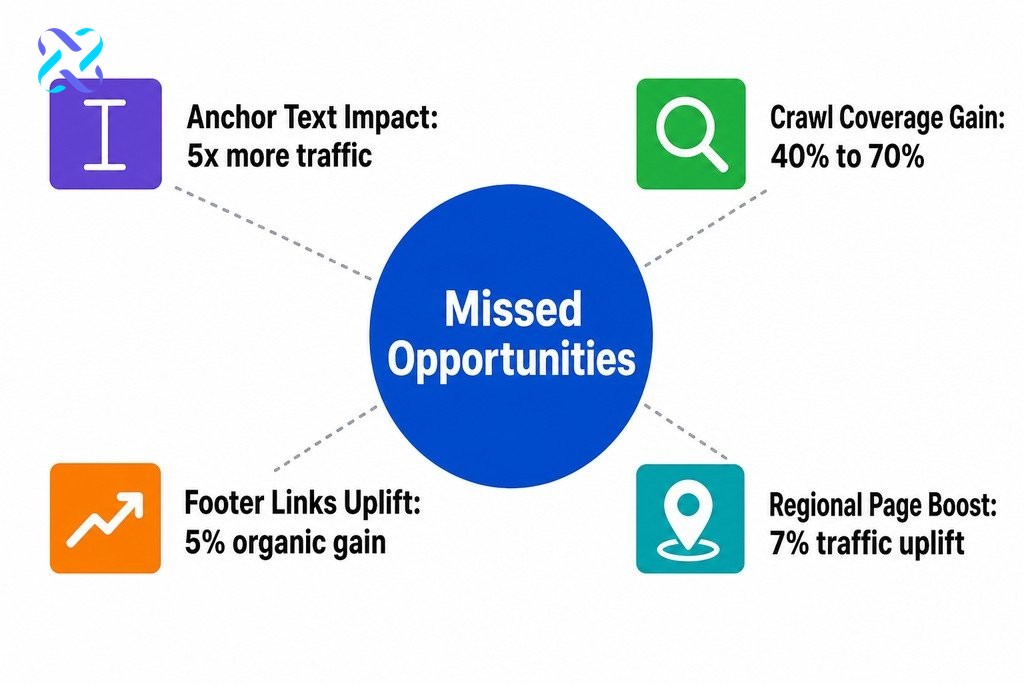
A basic site audit using a crawl tool will reveal which pages are isolated. Once you find them, the fix is straightforward: identify relevant existing content and add meaningful links. The lift from doing so can be significant. Controlled SEO tests by SearchPilot showed that adding internal links to regional pages produced a 7% uplift in organic traffic on the receiving pages, based on a site with approximately 8,000 regional pages.

What Is Link Equity and Why Does It Affect Rankings?
Link equity is the value or authority that passes from one page to another through a hyperlink. When a high-authority page on your site links to a newer or lower-ranking page, it transfers some of its credibility to that destination. The more strategically you route this equity, the more effectively your site can rank for competitive terms.
Most sites distribute this equity unevenly without realising it. They pour links into their homepage while service or product pages sit disconnected, starved of the authority they need to rank competitively.
Fixing link equity distribution does not require a site rebuild. It requires a deliberate review of which pages carry the most authority and whether those pages are linking to the ones that need a boost. Even structural changes at the footer level can move the needle. SearchPilot found that expanding homepage footer internal links yielded a 5% uplift in organic traffic for the destination pages, demonstrating that even non-contextual placements have measurable impact when they are intentional.
Think of your internal linking structure as a system that routes authority toward your most commercially important pages, not as a random collection of hyperlinks.
| Link Placement Type | Topical Signal Strength | Link Equity Impact | Best Used For |
|---|---|---|---|
| Contextual body link | High | High | Reinforcing topical relationships between related pages |
| Navigation / header link | Medium | Medium to high | Surfacing top-priority service or category pages |
| Footer link | Low | Low to medium | Broad site-wide coverage for important destination pages |
| Sidebar link | Low | Low | Supporting secondary pages or related content clusters |
How Contextual Internal Links Build Topical Authority
Not all internal links carry equal weight. A link tucked into a footer alongside a dozen others tells Google much less than a link placed naturally within a paragraph of relevant content. Contextual internal links, those embedded within body copy where they genuinely extend the reader’s understanding, send a much stronger topical signal. They tell Google that two pages share a meaningful relationship, which strengthens your overall content ecosystem.
Anchor text plays a critical role here. Generic labels like “click here” or “read more” give search engines almost nothing to work with. Descriptive, keyword-relevant anchor text tells Google what the linked page is about before it even follows the link.
Research from Zyppy, drawn from an analysis of 23 million internal links across 1,800 websites, found that pages with at least one exact-match anchor text from internal links had roughly five times the search traffic of pages without one. That is a significant difference produced entirely by the language you choose when writing a link.
Should You Plan Internal Links Before or After Publishing?
Plan them before. One of the most persistent structural problems on growing websites is the habit of writing content first and thinking about linking later. When internal link planning is treated as a retroactive cleanup task, it rarely gets done thoroughly, and structural debt accumulates over time.
The better approach is to plan your links as part of the content creation process. Before a page is published, identify which existing pages it should link to and which pages should link back to it. This is especially relevant within a topic cluster strategy, where a central hub and its surrounding content pages need to be tightly interconnected from the moment they go live.
Building this habit into your publishing workflow reduces the time spent on future audits, because the architecture stays coherent as the site grows.
Aligning Internal Links With Your Buyer’s Journey
Your internal linking patterns can mirror the path a buyer takes from first becoming aware of a problem to deciding on a solution. An article that introduces a challenge your audience faces can link to a page that explains your approach to solving it. That page can then link to a case study or a contact form.
This is not just good UX. It is a deliberate guide through the sales funnel, built into the fabric of your site. When links reflect the buyer’s journey, they reduce friction and increase the likelihood that a reader becomes a lead rather than bouncing back to Google.

Internal Linking Best Practices for Growing Canadian Businesses
For small and mid-sized businesses, the goal is not to implement every possible tactic at once. It is to build consistent habits that improve over time. A focused approach to internal linking best practices is far more sustainable than a one-time overhaul.
Start with these priorities:
- Link to your highest-value pages from every relevant piece of new content you publish.
- Use descriptive anchor text that reflects the topic of the destination page. Avoid generic labels like “click here.”
- Run a crawl audit every few months to catch orphan pages before they accumulate.
- Review existing pages when adding new content to find linking opportunities that reinforce your architecture.
The underlying principle is intent over volume. A site with fifty well-placed, purposeful internal links will generally outperform one with five hundred random ones. One large-site case study by JetOctopus found that a revised internal linking strategy increased Googlebot crawl coverage from 40% to 70%, a gain of thirty percentage points achieved purely through better link planning.
| Practice | Priority | Effort to Implement | Expected Benefit |
|---|---|---|---|
| Link to highest-value pages from new content | High | Low | Stronger link equity flow to key pages |
| Use descriptive, keyword-relevant anchor text | High | Low | Clearer topical signals to search engines |
| Run crawl audits every few months | Medium | Medium | Early detection of orphan pages and broken links |
| Review existing pages when publishing new content | Medium | Low to medium | Ongoing architecture coherence as the site grows |
When to Handle Internal Linking In-House and When to Bring in Support
If your site has fewer than fifty pages and your content output is modest, managing your internal linking strategy in-house is entirely achievable with the right framework in place. The concepts are not technically complex, and consistent attention to the basics produces genuine results over time.
Where it becomes harder to manage alone is when your site is growing quickly, when you are developing a pillar page strategy across multiple topic clusters, or when audit findings reveal widespread structural issues that need prioritising across hundreds of pages simultaneously.
At that scale, the real cost is not the effort of adding links. It is the opportunity cost of getting the hierarchy wrong or missing the connections that could be driving rankings right now. Bringing in a structured SEO partner means you are working with someone who can map your content architecture to your actual business goals, identify where link equity is being wasted, and build a system that scales with you.
At Leadsagna, we approach internal linking the same way we approach everything: with precision, data, and a clear focus on what moves your business forward. If your site is ready for a proper structure review or you want to understand where your organic growth is being held back, we would be glad to walk through it with you. Reach out to our Vancouver team and let us show you what a smarter internal linking strategy can do for your search performance.
Frequently Asked Questions About Internal Linking Strategy
How many internal links should a page have?
There is no fixed rule, but each link should serve a genuine purpose, either helping the reader or reinforcing your site structure. Overloading a page with links dilutes the equity passed to each destination. For most business pages, five to fifteen contextual links is a reasonable range, adjusted based on content length and page importance.
What is the difference between internal links and external links?
Internal links connect pages within the same website, while external links point to pages on other domains. Internal links distribute authority within your own site and guide visitors through your content. External links can add credibility when pointing to authoritative sources, but they do not directly boost your own page rankings.
Do internal links help with Google indexing?
Yes. Googlebot follows links to discover and crawl new pages. A page with no internal links pointing to it is far less likely to be crawled or indexed regularly. Connecting your pages through a logical internal link structure is one of the most reliable ways to ensure Google can find and evaluate all of your content.
What anchor text should I use for internal links?
Use descriptive, topic-relevant anchor text that reflects the content of the destination page. Phrases like “Vancouver content marketing services” or “pillar page strategy” are far more useful to search engines than generic labels like “click here” or “learn more.” Exact-match and close-variant anchors from internal links have been shown to meaningfully increase page traffic.
How often should I audit my internal links?
A crawl audit every three to four months is practical for most small and mid-sized businesses. This frequency is enough to catch orphan pages, identify broken links, and find new linking opportunities as your content library grows. Larger sites publishing frequently may benefit from monthly reviews or automated monitoring tools.


