

Key Takeaways
Local landing pages give Canadian businesses location-specific visibility in Google search by signaling exactly where they operate and who they serve.
- A general services page tells Google what you do — a local landing page tells Google where you do it, which is what earns placement in local search results and the map pack.
- Choose the right page type before you build: location pages work for businesses with a physical address, while service area pages are built for those who travel to clients without a fixed local presence.
- Swapping a city name into a copy-paste template is a ranking liability — effective local page content reflects the specific market, addresses local questions, and includes a location-specific call to action.
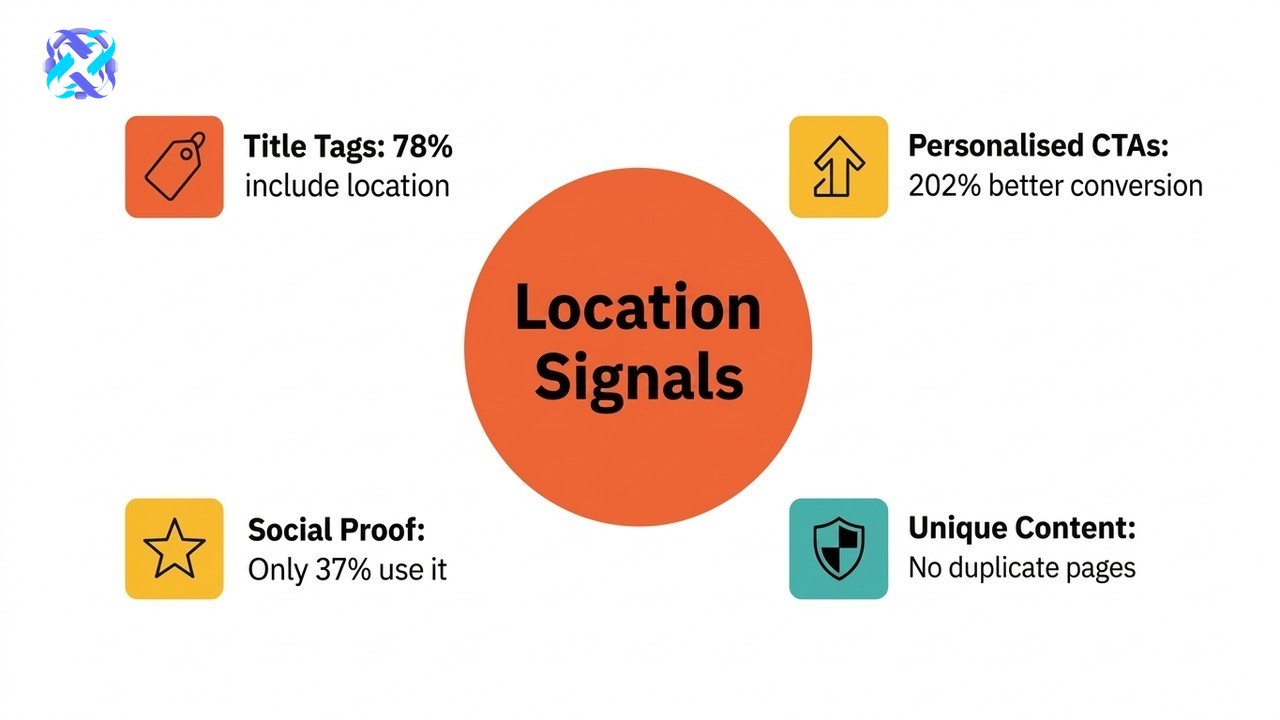
- 78% of top-ranking local pages include a location in the title tag, making it one of the most consistent and frequently overlooked on-page SEO signals available.
- A scalable service area SEO structure requires consistent URL patterns, unique content for each location, proper schema markup, and internal links that connect pages into a coherent local search architecture.
Most businesses invest in a website and assume visibility will follow. It rarely does — at least not in the specific cities, neighbourhoods, or service regions that actually matter to them. Local landing pages are the structural solution to this problem. They give search engines a clear, location-specific signal about where a business operates and who it serves. That signal is what separates businesses that appear in local search results from those that stay invisible. For businesses competing across multiple markets, this distinction is not minor — it is often the difference between a steady pipeline of qualified inquiries and a website that generates almost no local traffic at all.
This article walks through how local landing pages work, what separates effective ones from ineffective ones, and how to build a page structure that scales with your business. Whether you run a single-location company or serve clients across several regions or countries, the principles here apply directly to how your local SEO strategy should be structured.
What Are Local Landing Pages?
A local landing page is a dedicated website page built around a specific location and service. Instead of one generic services page, you have individual pages targeting each city or region you serve — each one telling Google exactly where you operate, what you offer there, and who you serve. This specificity is what earns placement in local search results and the Google map pack.

Why Location-Specific Pages Matter for Local SEO
Google does not treat all website pages equally when someone performs a location-based search. When a user searches for a service followed by a city name — or when Google infers local intent from their device — the algorithm looks for pages specifically relevant to that location, not just a homepage with a city name buried in the footer.
A general services page tells Google what a business does. A local landing page tells Google where that business does it, for whom, and in what context. That specificity is what earns placement in both organic local results and the map pack.
For businesses operating across multiple service areas, the stakes are even higher. A company based in one city may also serve surrounding towns, suburbs, and neighbouring regions — but if those markets are represented only by a line in a contact form, they effectively do not exist in local search. Each location without a dedicated page is a missed opportunity to rank, be found, and convert a qualified visitor into a lead.
Local Landing Pages vs. Service Area Pages
These two page types are frequently confused, but they serve different purposes. Using the wrong approach can suppress your rankings rather than support them.
When to Build a Location Page
A location page is the right choice when your business has a physical presence tied to a specific address — a storefront, office, clinic, or space where clients regularly visit. This type of page can reference the exact address, include a map embed, and signal to Google that your business genuinely operates from that location. Location pages carry more local authority because they are anchored to a verifiable place, which aligns with how Google evaluates trust and relevance in local search.
When Service Area Pages Are the Right Choice
Service area pages are built for businesses that work within a region without a fixed address there. This includes contractors, home service providers, mobile professionals, and any company that travels to clients rather than receiving them.
Creating a fake address or pretending to have a physical presence in a city is not only ineffective — it violates Google’s guidelines. Instead, a well-structured service area page communicates the geographic scope of your service, the specific work performed in that region, and the local context that makes the page relevant. Home renovation companies, HVAC providers, cleaning services, and digital agencies serving clients across multiple cities all fall into this category. The goal is to build service area page content that earns relevance through specificity, not fabricated proximity.
| Factor | Local Landing Page | Service Area Page |
|---|---|---|
| Physical address required | Yes — tied to a verifiable location | No — covers a region without fixed premises |
| Best suited for | Storefronts, offices, clinics, studios | Contractors, mobile professionals, home service providers |
| Map embed | Appropriate and recommended | Not applicable |
| Local authority signal | Higher — anchored to a verifiable place | Moderate — earned through content specificity |
| Client direction | Clients visit the business | Business travels to clients |
| Google guideline risk | Low when address is genuine | Risk only if a fake address is used |
What Strong Local Landing Page Content Includes
The most common mistake businesses make is treating local pages as templates — swapping a city name into an otherwise identical page and publishing it across dozens of locations. Search engines are highly effective at detecting thin, duplicated content, and they typically suppress it in rankings. A page that genuinely serves a local visitor reflects the specific market it targets, answers the questions that market has, and makes it easy for a visitor to take action.
Key Elements Every Local Page Should Have
- Location-specific service description: Explain what you do in that specific city or region, not just what you do in general.
- Local context and references: Mention relevant neighbourhoods, landmarks, or regional characteristics that show genuine local knowledge.
- Customer testimonials: According to Nifty Marketing’s Local Landing Page Study, only 37% of top local landing pages include testimonials — making social proof an underused but highly effective trust signal.
- A personalised call to action: A HubSpot analysis of 330,000 calls-to-action found that personalised CTAs outperformed generic ones by 202%. A CTA that references the city and specific service converts measurably better than a generic “contact us” button.
How to Show Local Relevance Naturally
Referencing local context helps both search engines and visitors understand the page was written for their specific market. A roofing company page targeting a northern city might reference how seasonal weather patterns affect roof maintenance timelines. A marketing agency page targeting businesses in a dense urban centre might speak to the competitive landscape of certain industries in that market. The goal is to demonstrate local knowledge, not just local presence.
Location Page SEO: Key Ranking Factors
On-page SEO for local service pages follows the same structural logic as general SEO, but with location signals embedded at every level.
Title Tags
Research from Nifty Marketing’s Local Landing Page Study found that 78% of top local landing pages on Google include a location in the title tag — making it one of the most consistent ranking signals across high-performing pages. This is a basic but frequently overlooked starting point for location page SEO.
Headers, Schema, and Internal Links
Beyond the title tag, strong local pages benefit from:
- Structured headers that reflect both the service and the location
- Schema markup (LocalBusiness or Service) that helps search engines parse business information correctly
- Internal links that connect service area pages to each other and to the main site architecture, distributing authority and helping search engines understand your geographic scope
How to Build a Service Area Structure That Scales
Businesses that serve multiple cities need a page architecture that can grow without a complete rebuild each time a new market is added. The right approach is to plan the structure before building the first page.
This means establishing consistent URL patterns, shared page templates with built-in differentiation points, and a clear hierarchy connecting regional pages to broader service categories. A business serving ten cities should have ten distinct local landing pages — each substantively different, each connected logically within the site, and each aligned with how potential clients in that market actually search.
Avoiding Duplicate Content Across Geographic Markets
Duplicate content is the most common technical risk when building service area pages at scale. The solution is not to avoid building multiple location pages — it is to build each one with enough unique, locally specific content that search engines treat them as separate, authoritative resources rather than copies of each other.
Unbounce’s Conversion Benchmark Report, which analysed 44 million conversions, found that pages with a single clear CTA converted significantly better than pages with multiple competing offers. Apply that principle across your location pages: one geographic market, one primary service, one clear next step for the visitor.
Pre-Publish Checklist for Local Landing Pages
Publishing a local page without verifying its foundational accuracy can create problems that are harder to fix after the fact. Before you publish, confirm the following:
| Item | What to Verify | Priority |
|---|---|---|
| NAP consistency | Name, address, and phone number match exactly across your website, Google Business Profile, and major directories | High |
| Title tag and H1 | Both include the location and primary service term | High |
| Mobile performance | Page loads at competitive speed on mobile devices — a non-negotiable baseline for local rankings | High |
| Call to action clarity | One primary action per page, worded specifically for the location and service | High |
| Schema markup | LocalBusiness or Service schema is correctly implemented and free of errors | High |
For businesses entering competitive markets or managing pages across many locations, working with an SEO professional rather than relying on generic templates is worth considering. The compounding errors that come from poorly built local page networks can be difficult and time-consuming to reverse.
How a Structured Approach to Local Pages Produces Leads
A single local landing page with no internal link structure, no connection to related service pages, and no alignment with your Google Business Profile functions like a standalone flyer left in an empty room. The businesses that consistently generate qualified local traffic treat their local and service area pages as a connected system — each page reinforcing the others, each one contributing to the overall authority of the domain in a specific geographic market.
The better question to ask is not “how many pages should we have” but “what does the complete local search architecture need to look like for this business to be found across all of its markets.” That question leads to a structured plan: a clear page hierarchy, consistent technical standards, differentiated local content for each location, and measurable goals for each page.
At Leadsagna, this is exactly how we approach local SEO for clients — not as a content checkbox, but as a system built to produce real inquiries from people who are actively looking for what a business offers.
If your business is struggling to generate local traffic despite having a website, or if you serve multiple markets but are only visible in one, the page structure is likely a contributing factor. Reach out to the Leadsagna team to review what your local search architecture actually needs and build something that works.
Frequently Asked Questions About Local Landing Pages
What is the difference between a local landing page and a service area page?
A local landing page is anchored to a physical address your business occupies — an office, clinic, or storefront. A service area page targets a region where you work but have no fixed premises. The right choice depends on whether clients visit you or you travel to them. Using the wrong type can undermine your local rankings.
How many local landing pages does a business need?
You need one dedicated page for each distinct location or service area you want to rank in. A business serving five cities should have five separate, substantively different pages. Publishing the same content with only the city name swapped is treated as duplicate content by search engines and is unlikely to rank well.
What should a local landing page include to rank well?
The page needs a location-specific service description, local context such as neighbourhood references or regional details, a personalised call to action, and correct schema markup. The title tag and H1 heading should both include the location and primary service. NAP details must be consistent with your Google Business Profile.
Can I use the same content across multiple local pages?
No. Search engines detect near-duplicate content across location pages and typically suppress it in rankings. Each page needs genuinely unique content that reflects the specific market — local context, relevant examples, and service details specific to that area rather than copied from another page with only the city name changed.
How do local landing pages connect to Google Business Profile?
Your Google Business Profile and local landing pages should reference the same business name, address, and phone number. Inconsistencies between the two can weaken your local authority. Linking your profile to the correct location page also helps Google confirm that your on-site content and business listing represent the same entity.


