

Key Takeaways
Most service area pages fail because they lack local specificity, trust signals, and structure — here is exactly how to fix them.
- Duplicating the same copy across multiple city pages with only the place name swapped signals low-quality content to Google and actively hurts your local rankings.
- Strong service area page content requires three things working together: neighbourhood-specific context, location-tied social proof, and a clear reason why someone in that area should choose your business.
- Aligning your service area pages with your Google Business Profile service areas is a foundational step many businesses skip — and it can quietly suppress your visibility across the board.
- Page structure matters as much as the writing itself: subheadings, mid-page proof points, and a clearly placed CTA with a button rather than buried text can significantly improve conversions.
- Ranking and converting are separate goals that must both be addressed — traffic without a low-friction call to action means your page is doing half the job at best.
If you run a service-based business in Vancouver and you have built pages targeting the neighbourhoods or municipalities you work in, you already understand the basic idea. The question is whether those pages are doing any real work, or simply taking up space on your domain. For most local businesses, the honest answer is closer to the latter. The pages exist, they have a title, a few paragraphs, and maybe a phone number, but they are not ranking, not converting, and not doing anything to separate your business from a competitor who copied the same template.
This article identifies exactly what is missing from those pages and how to fix it in a way that serves both your search visibility and the real people reading them. Whether you are managing local landing pages for one neighbourhood or twenty, the principles are the same: specificity, trust, and a content structure that guides someone toward a decision.
Why Most Service Area Pages Fail Before Anyone Reads Them
The most common mistake is treating service area pages as an administrative task rather than a strategic asset. A page gets created for each city or district on the list, the same copy gets duplicated with a different place name dropped in, and the job feels done. But according to BrightLocal, near-identical pages across fifteen or more cities are flagged by Google’s quality systems as unhelpful content, meaning they are actively deprioritised in the very rankings you built them to achieve.
The problem runs deeper than duplicate text. Even when a business writes original copy, the content often lacks the signals that confirm genuine local relevance. There is no mention of how the area’s housing stock, climate, infrastructure, or community context affects the service being offered. There is no proof the business has actually worked there. There is no reason compelling enough to make someone in that specific location feel like they are reading something written for them. Google’s systems and real visitors both pick up on that absence, just in different ways.
In the Greater Vancouver context, this plays out across a patchwork of distinct communities, from Burnaby and New Westminster to North Vancouver, Coquitlam, and Surrey. A page that vaguely targets “Metro Vancouver” without acknowledging how different those communities are tells both Google and prospective customers that the business does not really know the area.

The Hidden Gaps in Your Service Area Copywriting
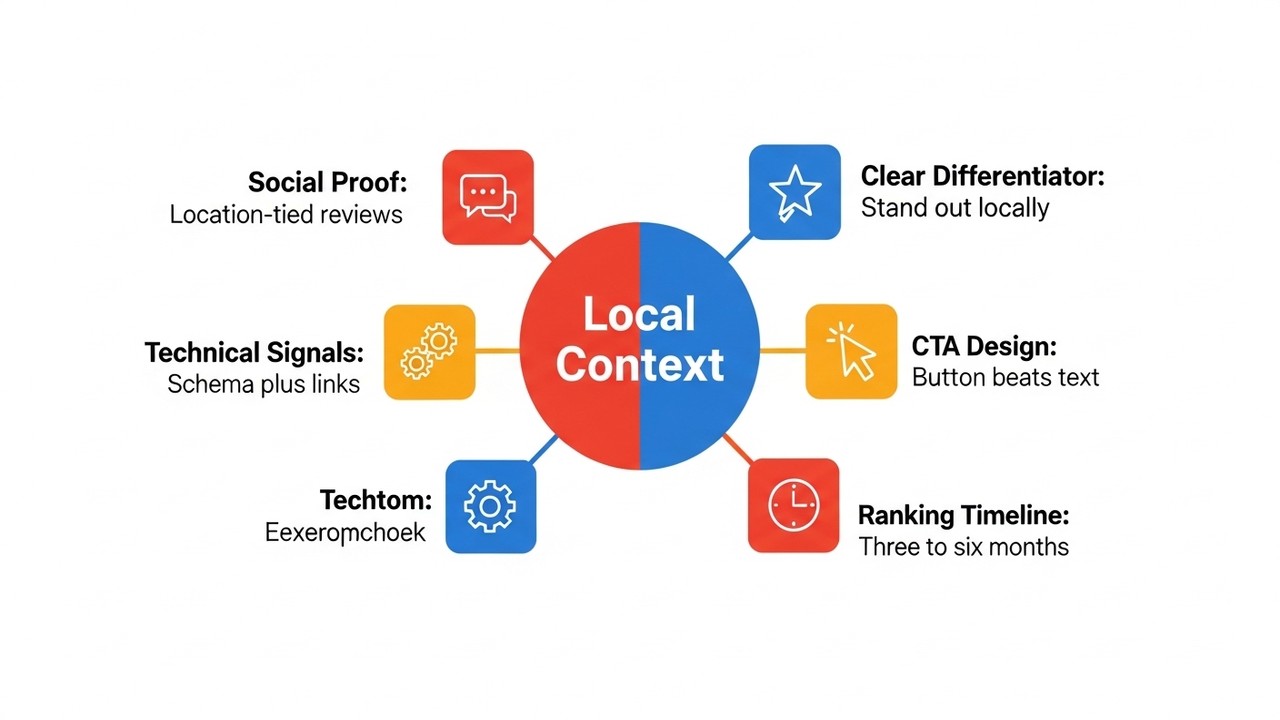
Most service area pages are missing three things at once: neighbourhood-specific context that grounds the content in a real place, social proof tied directly to that location rather than generic reviews, and a clear reason why someone in that area should choose your business over anyone else. Remove any one of those three and the page becomes noticeably weaker. Remove all three and you have a page that ranks for nothing and convinces no one.
These gaps hurt rankings and conversions simultaneously. A page without local depth fails the relevance signals search engines use to understand geographic intent. The same page, even if it received traffic, would struggle to convert because it offers no evidence of familiarity or credibility within that community. This is not an SEO problem or a copywriting problem in isolation. It is both at once.
| Missing Element | Impact on Rankings | Impact on Conversions |
|---|---|---|
| Neighbourhood-specific context | Weak geographic relevance signals | Visitor does not feel the page was written for them |
| Location-tied social proof | Low engagement, high bounce rate | No evidence of credibility within the community |
| Clear local differentiator | Page indistinguishable from competitors | No compelling reason to choose this business |
When Local Content Feels Like a Template
Swapping a city name into a copied paragraph does not create a local page. It creates a template with a different label. Search engines have become increasingly capable of identifying when content lacks genuine geographic substance. What they look for goes beyond keyword presence. They assess whether the content reflects real knowledge of the area: specific conditions, the types of customers served there, and the language local people actually use when searching.
According to Whitespark, service area pages that match a potential customer’s exact search language, through documented community research and keyword analysis, significantly increase the likelihood of appearing as a relevant organic result. That research cannot happen if you are working from a template.
Sterling Sky has found that service area pages with duplicated or near-duplicate content can still drive some organic traffic, but their effectiveness is notably limited without locally distinct content elements. Thin content is not a complete dead end, but it creates a ceiling you cannot break through without doing the real work.
Missing Trust Signals at the Local Level
Trust is earned differently at the local level. A potential customer in Kitsilano, East Vancouver, or the North Shore is not just evaluating your service in the abstract. They are asking: do you understand this area, do you know its particular needs, and has anyone nearby used you and found you reliable?
Area-specific testimonials carry far more weight than generic five-star reviews. A mention of a familiar street, a local landmark, or a recognisable neighbourhood reference does not just add colour. It signals that your business has genuine roots in that area rather than a manufactured digital presence.
Service area businesses face a structural challenge worth acknowledging. Per Google’s own guidelines, service area businesses are required to hide their physical addresses. Research from Whitespark has documented cases where revealing a physical address caused local rankings in surrounding service areas to decline significantly, confirming that what is written on the page is what drives visibility. This makes the trust signals on each individual page more important, not less.

What Strong Service Area Page Content Looks Like
A well-built service area landing page has a clear job to do from the first sentence to the final call to action. It needs to confirm location relevance immediately, establish credibility through proof and context, answer the practical questions a buyer is actually asking, and make it easy to take the next step. Each section serves a distinct purpose, and the order matters, because it mirrors the way a real prospect evaluates a business before making contact.
Opening With a Local Signal, Not a Generic Claim
The opening of any local service page should do one thing before anything else: tell the reader this page was written for them, not repurposed from another city’s version. That signal can come from a reference to a local condition, a specific challenge residents in that area commonly face, or a direct acknowledgement of the community.
It does not need to be elaborate. It needs to be accurate and specific enough that someone who lives there would recognise it as genuine. A generic opener like “We serve [City Name] with professional [service] solutions” does nothing. It wastes the most valuable real estate on the page. For Vancouver-area businesses, this is particularly true. Residents across Metro Vancouver are well-served by many competing providers, and a boilerplate opener gives them no reason to keep reading.
Structuring the Middle for Skimmers and Decision-Makers
Most visitors to a service page will skim before they read. They are looking for the answer to a specific question, and if the page structure does not make that answer easy to find, they leave. Subheadings, short paragraphs, and proof elements placed at natural decision points keep both skimmers and serious decision-makers engaged.
A ResearchGate study using Google Analytics data found that bounce rates, time on page, and navigation patterns are measurable signals of whether landing page content aligns with user intent. If visitors are leaving quickly, the structure is not matching what they came looking for. Testimonials, FAQs, and specific proof points placed mid-page address the trust questions that come up before someone picks up the phone.
Vancouver Service Area Page Optimisation Beyond Keywords
Area page optimisation does not stop at the written content. The technical and structural layer of your page plays a direct role in whether search engines can interpret and rank it correctly.
- Internal linking from your main service pages to each area page helps distribute authority and signals the relationship between your core offering and each geographic target.
- Schema markup, specifically LocalBusiness or Service schema with area-specific attributes, gives search engines structured data to work with when the address itself is hidden.
- Page speed and mobile experience are foundational requirements for local search, where the majority of queries happen on a phone.
| Optimisation Factor | What It Does | Priority Level |
|---|---|---|
| Internal linking | Distributes authority and signals geographic relevance to search engines | High |
| Schema markup | Provides structured data for local relevance when address is hidden | High |
| Page speed and mobile experience | Meets foundational local search requirements; most queries are on mobile | High |
| Google Business Profile alignment | Ensures service area settings match on-page signals to avoid conflicting signals | High |
One of the most commonly overlooked issues is the alignment between a service area page and the corresponding Google Business Profile. If the service areas listed in the profile do not match the pages built on the website, the signals conflict. Many businesses built their website and their profile at different times without cross-referencing them. For businesses operating across multiple Metro Vancouver communities, this misalignment is especially common. Checking that alignment before assuming the page is properly optimised can surface quick wins that no amount of copy revision will fix on its own.

How to Write Service Area Copy That Converts, Not Just Ranks
Ranking and converting are two different outcomes that require two different types of thinking, and a page that does both has to satisfy both at once. Traffic without conversions means the page attracted the right audience and then failed them. A simple way to evaluate any service area page is to ask: Does this page tell search engines what location and service it represents? Does it give a local visitor a genuine reason to trust this business? Does it make the next step obvious and low-friction?
The call to action is where this often breaks down. Conversion research consistently suggests that button-based CTAs tend to outperform text-based ones. A page that ends with a phone number buried in a paragraph is not designed to convert. A page with a clearly placed button, a specific prompt, and a low-commitment entry point removes the friction that causes people to leave without acting. The copywriting handles local relevance and ranking. The structure and CTA design handle conversion. Both have to be present.

When to Get Professional Help With Your Service Area Pages
There is a point where managing service area pages across multiple locations becomes genuinely complex. Writing distinct, locally researched copy for ten or twenty pages across the Lower Mainland, keeping schema aligned, maintaining internal linking, and measuring what is actually working requires time, skill, and a system.
These are real signs that DIY copy has reached its limit:
- Your pages have been live for six months and still are not ranking
- Bounce rates are high and contact form submissions are low
- You are expanding into new service areas and want to build the right foundation from the start
A qualified local SEO and content team should be doing more than writing words on a page. They should be conducting genuine keyword research for each area, building a content structure grounded in actual search behaviour, aligning on-page signals with your Google Business Profile, and measuring results over a realistic timeline. For most businesses, meaningful movement in local rankings takes several months of consistent, well-structured work. Anyone promising instant results is not being straight with you.
At Leadsagna, we approach service area page content the same way we approach every other part of a local growth strategy: with precision, real data, and a clear focus on outcomes that matter to your business. If your local landing pages are not pulling their weight, whether you serve one neighbourhood or the full Metro Vancouver region, we would be glad to take a look and show you exactly where the gaps are. Reach out to our team and let’s build something that actually works.
Frequently Asked Questions About Service Area Pages
How many service area pages does a Vancouver business actually need?
You need one page per community you actively serve and can write distinct, relevant content about. If you genuinely work in Burnaby, Coquitlam, and North Vancouver, build a page for each. Creating pages for areas you rarely serve just to capture traffic will likely hurt your credibility with both visitors and search engines.
Can I use the same page structure for every service area?
You can use the same structural template (heading order, CTA placement, proof sections) but the written content must be unique to each location. Duplicating the copy with only the city name changed is what triggers Google’s unhelpful content signals and limits your rankings. The structure can repeat; the substance cannot.
What makes a service area page convert better?
Pages convert better when they include location-specific social proof, a clearly visible call-to-action button, and content that directly addresses what a local buyer is actually asking. Reducing friction through short forms, clickable phone numbers, and a specific next-step prompt also meaningfully improves contact rates.
Do service area pages work without a physical address in that location?
Yes. Service area businesses that hide their physical address, as Google’s guidelines require, can still rank locally by building strong on-page signals. This includes locally specific content, area-referenced testimonials, schema markup, and consistent alignment between the page and the Google Business Profile service area settings.
How long does it take for a service area page to rank?
Most well-built service area pages begin showing meaningful movement within three to six months, depending on competition in that area and the overall authority of your domain. Pages built on thin or duplicated content will plateau earlier. Consistent refinement, including updating content, adding new reviews, and building internal links, supports continued improvement over time.


