


Key Takeaways
Near me keywords capture buyers at peak purchase intent, and businesses that optimize for them correctly turn local search visibility into consistent, measurable revenue.
- Near me search intent signals a buyer who is ready to act, not browse — making proximity-based searches one of the highest-converting traffic sources available to local businesses.
- 46% of all Google searches carry local intent, so a near me keyword strategy is not niche — it is a mainstream acquisition channel for any service-based business operating in a defined geography.
- Targeting longer, more specific nearby service queries like ’emergency furnace repair near me’ attracts a smaller but far more qualified audience than broad category terms with overwhelming competition.
- Keywords alone do not convert — a verified Google Business Profile, consistent citation data, mobile-optimized site speed, and active review management must all be in place before rankings translate into leads.
- Common conversion killers include missing location signals on service pages, weak calls to action, inconsistent directory listings, and neglecting review acquisition — all of which are correctable and often produce faster results than adding new content.
When someone types “plumber near me” or “coffee shop near me” into their phone, they are not browsing out of curiosity. They have a problem, they know what they need, and they want to solve it within the next few minutes. That is the defining quality of near me keywords: they compress the buyer journey from awareness to action into a single search.
For businesses competing in local markets anywhere in the world, understanding this is not a minor SEO detail. It is the difference between a marketing investment that generates real revenue and one that produces traffic without customers.
This article breaks down how near me search intent works, how buyer behaviour around proximity searches has evolved, and what it takes to build a keyword strategy that consistently turns local visibility into sales.
What Near Me Keywords Signal About Buyer Intent
Most search queries fall somewhere on a spectrum from purely informational to clearly transactional. A person searching “how does HVAC work” is learning. A person searching “HVAC repair near me” is ready to call someone.
This is what makes proximity-based searches so commercially valuable. The intent is already resolved by the time the user hits search. There is no persuasion phase left to complete. The business that appears simply needs to be credible and easy to reach.
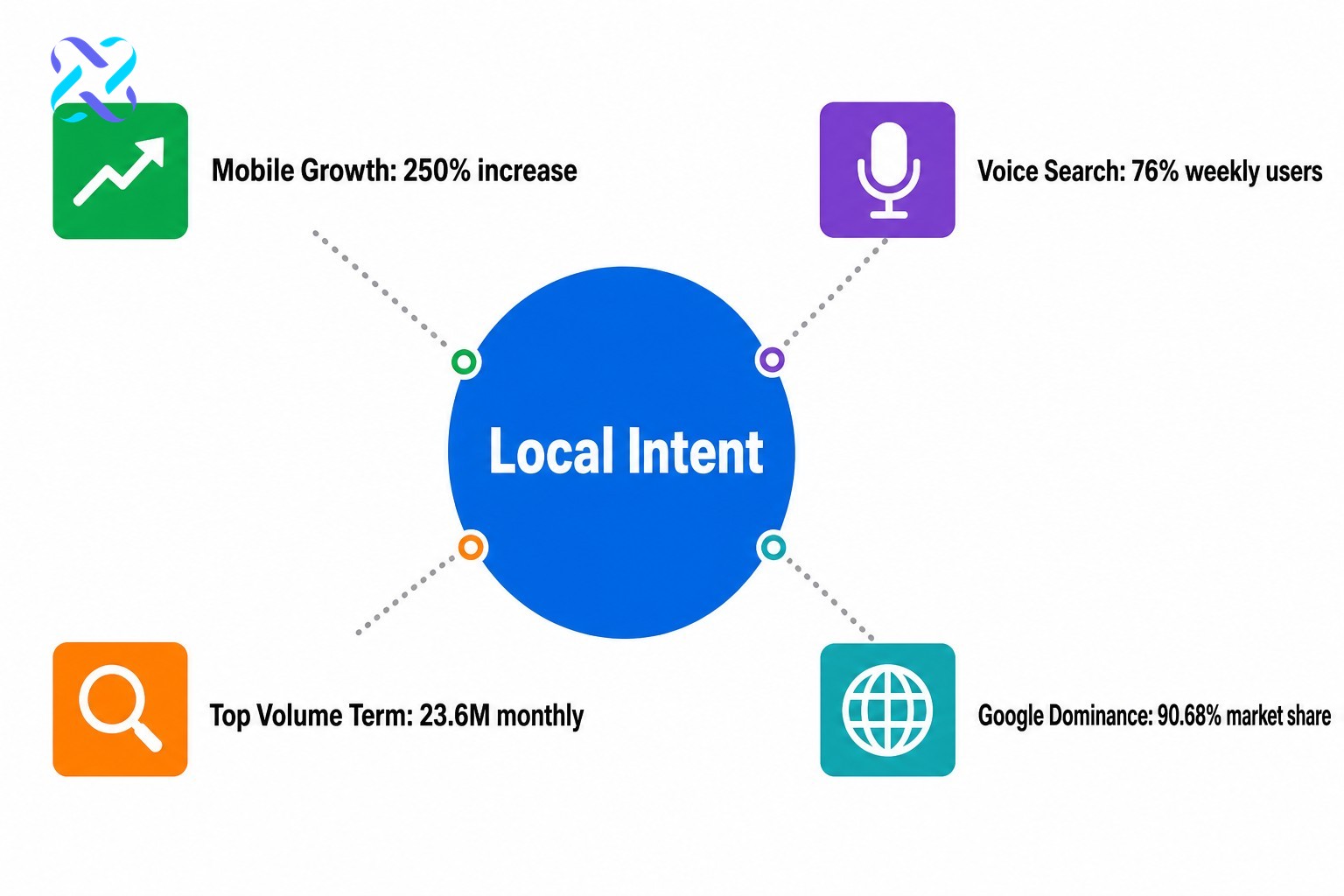
According to Google, 46% of all searches carry local intent, meaning nearly half of the platform’s entire search volume has some degree of geographic relevance. Local keyword research is not a niche strategy reserved for brick-and-mortar retail. It is a mainstream acquisition channel affecting nearly every service-based business operating in a defined geography, whether that is a single city, a regional service area, or multiple locations across different markets.
The contrast with informational queries also changes how success is measured. An informational page might generate thousands of visits and almost no leads. A well-optimised local landing page might attract a fraction of that traffic and convert at a substantially higher rate. Volume alone is not the measure of value here. Purchase proximity is.

How Near Me Searches Have Changed Buyer Behaviour Globally
The scale of this shift is not speculative. Google’s own research documented 250% growth in “near me” mobile searches between 2017 and 2019, and mobile searches combining “where to buy” and “near me” increased by 200% in the same period. These figures reflect a fundamental change in how people make purchasing decisions across markets worldwide.
Buyers increasingly expect local results to surface immediately, without needing to specify a city, postcode, or zip code. Google has built its local ranking algorithm to deliver exactly that, regardless of where the search originates.
This shift toward mobile-first, voice-enabled searching has also raised what buyers expect to find after a nearby search. They expect a business listing with current hours, a working phone number, reviews from real customers, and a website that loads quickly on a smartphone.
According to Statista, 76% of people use voice search at least weekly to find local businesses, mostly on smartphones rather than smart speakers. Voice-driven nearby service queries now form a significant share of local intent traffic globally, and they tend to be conversational and question-based. This affects how keywords should be structured across your content.
When those expectations go unmet — outdated hours, a slow mobile site, no reviews, or a missing phone number — the lead does not wait around. They move to the next result. The cost of that failure is invisible in analytics but very real in lost revenue.
How to Build a Near Me Keyword Strategy That Targets Ready-to-Buy Customers
A near me keyword strategy is not about stuffing location phrases across every page of your website. It is about identifying the specific nearby service queries your customers are already using, then making sure the right pages speak directly to that intent.
This process starts with understanding your service categories and geographic areas, then cross-referencing those with actual search data to find terms that carry both volume and conversion potential.
Choosing the Right Local Search Terms
Not all near me terms are worth targeting equally. “Restaurants near me” ranks among Google’s top 100 searches with a monthly volume of 23,600,000 according to Semrush, which illustrates both the ceiling of broad terms and the level of competition involved. For most businesses, the smarter path is through longer, more specific local intent search terms.
A phrase like “emergency furnace repair near me” or “small business accountant near me” connects with someone who has already made most of their buying decision. The same principle applies across industries and regions. When evaluating terms, consider three factors together:
- Search volume — how many people are searching for it each month
- Keyword difficulty — how competitive the term is to rank for
- Commercial specificity — how clearly the phrase signals purchase intent
A high-volume term with strong competition may take months to rank. A mid-volume, lower-competition term targeting a specific service can generate leads faster. Treat keyword selection as a prioritisation exercise, not a wish list.
| Keyword Type | Example | Search Volume | Competition Level | Purchase Intent | Best For |
|---|---|---|---|---|---|
| Broad near me term | restaurants near me | Very high | Very high | Medium | Large, established brands |
| Specific service near me | emergency furnace repair near me | Medium | Lower | Very high | Most local service businesses |
| Niche professional near me | small business accountant near me | Medium | Lower | High | Specialist or professional services |
Where to Place Near Me Keywords on Your Website
Natural placement matters as much as selection. Near me phrases work well in page titles and H1 headers, meta descriptions, Google Business Profile service descriptions, introductory copy on service landing pages, and FAQ sections that mirror conversational voice-search queries.
What they do not belong in is body copy where they read awkwardly, or headers that exist solely for keyword placement. Over-optimisation is a real risk, and Google is well-equipped to detect it. The goal is for service page keywords and location signals to feel like a natural part of how your business describes what it does and where it operates.

What Needs to Be in Place Before Keywords Can Convert
Near me keywords create visibility. Everything else determines whether that visibility becomes a customer.
Before investing heavily in near me keyword targeting, confirm that the technical and content conditions for conversion are already in place:
- Page speed: A visitor who arrives on a page that takes more than a few seconds to load will leave before reading a single word. Google also factors mobile usability directly into local rankings.
- Google Business Profile accuracy: Inconsistent business name, address, or phone number data across your listing, website, and directories creates confusion for both users and search engines.
- Reviews: A steady flow of genuine customer reviews is foundational, not optional, to competing in local search results regardless of the market you operate in.
The full local search journey moves from a Google Maps result to a Business Profile to a website to a contact action. Any friction in that chain reduces the number of people who complete it.
Common Mistakes That Waste Near Me Traffic
The most frequent error is targeting near me terms without providing any meaningful location signal on the page itself. A service page that mentions “plumbing services” without naming the city, region, district, or neighbourhood gives Google very little to work with when determining geographic relevance. The fix is straightforward: include your service area explicitly in the page content, not just in metadata.
Other common mistakes include weak or absent calls to action, inconsistent listing data across directories, targeting one broad term rather than a range of specific nearby service queries, and neglecting review acquisition, which is one of the most significant prominence signals in Google’s local ranking algorithm.
Each of these errors is correctable. Fixing them often produces faster ranking improvements than adding new content, because they address gaps that are actively suppressing existing visibility.

How a Structured Local SEO Approach Turns Rankings Into Revenue
Rankings without a system behind them produce inconsistent results. Businesses that generate sustained revenue from local keyword visibility treat SEO as an interconnected set of components — keyword targeting, Google Business Profile optimisation, on-page content, citation building, review management, and performance tracking — that work together rather than in isolation.
A structured approach means defining measurable objectives, identifying the gaps between current performance and those targets, and making systematic changes that can be tracked and refined over time. The focus stays on ROI, not on rankings as a vanity metric, but on the leads, calls, and transactions that rankings produce.
Google holds a 90.68% share of the global search engine market according to Similarweb, which means this system needs to be built around Google’s local ranking signals specifically. Content, listings, reviews, and technical health all need to be aligned toward how Google evaluates local relevance and prominence, whether your business operates from one location or across multiple regions and markets.
What to Check Before You Build or Audit Your Local Keyword Strategy
Before committing budget or time to a near me keyword strategy, confirm these foundational elements are in order:
- Google Business Profile status: Is it claimed, verified, and fully completed with accurate service categories, hours, and contact details?
- Current rankings: Are there local intent terms the site already ranks for, even outside the top positions? These represent the fastest path to improved visibility.
- Site health: Are there crawl errors, broken links, duplicate content, or missing metadata limiting how Google indexes your local pages?
- Mobile performance: Does the site load quickly and display correctly on mobile, the dominant platform for proximity-based searches worldwide?
- Citation consistency: Is your business name, address, and phone number identical across your website, Google Business Profile, and major directories in your market?
| Audit Area | What to Check | Impact on Local Rankings |
|---|---|---|
| Google Business Profile | Claimed, verified, accurate categories, hours, and contact details | High |
| Current rankings | Existing local intent terms ranked outside top positions | High — fastest path to visibility gains |
| Site health | Crawl errors, broken links, duplicate content, missing metadata | Medium to high |
| Mobile performance | Page speed and correct display on smartphones | High |
| Citation consistency | Identical business name, address, and phone across all directories | Medium to high |
Some businesses have the internal capacity to manage this audit and the ongoing work that follows. Others benefit from working with an experienced local SEO partner who can identify gaps faster, prioritise the highest-impact corrections, and connect keyword strategy to measurable business outcomes rather than search position alone.
At Leadsagna, we approach local SEO the same way we approach every growth challenge: with precision, real data, and a focus on what actually moves the revenue number. If you want to understand exactly where your local keyword strategy stands today and what it would take to turn search visibility into consistent sales, reach out to our team and let’s build that picture together.
Frequently Asked Questions About Near Me Keywords
- What are near me keywords and why do they matter for local businesses?
- Near me keywords are search phrases that signal a user wants a product or service close to their current location, such as “dentist near me” or “electrician near me.” They matter because searchers using these terms have already decided they want to act, making them among the highest-converting query types in local SEO.
- Do I need to literally use the phrase “near me” on my website pages?
- Not necessarily. Google infers location from your Google Business Profile, page content, and signals like your address and service area. Including “near me” naturally in headings, FAQs, or service descriptions helps align your content with how users phrase their searches, particularly for voice queries.
- How does Google decide which businesses appear for near me searches?
- Google’s local ranking algorithm weighs three main factors: relevance (how well your business matches the query), distance (how close you are to the searcher), and prominence (your reviews, citations, and overall authority). A complete and accurate Google Business Profile directly supports all three.
- Can near me keywords work for businesses without a physical storefront?
- Yes. Service-area businesses such as plumbers, cleaners, or mobile pet groomers can rank for near me searches by setting a defined service area in their Google Business Profile and optimising their website for the locations they serve. A physical address is not a requirement for local visibility.
- How long does it take to rank for near me keywords?
- Timelines vary depending on competition, site health, and how established your Google Business Profile is. Specific, lower-competition terms in less saturated markets can show movement within a few weeks. Broader or highly competitive terms in major cities typically require several months of consistent optimisation.


