

Key Takeaways
Choosing the right Google Ads campaign type is the single most important decision shaping your ROI, and this guide shows you exactly how to match each format to your business goals.
- Search campaigns are the strongest starting point for most businesses because they reach people actively looking for what you offer, making them far more efficient for lead generation and direct sales than awareness formats.
- Display ads work best as a retargeting and brand awareness tool, not as a primary conversion driver; expecting Search level results from Display is one of the most common ways budgets get wasted.
- Shopping campaigns are essential for ecommerce and product based businesses, as showing product images and prices directly on the search results page pre qualifies shoppers before they click and reduces wasted spend.
- Performance Max campaigns should complement a dedicated Search campaign rather than replace it, and they require at least 30 to 50 conversions per month and clean conversion tracking before they can optimise effectively.
- Before launching any campaign, confirm that conversion tracking is correctly installed, negative keywords are defined, and your budget is sufficient for the bid strategy to stabilise and generate reliable data.
Every dollar spent on Google Ads is either working toward a result or quietly draining your budget without one. One of the most common reasons campaigns underperform has nothing to do with ad copy, landing pages, or bid strategy. It comes down to a more fundamental decision made before any of that: which campaign type actually fits what your business is trying to accomplish. Getting this right is not a technical nicety. It is the foundation of every paid campaign decision that follows.
This guide walks through each major campaign format in plain language, explains how to match your goals to the right format, and outlines the most common mistakes that bleed budget before a campaign has a real chance to perform. Whether you are running ads for the first time or trying to diagnose why your current setup is not converting, campaign type selection is the clearest place to start.
Why Campaign Type Selection Shapes Your ROI
Many advertisers treat Google Ads as though it is a single tool with one setting. In reality, choosing the wrong campaign type is like hiring a salesperson to hand out flyers at a shopping mall when your goal is closing high-value B2B contracts. The effort may be real, but the format is fundamentally misaligned with the objective. Impressions accumulate, clicks come in, and the budget disappears without a meaningful return.
Campaign type selection is a strategic business decision that shapes audience reach, placement, cost per click, and the quality of traffic arriving at your offer. According to WordStream 2025, Search campaign conversion rates average 7.52% for ecommerce compared to just 0.59% for Display, a difference of more than twelve times. That gap reflects a fundamental difference in how users arrive at each format. One captures people already looking to buy. The other reaches people who may not be thinking about your product at all. Treating these two formats as interchangeable is one of the most expensive misunderstandings in paid advertising.
Google Ads Campaign Types: A Plain-Language Breakdown
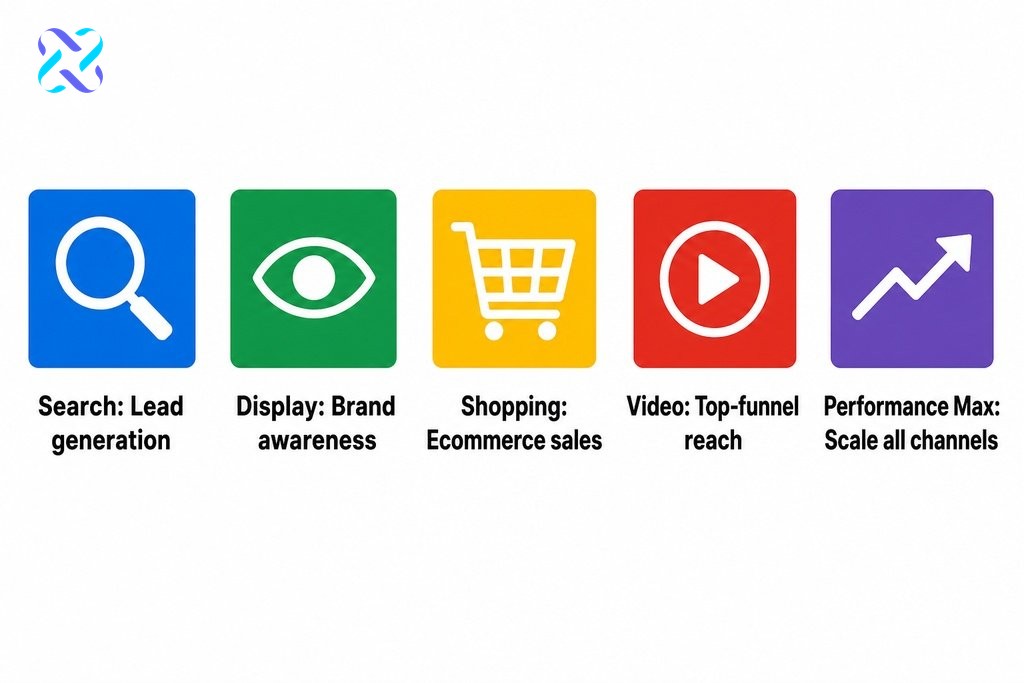
Google Ads is not a single advertising channel. It is a family of formats, each designed for a different stage in the buyer journey and a different type of business objective. The broad distinction to keep in mind is the difference between intent-driven formats, where users are actively searching for something, and awareness-driven formats, where your ad reaches users during other online activities. The right choice depends entirely on where your potential customer is in their decision process.
Search Campaigns: Capturing Active Buying Intent
Search campaigns display text ads on Google’s results page when someone types a relevant query. The reason they perform so well for direct-response goals is that the intent is already there. Your ad is not interrupting someone; it is answering a question they just asked.
This makes Search the most common entry point for businesses focused on lead generation, service enquiries, or direct sales. More than 65% of small businesses use Search campaigns as their primary Google Ads format, according to Marketing LTB, which reflects how well this format aligns with the goal of reaching ready-to-buy audiences. For Vancouver businesses, whether you operate in services-dense areas like Downtown, Mount Pleasant, or the North Shore, if your customers are searching for what you offer by name or category, a well-structured Search campaign is typically the most direct path to qualified traffic.
Best for: Lead generation, service enquiries, direct sales, local businesses.
Display Campaigns: Brand Awareness and Retargeting
Display campaigns place visual banner ads across millions of websites and apps in Google’s Display Network. The cost per click is much lower than Search, but so is the conversion rate, and for good reason. Users seeing Display ads are rarely in active buying mode. They are reading an article, watching a video, or browsing a news site.
This makes Display a poor choice for bottom-funnel conversion goals but a strong format for brand awareness and retargeting. If someone visited your website without converting, a well-configured Display retargeting campaign keeps your brand visible while they continue browsing, bringing them back when they are ready to act. Think of Display as a follow-up tool rather than a primary acquisition channel. Expecting search-level results from an awareness-focused format is one of the most common ways budgets get misallocated.
Best for: Brand awareness, retargeting past website visitors, staying top of mind during longer buying cycles.
Shopping Campaigns: The Standard for Ecommerce
Shopping campaigns are the standard format for retail and ecommerce businesses. Rather than text ads, they show product images, prices, and store names directly on the search results page, meaning a user can see exactly what they are considering before they click. This pre-qualification effect reduces wasted clicks and generally delivers stronger purchase intent compared to standard Search ads for product-based queries.
A google shopping ads strategy works best when the product feed is clean, pricing is competitive, and the campaign is structured around product categories with clear margin priorities. If you sell physical or digital products, Shopping is rarely optional. It is the format your customers are already using to compare options before deciding where to buy.
Best for: Ecommerce, product-based businesses, retailers competing on price or selection.
Video and Performance Max: Scaling Across Google’s Inventory
Video campaigns on YouTube support awareness objectives at the top of the funnel and retargeting at the bottom, with remarketing-based video delivering notably stronger conversion rates than prospecting video.
Performance max campaigns work differently from every other format. A single PMax campaign runs across all Google inventory simultaneously, including Search, Display, YouTube, Discover, Gmail, and Maps, with Google’s AI determining how to allocate budget across placements. The efficiency potential is real, but so is the reduction in transparency.
Research from Optmyzr across 24,702 Performance Max campaigns confirmed that running PMax alongside dedicated keyword-based Search campaigns, rather than as a standalone format, produces stronger account-level results. Google’s own guidance frames Performance Max as a complement to Search, not a replacement. Advertisers who understand this distinction tend to extract more value from both.
Best for: Scaling established accounts, ecommerce with strong conversion data, brands with presence across multiple Google channels.
| Campaign Type | Ad Format | User Intent | Funnel Stage | Best For |
|---|---|---|---|---|
| Search | Text ads on Google results page | High — actively searching | Bottom (conversion) | Lead generation, service enquiries, direct sales |
| Display | Visual banner ads across websites and apps | Low — passively browsing | Top (awareness) / Mid (retargeting) | Brand awareness, retargeting past visitors |
| Shopping | Product images, prices, store names on results page | High — product-focused searches | Bottom (purchase intent) | Ecommerce, product-based businesses, retailers |
| Video (YouTube) | Video ads on YouTube | Varies — awareness to retargeting | Top to Bottom | Brand awareness, remarketing, top-of-funnel reach |
| Performance Max | All formats across all Google inventory | Varies — AI-determined | All stages simultaneously | Scaling established accounts with strong conversion data |
Matching Campaign Types to Your Vancouver Business Goals
Choosing the right format becomes much simpler when you frame the decision around three factors: where your audience is in the buying journey, what action you want them to take, and how much budget you have available before expecting meaningful data.
A Vancouver business launching a new service with a limited monthly budget will get very different results from a Search campaign than from a Performance Max setup with no prior conversion history to feed Google’s algorithm. Starting with intent-driven formats and layering in broader reach formats as conversion data accumulates is a consistently more reliable path than doing the reverse.
A straightforward paid campaign format comparison based on the most common business objectives:
- Lead generation: Search campaigns targeting high-intent service queries, with Display retargeting as a supporting layer
- Ecommerce and product sales: Shopping campaigns as the core format, with Performance Max added once product feed and conversion data are established
- Local visibility: Search campaigns with location extensions, or Performance Max using store visit goals
- Brand awareness: Display and Video campaigns focused on reach and frequency rather than direct conversion
This framework reflects a core principle in sound google ads management: the format must serve the funnel stage, not the other way around. Google research also suggests that integrating campaign types across web and app channels can meaningfully improve overall campaign ROI, according to Google Ads Help. That is why a single-format strategy rarely captures the full opportunity.

Common Campaign Mistakes and What to Check Before You Spend
The most common campaign mismatches follow predictable patterns. Running a Display campaign to drive immediate form submissions is one of the most frequent. Display reaches passive audiences, and expecting them to convert at the same rate as Search traffic almost always leads to disappointment and misattributed budget cuts.
Another common mistake is launching Performance Max without sufficient conversion data. The format depends on Google’s AI to allocate spend intelligently, and without clean signals from your tracking setup, the algorithm has nothing reliable to learn from. This often results in budget being absorbed by lower-quality placements before the campaign has any chance to optimise.
Before launching any campaign type, confirm the following:
- Conversion tracking is correctly installed and firing on the specific actions that matter to your business
- Audience signals are defined for Performance Max, giving Google a starting point rather than relying entirely on broad discovery
- Negative keywords are in place to prevent irrelevant traffic, particularly for broad match and PMax setups
- Budget is sufficient to generate enough conversions for the bid strategy to function — typically a minimum of 30 to 50 conversions per month for smart bidding to stabilise
| Checklist Item | Search | Display | Shopping | Performance Max |
|---|---|---|---|---|
| Conversion tracking correctly installed | Essential | Essential | Essential | Essential |
| Negative keywords defined | Essential | Recommended | Recommended | Essential |
| Audience signals or retargeting lists set up | Recommended | Essential for retargeting | Optional | Essential |
| Clean product feed in Merchant Centre | Not applicable | Not applicable | Essential | Essential for ecommerce |
| Sufficient monthly conversion volume for smart bidding | Recommended (30–50/mo) | Recommended | Recommended | Essential |
Google ads audience targeting decisions deserve the same care as format selection. Choosing the right campaign type and then pointing it at the wrong audience produces the same outcome as choosing the wrong campaign type entirely.

How a Systematic Approach Improves Paid Ads Performance Over Time
One of the clearest differentiators between campaigns that compound in efficiency and campaigns that plateau is whether they are treated as a living system or a one-time setup. Campaigns that are structured, monitored, and refined based on real data consistently lower cost per lead and improve conversion rate over months. Campaigns that are launched and left to run rarely improve on their own.
At Leadsagna, the approach to Google Ads is built on the same principles used in engineering: design a structure that works, measure outputs precisely, and adjust based on data rather than intuition. AI-powered tools help identify patterns in campaign performance that would not surface through manual review alone, including which campaign types are contributing to overall account performance versus which are absorbing budget with diminishing returns.
This is also where the question of google ads for different business models becomes particularly important, because the campaign structure that works for a professional services firm looks fundamentally different from one built for an ecommerce retailer. The compounding benefit of this approach shows up in metrics that matter to business owners: lower cost per acquisition, higher lead quality, and more predictable returns from ad spend over time.
Should You Manage Google Ads In-House or Bring in Professional Help?
Some businesses are well-positioned to manage campaigns internally, particularly when monthly spend is modest, the product or service is straightforward, and someone on the team has the capacity to learn the platform methodically. In those cases, starting with a focused Search campaign targeting a small set of high-intent keywords is a reasonable approach that does not require professional management to execute.
The signal to bring in professional help tends to arrive in one of three ways:
- The budget has scaled to the point where inefficiencies are costing more than a management fee would
- Performance has plateaued despite adjustments
- The account has grown complex enough that multiple campaign types, audience layers, and bidding strategies are running simultaneously without a clear optimisation framework
When evaluating a Google Ads partner in Vancouver, look for transparency in reporting, a clear methodology for campaign type selection, and accountability tied to business outcomes rather than vanity metrics. The right partner will not just manage what you have. They will challenge whether the current structure is the right one for your goals. That conversation starts with choosing the right campaign types from the outset. If you are ready to have that conversation, Leadsagna is here to help you build a paid ads system that consistently turns clicks into customers.
Frequently Asked Questions About Google Ads Campaign Types
What is the best Google Ads campaign type for a small business?
Search campaigns are typically the best starting point for small businesses. They reach people already searching for your product or service, so the intent is there before your ad appears. This makes Search more efficient for limited budgets than awareness-focused formats like Display.
How is Performance Max different from other Google Ads campaign types?
Performance Max runs a single campaign across all Google channels simultaneously, including Search, Display, YouTube, Gmail, and Maps, using AI to allocate your budget. Unlike other formats, you do not choose specific placements. It works best once you have established conversion data and is generally more effective when run alongside a dedicated Search campaign.
When should I use Display ads instead of Search ads?
Use Display ads for brand awareness or retargeting, not for driving immediate conversions. Display reaches people passively browsing the web, so conversion rates are much lower than Search. It works well as a follow-up tool, for example, showing ads to people who visited your website but did not fill out a form or make a purchase.
Do I need Shopping campaigns if I already run Search ads?
Yes, if you sell physical or digital products. Shopping ads show product images, prices, and store names directly on the search results page, helping shoppers compare options before clicking. This pre-qualification typically reduces wasted clicks and attracts higher purchase intent than a text-only Search ad for product queries.
How much budget do I need before smart bidding works properly?
Smart bidding generally requires at least 30 to 50 conversions per month to stabilise and optimise effectively. Below that threshold, Google’s algorithm lacks enough data to make reliable decisions, and spend can be directed toward lower-quality traffic. Starting with manual or enhanced CPC bidding until that volume is reached is a common and practical approach.
Can I run multiple Google Ads campaign types at the same time?
Yes, and for most businesses this is the right approach once you have baseline conversion data. Running Search and Shopping together covers both product discovery and active purchase intent. Adding Display retargeting supports users who need more time before converting. The key is ensuring each format serves a distinct role in your funnel.


