


Key Takeaways
Cheap SEO risks Google penalties and costly remediation while professional SEO builds durable page one rankings that compound into real revenue for Vancouver businesses.
- Cheap SEO services priced under $500 per month typically deliver templated audits, thin content, and low authority links that can accumulate toxic backlinks and trigger Google algorithm penalties over time.
- Professional SEO focuses on intent matched content, editorial link building, and transparent reporting tied to leads and revenue rather than impressions or raw keyword counts.
- Over 99% of organic clicks go to page one results according to Backlinko data, meaning an SEO campaign that keeps your site on page two delivers effectively no return regardless of monthly activity reports.
- Budget SEO may suit a brand new business in a low competition niche with no urgent lead timeline, but in competitive Vancouver markets such as real estate, legal services, or trades it is unlikely to move the needle and may cause technical damage that costs more to fix.
- Before signing any SEO contract, ask who writes the content, what link building involves, and how success is defined in business terms. Vague deliverables and guaranteed ranking promises within fixed timeframes are clear warning signs at any price point.
If you have ever stared at two SEO proposals and wondered why one costs $300 a month and another costs $3,000, you are not alone. The question of cheap SEO vs professional SEO comes up constantly for Vancouver business owners, and the confusion is completely understandable. Pricing signals almost nothing on its own when the deliverables look similar on paper. Both proposals mention keywords, content, and rankings. Both promise results. The difference only becomes clear once the work actually starts, and by then, some businesses have already paid a steep price for choosing wrong.
This article is a practical comparison designed to help you understand what each tier genuinely delivers, what risks come with the lower end, and how to evaluate any SEO investment against your actual business goals.
Cheap SEO vs Professional SEO: The Core Difference
Cheap SEO typically costs under $500 a month and delivers templated audits, thin content, and low-quality link building. Professional SEO costs more but builds a durable, technically sound presence designed to attract qualified traffic that converts. The core difference is not just price. It is what happens to your site six to twelve months down the road.

Why Vancouver Business Owners Keep Asking This Question
SEO pricing in Canada varies more wildly than almost any other marketing service. A freelancer might charge $400 a month. A boutique agency might charge $2,500. A full-service digital marketing firm might start at $5,000. None of those numbers, on their own, tells you whether the work will actually grow your business.
What makes this especially frustrating is that SEO results are slow to appear, which means a bad decision can run for six months before the damage becomes obvious. Most business owners asking this question have either been burned before or are trying hard to avoid it. They hired a cheap provider, saw little movement, and were told to wait longer. Or they paid a premium and received glossy reports with no real leads to show for it. Both experiences are common across competitive markets like Metro Vancouver.
The real issue is that the SEO industry lacks standardized pricing or transparent deliverable benchmarks, making it genuinely difficult to know where quality ends and risk begins without a clear framework for comparison.
What Cheap SEO Actually Includes
A low-cost SEO service, typically priced under $500 a month in the Canadian market, generally delivers a predictable set of outputs: a templated site audit generated by an automated tool, a keyword list pulled from basic research with little competitive analysis, a handful of short blog posts written for volume rather than relevance, and directory submissions or link placements on low-authority sites that exist primarily to sell links.
For a brand-new business with a fresh website and no existing SEO presence, this can seem like a reasonable starting point. Some keywords get targeted, content does get published, and in the first few months you might see a small uptick in impressions inside Google Search Console. The problem is that what gets built at this price point is often fragile, and fragile SEO has a habit of collapsing at the worst possible moment.
The Real Risks of Low-Cost SEO Over Time
The risks of cheap SEO are not always visible immediately. Spammy backlinks accumulate quietly. Thin content gets indexed without triggering a penalty right away. But Google’s algorithm updates consistently target exactly these patterns, and when they hit, sites built on low-effort foundations drop sharply and recover slowly.
As Bruce Clay, Founder and President of Bruce Clay Inc., noted in Search Engine Land: “In SEO, these tradeoffs are especially important to understand because you’re often creating problems that will cost more to fix later.” That observation is particularly relevant for Vancouver businesses that discover, after 12 months of cheap SEO, that their site has accumulated hundreds of toxic backlinks requiring a disavow campaign, or that thin content has suppressed ranking potential across entire topic areas.
Recovery work is expensive and slow. A link audit, content overhaul, and penalty recovery process often costs more than a year of quality SEO would have in the first place. According to Backlinko, only 0.63% of users click on page two results, meaning over 99% of organic traffic goes to page one listings. A cheap campaign that keeps your site stuck on page two or lower is effectively no return at all, regardless of what the monthly report says about keyword coverage.

What Professional SEO Actually Delivers
Professional SEO is best understood not by what it includes, but by what it changes inside your business. A quality engagement typically covers technical work that goes beyond automated flags to trace how search engines crawl, index, and interpret your site structure; intent-matched content designed to reach a buyer at a specific stage of their purchasing decision; editorial link building where links are earned through relevance and authority rather than volume or paid placements; and transparent reporting that explains performance in business terms, covering leads, revenue, and what changes are driving them.
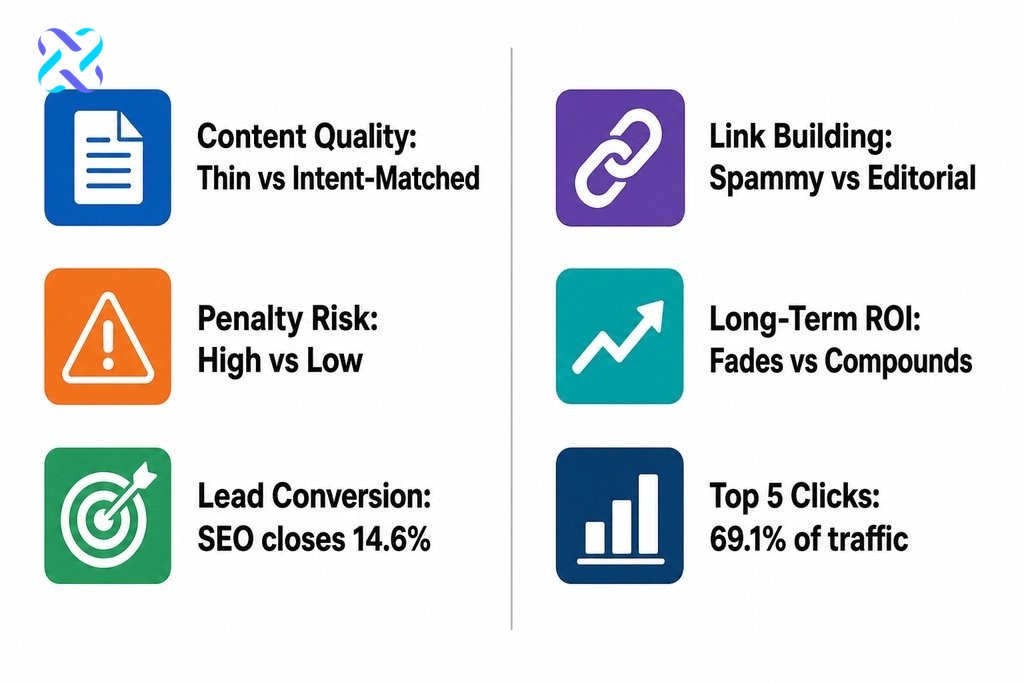
The outcomes that matter are not impressions or raw clicks. They are qualified visitors who convert. Research from Doyen Digital suggests that SEO leads close at 14.6% compared to 1.7% for outbound leads, which indicates the quality of the traffic source can have a meaningful effect on revenue. That conversion advantage is only realised when content, targeting, and site experience are built to match actual buyer intent, a level of alignment that requires both expertise and time that low-cost services structurally cannot provide.
According to Backlinko’s SERP click-through rate study across 11.8 million Google search results, the first five organic results account for 69.1% of all clicks. Professional SEO is built to reach those positions and hold them, which is a fundamentally different goal than simply appearing somewhere on page one for a handful of low-competition terms.
Cheap SEO vs Professional SEO: Side-by-Side Comparison
When you map the two tiers across the criteria that actually matter to a growing business, the differences become concrete.
On timeline to results, professional SEO builds toward durable page-one rankings over 6 to 12 months, while cheap SEO may show early movement that fades or plateaus. On content quality, professional services produce intent-matched, editorially sound content, while budget services produce templated or thin posts optimised for volume. On reporting transparency, professional providers explain performance in business terms, while budget providers often share automated rank tracking with no strategic context. On risk level, professional SEO builds a clean, defensible backlink profile, while cheap SEO can accumulate toxic links and thin content that triggers future penalties. On long-term ROI, professional campaigns compound over time, while cheap campaigns often require costly remediation that wipes out any early savings.
Research from Ahrefs shows that only 2% of pages reach the Top 10 within a year, and approximately 73% of top-ranking pages are more than three years old. A professional approach acknowledges this reality and builds accordingly. A cheap campaign often promises faster results and delivers short-term visibility that fades.
| Criteria | Cheap SEO (under $500/mo) | Professional SEO |
|---|---|---|
| Timeline to results | Early movement that often fades or plateaus | Durable page-one rankings over 6 to 12 months |
| Content quality | Templated or thin posts optimised for volume | Intent-matched, editorially sound content |
| Link building | Low-authority directories and paid placements | Editorial links earned through relevance and authority |
| Reporting transparency | Automated rank tracking with no strategic context | Performance explained in business terms (leads, revenue) |
| Risk level | High: toxic links and thin content can trigger penalties | Low: clean, defensible backlink profile |
| Long-term ROI | Often requires costly remediation that erases early savings | Compounds over time; Backlinko data shows 69.1% of clicks go to top 5 results |
What to Ask Before Signing Any SEO Contract in Vancouver
Before committing to any provider, ask these specific questions regardless of price point. Who writes the content: an experienced writer with subject knowledge, or a bulk content tool with minimal editing? What does link building involve, and can the provider show examples of recent placements? How is success defined in your contract, and can the provider show historical case examples from comparable industries? What exactly will be built, and why? Any provider who cannot answer that last question clearly is not worth trusting with your domain’s long-term health.
Red flags at any price point include vague deliverables like “up to 10 keywords optimised” with no explanation of how, guaranteed ranking promises within specific timeframes, and reporting that focuses entirely on impressions while ignoring leads or revenue. These warning signs appear just as often with agencies operating locally in Vancouver as with offshore providers.

When a Budget SEO Option Makes Sense
There are genuine scenarios where a lower-cost entry point is a reasonable first step. A brand-new local business with a clean website, low competitive pressure, and no urgent lead generation timeline may get real value from a modest investment. The same applies to markets where top-ranking competitors have weak SEO, or industries where establishing a basic organic presence does not require enterprise-level effort.
However, if you are operating in a competitive Vancouver market, whether that is real estate, legal services, trades, or professional services across neighbourhoods like Gastown, Kitsilano, or Burnaby, if your site already has technical debt from previous low-quality work, or if leads need to come in within the next two to three quarters, a budget approach is likely to cost you more than it saves.
FirstPageSage research across multiple industries suggests that professional SEO campaigns can achieve positive ROI within 6 to 16 months, with B2B SaaS and HVAC services among the stronger performers in their data. Those returns are only achievable when the foundation is built correctly from the start. A seo pricing for small business conversation should always begin with your competitive landscape and lead timeline, not just your monthly budget.
| Business Situation | Budget SEO | Professional SEO |
|---|---|---|
| Brand-new website, no existing SEO | May be a reasonable starting point | Recommended for a faster, durable foundation |
| Low-competition niche or market | Can produce a basic organic presence | Delivers more headroom for future growth |
| No urgent lead generation timeline | Suitable if expectations are modest | Still preferable for long-term compounding |
| Competitive Vancouver market (real estate, legal, trades) | Unlikely to move the needle; risks technical damage | Necessary to compete effectively |
| Site with existing technical debt from prior cheap SEO | Will compound existing problems | Required to diagnose and remediate properly |
| Leads needed within 2 to 3 quarters | Too slow and unreliable at this tier | Better aligned with realistic result timelines |
How an Engineering Approach Changes What SEO Delivers
Most SEO services are sold as ongoing retainers where you pay monthly and receive a set of activities. An engineering approach treats SEO as a system, where every component, from technical infrastructure to content architecture to link equity, is designed to work together and produce a measurable output. The difference matters because a system can be diagnosed, adjusted, and improved based on data, whereas a service can only be continued or cancelled.
At Leadsagna, this is the core of how SEO engagements are structured. Rather than delivering a list of tasks each month, the team uses AI-powered analysis to identify exactly where a site is losing ranking potential and what changes will produce the highest return. Every decision is tied back to revenue, not rankings alone. This focus on ROI is what separates a campaign built around affordable seo services that actually work from one that simply generates activity.
The global SEO market was estimated at $82.3 billion in 2023 and is projected to reach $143.9 billion by 2030 according to Research and Markets, which means the industry is growing fast and so is the range of providers operating within it. For Vancouver businesses navigating that crowded field, working with a team that treats your site as a system rather than a client account is the clearest way to ensure that investment compounds rather than evaporates.
If you are ready to understand exactly what your site needs and what a results-focused SEO strategy would look like for your business, the team at Leadsagna is glad to walk you through it. Reach out and let’s have a straightforward conversation about where your organic growth should go from here.
Frequently Asked Questions About Cheap SEO vs Professional SEO
What is the main difference between cheap SEO and professional SEO?
The main difference is the quality and durability of what gets built. Cheap SEO typically relies on templated audits, thin content, and low-authority links that can trigger Google penalties. Professional SEO builds a technically sound, intent-matched presence designed to attract traffic that converts and hold page-one rankings over the long term.
Is cheap SEO ever worth it for a Vancouver business?
It can be, in limited circumstances. A brand-new business in a low-competition niche with no urgent lead generation timeline may get a reasonable starting point from a modest budget. In competitive Vancouver markets like real estate, legal services, or trades, a budget approach is unlikely to move the needle and may cause technical damage that costs more to fix later.
How long does professional SEO take to show results?
Most professional SEO campaigns begin showing meaningful results between six and twelve months. Research from Ahrefs indicates that approximately 73% of top-ranking pages are more than three years old, which reflects how competitive page-one positions are built through sustained, compounding effort rather than quick wins.
What are the warning signs of a low-quality SEO provider?
Key red flags include guaranteed ranking promises within fixed timeframes, vague deliverables with no strategic explanation, and monthly reports that focus on impressions while ignoring leads or revenue. These patterns appear with both offshore providers and local agencies, so price and geography are not reliable filters on their own.
Why do toxic backlinks from cheap SEO cause lasting damage?
Google’s algorithm updates specifically target low-quality link patterns. Sites that accumulate spammy backlinks can drop sharply in rankings when those updates roll out. Recovery typically requires a disavow campaign and often a full content overhaul, work that frequently costs more than a year of professional SEO would have from the start.
How should I evaluate SEO pricing for my small business?
Start with your competitive landscape and lead timeline rather than your monthly budget. A seo pricing for small business conversation should clarify what your competitors are doing, how quickly you need results, and whether your site has existing technical debt, all of which affect what level of investment is actually appropriate.


