


Key Takeaways
A focused small business SEO strategy built around local visibility, high intent keywords, and consistent content delivers compounding organic growth tied directly to real revenue goals.
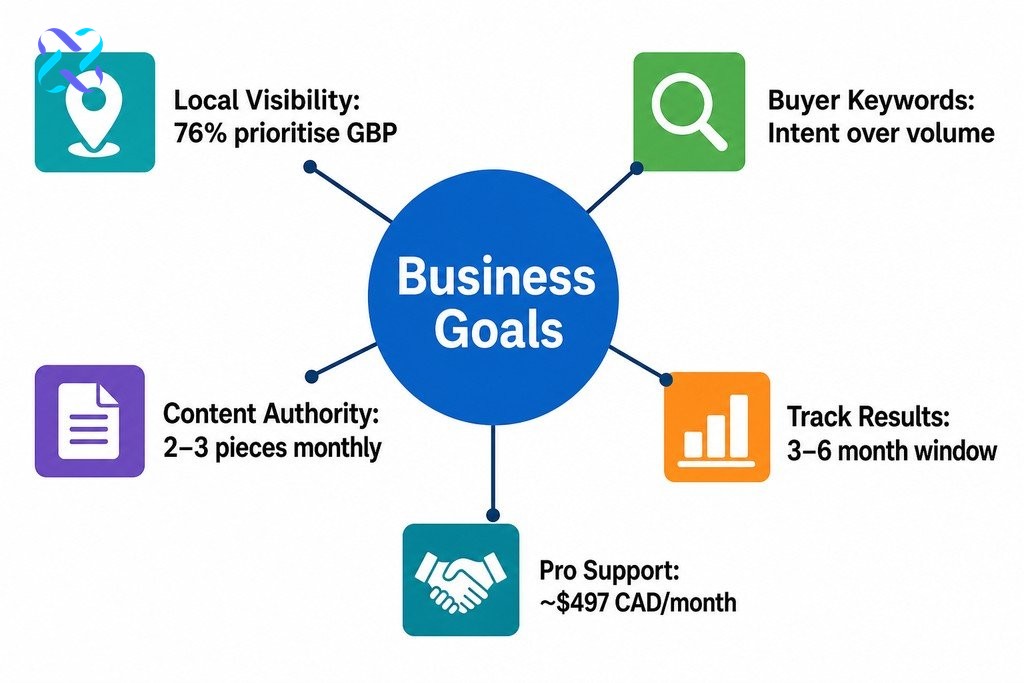
- Start with your business goals before selecting keywords; working backwards from your ideal customer and their buying intent filters out tactics that waste time and budget.
- Local search infrastructure including your Google Business Profile, consistent directory listings, and online reviews forms the foundation of small company online visibility before any content is created.
- High intent keywords with location or service qualifiers convert at far higher rates than broad category terms, making them the priority for small business search optimization with limited resources.
- Content that answers real buyer questions about pricing, timelines, and credentials builds authority steadily over time; even two or three pieces per month compounds into meaningful rankings across dozens of searches.
- Measure leading signals such as organic traffic trends and keyword movement in the first three to six months, and avoid abandoning your SEO plan before it has had enough time to produce results.
A small business SEO strategy is not simply a scaled-down version of what enterprise brands do. It is a fundamentally different approach built around limited time, real revenue goals, and the specific customers you serve in your local market. For owners and marketers in Vancouver and across British Columbia, getting this distinction right is the difference between a website that generates leads and one that sits unnoticed in search results. According to WordStream, 71% of small businesses investing in SEO are satisfied with their results, a clear signal that the strategy works when applied with focus and intention. The challenge is building that focus from the start rather than stumbling through disconnected tactics that drain time without delivering returns.
This article walks through how to approach SEO for business as a small company owner or marketer, covering everything from setting the right priorities to knowing when to bring in professional support. Each section gives you a grounded, realistic picture of what a working SEO strategy actually looks like at the small business level.
Why Most SEO Advice Misses the Mark for Small Business Owners
Most SEO guides are written with large teams, generous budgets, and dedicated content departments in mind. When a small business owner reads advice to publish four blog posts per week, run technical audits across hundreds of URLs, and build a backlink outreach programme simultaneously, the result is paralysis rather than progress. Generic advice creates the illusion of complexity where focused action would serve far better.
An effective approach starts by stripping away everything that does not connect directly to customer acquisition. Vanity metrics such as raw traffic numbers, domain authority scores, and broad keyword rankings feel meaningful but rarely translate into revenue for a business with a defined service area and a limited product range. The frame that matters is outcome-first: what does your business need to achieve, and which search-driven actions by real buyers will get you there? Starting from that question changes every prioritisation decision that follows.

Start With Business Goals, Not Keywords
Before opening a keyword research tool, map your revenue outcomes. If your goal is to book ten new client consultations per month in Vancouver, the keywords worth pursuing are those typed by people who are close to making a hiring decision, not people at the beginning of a broad research journey.
This distinction between informational and transactional search intent shapes the entire architecture of a useful SEO plan. Working backwards from your ideal customer, who they are, what problem they need to solve, and what they type into Google when they are ready to act, gives you a filtering mechanism no tool can replicate on its own.
Setting clear SEO goals for small business before diving into tactics also protects you from optimising for the wrong things. A business that wants to increase phone enquiries needs a different content and technical setup than one trying to grow e-commerce sales. Measurable goals tied to leads, bookings, or revenue create a baseline against which your SEO efforts can be evaluated honestly.
How to Build a Realistic SEO Strategy for Small Companies in Vancouver
A realistic SEO plan for small business is phased, prioritised, and honest about capacity. Most small business owners cannot execute every SEO recommendation at once, and attempting to do so leads to shallow work across too many areas. A better approach is to identify the highest-leverage actions for your current situation, execute them properly, measure the results, and then expand.
Research from BrightLocal’s Local Marketing Industry Survey 2024 found that 76% of marketers consider Google Business Profile management the most valuable local SEO service, followed by content creation at 53% and citation building at 43%. This prioritisation applies directly to small businesses in competitive markets like Vancouver: start where the return is highest and build outward from there.
| Local SEO Service | Marketers Ranking It as Most Valuable |
|---|---|
| Google Business Profile management | 76% |
| Content creation | 53% |
| Citation building | 43% |
Choosing Keywords Based on Buyer Readiness
Keyword research for small businesses does not require exhaustive lists of thousands of terms. It requires a clear understanding of buyer readiness. High-intent keywords reflect someone who has already decided to act and is now choosing between providers. These terms tend to be more specific, include location signals or service qualifiers, and attract lower search volumes, but the traffic they deliver converts at a far higher rate.
A practical framework for choosing the right keywords:
- Match buyer intent: Focus on terms a ready buyer would actually type, not broad category searches.
- Assess ranking feasibility: Choose keywords where your site can realistically compete given current domain strength.
- Connect to revenue: Prioritise terms that map directly to a service or product you offer.
Running through an SEO checklist for small business that covers on-page elements, title tags, and local signals alongside keyword selection helps ensure nothing structural is missed.
Building Local Visibility in Vancouver
For most small businesses serving a geographic area, local visibility is the foundation, not an add-on. Your Google Business Profile, the consistency of your name, address, and phone number across directories, and your online reviews collectively determine whether you appear in local map results before a single blog post is written. In a city like Vancouver, where neighbourhoods such as Kitsilano, Mount Pleasant, and the West End each have their own distinct customer base, appearing in the right local searches can make a significant difference to the volume and quality of enquiries you receive.
According to the Brand Beacon Report 2024 cited in BrightLocal’s research, 94% of high-performing brands have a dedicated local marketing strategy, compared to just 60% of average-performing brands. That gap reflects a structural difference in how seriously these businesses treat their local search presence. Getting the local foundation right amplifies every other content and link-building effort that follows.

Content That Builds Authority Over Time
An organic growth strategy depends on content that earns trust from both search engines and prospective customers. The most effective content answers the specific questions your buyers ask before they contact you, covering practical, credible responses to real concerns about pricing, timelines, credentials, local options, and expected outcomes.
Producing this kind of content consistently, even at a modest pace of two or three pieces per month, compounds over time into a library that supports rankings across dozens of relevant searches. DemandSage reports that 88% of online users will not return to a site after a bad experience, which means what a visitor finds when they arrive matters just as much as the ranking that brought them there.
The practical challenge for most owners is writing capacity. Publishing consistently without a dedicated writer requires one of three approaches:
- Scheduling short writing blocks into a regular weekly routine.
- Repurposing existing expertise from client conversations and FAQs.
- Working with a content partner who understands your market.
The key distinction to keep in mind is the difference between content that ranks and content that converts. Rankings bring traffic; conversion comes from clarity, trust signals, and a clear next step. Planning content with both outcomes in mind prevents the common situation where a page attracts visitors but generates no enquiries.
What to Measure and When to Adjust Your SEO Plan
SEO produces results on a timeline that rewards patience more than urgency. Most strategies show measurable progress within three to six months and stronger ROI within six to twelve months of consistent effort.
The early indicators worth tracking are leading signals that confirm the strategy is moving in the right direction:
- Organic traffic trends: Is overall search traffic growing month over month?
- Lead quality and volume: Are enquiries arriving from search increasing?
- Keyword ranking movement: Are your target terms trending upward in search results?
Tracking these in a simple spreadsheet is enough to surface patterns without requiring deep analytics expertise.
Knowing when to adjust is as important as knowing when to hold. If rankings are improving but conversions are flat, the issue is likely on-page content or user experience rather than keyword targeting. If traffic is growing but not from the right intent, the keyword strategy may need refinement. The most common and costly mistake is abandoning an SEO plan before it has had time to compound. AIOSEO reports that 74% of small businesses invest in SEO, with average monthly services costing around $497 CAD. Understanding what that investment is actually producing at each stage protects you from reactive decisions based on incomplete data.

When DIY SEO Has Limits and Professional Help Makes Sense
Self-managed SEO is a viable starting point for many small businesses, particularly for local visibility setup and basic on-page improvements. However, there are clear situations where the self-managed approach stalls and the cost of the delay outweighs the cost of professional support.
Consider bringing in professional help when:
- Technical issues are holding you back: Slow load speeds, crawl errors, or mobile usability problems require skills most business owners do not have, and they suppress rankings regardless of how strong the content is.
- The market is highly competitive: In a market like Vancouver, established competitors with years of consistent SEO investment may require a structured, resourced approach to gain ground within a reasonable timeframe.
- Content capacity is a bottleneck: Producing credible, well-structured content at the frequency needed to build authority is a significant time commitment that can stall progress on its own.
| Situation | DIY SEO | Professional Support |
|---|---|---|
| Google Business Profile setup | Manageable | Optional |
| Basic on-page improvements | Manageable | Optional |
| Technical issues (speed, crawl errors) | Difficult without specialist skills | Recommended |
| Highly competitive local market | Limited impact | Recommended |
| Consistent content production | Time-intensive | Recommended |
As the Sales Genie Editorial Team observed: “Businesses that are easy to find, easy to trust, and easy to choose are in the strongest position to win local demand.” When self-managed efforts plateau on any of these fronts, a structured partnership with an experienced team typically delivers better ROI than stretching limited internal resources across an increasingly complex set of requirements.
How a Systematic Approach Changes the Results
Leadsagna approaches SEO the way an engineer approaches a system: by identifying the components, understanding how they interact, and building a process that produces consistent, measurable output. Rather than applying a checklist of disconnected tactics, the work is structured around data analysis, strategic content planning, and ROI-focused prioritisation tied directly to client revenue goals.
AI tools support this process by accelerating keyword analysis, identifying content gaps, and surfacing technical issues before they compound. According to WordStream, 67% of small businesses are already using AI for content creation and SEO, and over 86% of SEO experts have integrated AI tools into their strategies, reflecting how this approach is reshaping what resource-efficient SEO looks like in practice.
The outcome of treating SEO as a built system rather than a series of one-off tasks is compounding visibility. Each piece of content, each technical improvement, and each local citation strengthens the overall structure rather than existing in isolation. For small businesses in Vancouver and across British Columbia, this means affordable SEO services do not have to mean limited results. With the right priorities, a phased approach, and consistent execution, organic growth becomes a reliable acquisition channel rather than a hopeful experiment. If you are ready to build an SEO strategy that connects directly to your revenue goals, Leadsagna is available to assess where you are and map out exactly what needs to happen next.
Frequently Asked Questions About Small Business SEO Strategy
How long does it take for a small business SEO strategy to show results?
Most small businesses begin to see measurable improvement in rankings and organic traffic within three to six months of consistent effort. Stronger ROI, in the form of lead volume and enquiry quality, typically becomes visible between six and twelve months. The timeline depends on market competitiveness, starting domain strength, and how consistently the strategy is executed.
What is the most important first step in building a small business SEO strategy?
The most important first step is defining your business goals before selecting keywords or creating content. Knowing whether you want more phone enquiries, online bookings, or e-commerce sales determines every subsequent decision, from which keywords to target to how your pages should be structured. Starting with goals rather than tactics prevents wasted effort on content that does not connect to revenue.
How does local SEO differ from general SEO for small businesses?
Local SEO focuses on making your business visible to people searching within a defined geographic area. This involves optimising your Google Business Profile, maintaining consistent contact information across directories, and earning location-relevant reviews. General SEO prioritises broader keyword rankings and domain authority. For most small businesses serving a specific city or neighbourhood, local SEO tends to deliver faster and more direct revenue results.
Can a small business in Vancouver handle SEO without hiring an agency?
Yes, particularly in the early stages. Setting up a Google Business Profile, fixing basic on-page issues, and publishing relevant content are all tasks an owner or in-house marketer can manage. However, technical SEO problems, competitive markets, and consistent content production often require specialist support to maintain momentum and avoid costly delays.
What metrics should a small business track to evaluate SEO performance?
The three most useful early indicators are organic traffic trends, keyword ranking movement on target terms, and the volume and quality of inbound enquiries from search. Tracking these monthly in a simple spreadsheet is sufficient to identify whether the strategy is progressing, stalling, or pointing to an issue that needs adjustment.
How much should a small business budget for SEO in Canada?
Monthly SEO services for small businesses in Canada average around $497 CAD, though costs vary based on scope, market competition, and the level of support required. Some businesses start with a one-time audit and basic setup before committing to ongoing services. The key is matching investment to realistic revenue goals rather than choosing the cheapest option available.


