


Key Takeaways
A structured content optimization system focused on improving existing pages and aligning search intent drives compounding organic traffic and measurable business results.
- Start your optimization process by auditing existing pages in Google Search Console and filtering for positions 8 to 20. These pages already have crawl history and indexing data, making them your highest leverage opportunities for ranking gains.
- Matching search intent before editing body copy is the single most important step in content optimization. Review the top three ranking pages for your target keyword to understand the expected format, depth, and angle before making any changes.
- Updating statistics, refreshing examples, and revising structured data markup signals freshness to search engines. Pages actively maintained are treated as more trustworthy current sources, which improves both traditional rankings and visibility in AI generated answers.
- Four metrics identify pages worth prioritizing: average position between 8 and 20, impressions significantly higher than clicks, below average time on page, and very few internal links from other pages on your site. Each signal points to a specific fix.
- Content optimization produces compounding returns when applied as a consistent system across a topic cluster. A site that improves pages regularly over time will outperform one that rewrites its entire library once and leaves it untouched.
Content optimization is one of the most misunderstood activities in digital marketing. Many website owners publish article after article, check a few formatting boxes, and then wonder why their organic traffic stays flat. The problem is rarely the writing itself. It is the absence of a structured system behind the content, one that connects every page to a measurable business outcome. For businesses in Vancouver, whether based in Gastown, Kitsilano, or the North Shore, knowing how to properly optimize content is not optional. It is the difference between a website that quietly generates leads and one that simply occupies server space.
This guide takes a consultant-level approach to content optimization. Rather than listing generic tips, it walks through why most advice falls short, what a proper optimization workflow actually looks like, and how to build a process that compounds results over time.
Why Most SEO Content Advice Falls Short
Most SEO content guides hand you a checklist: add your keyword to the title, write a meta description, use headers, include internal links. These are not wrong, but they are incomplete. Following a checklist treats optimization as a one-time formatting exercise rather than a continuous performance system.
Vancouver businesses that apply this approach typically see a brief uptick in impressions and then plateau. No checklist tells you which pages deserve attention first, how to measure whether your changes worked, or when to revisit a page that has started slipping.
The stakes are real. According to Rellify, citing aggregated search behaviour research, the top result on Google earns roughly 28.5% of all clicks, while the second page of results receives less than 6%. If your content sits on page two or three, it is effectively invisible from a revenue standpoint. A checklist will not close that gap. A repeatable, data-informed content improvement process will.

What Content Optimization Actually Means for Rankings
Content optimization is the ongoing process of improving a page so it more accurately satisfies what a searcher needs, signals relevance to search engines, and converts visitors into customers or leads.
It covers four interconnected dimensions: relevance, structure, search intent alignment, and technical signals. Each element reinforces the others. A page with strong technical signals but poor intent alignment will still underperform, just as a well-written page with weak metadata will fail to attract clicks.
One distinction that matters enormously is the difference between publishing new content and improving what already exists. Most businesses default to producing more, when the higher-ROI move is almost always improving what they already have. Existing pages carry crawl history, backlink equity, and indexed data that new pages take months to accumulate.
A solid SEO content strategy acknowledges both tracks but weights improvement work appropriately, especially for sites that have been publishing for more than a year.
How to Audit Your Content Before You Optimize Anything
Before changing a single word, you need a clear picture of where your content currently stands. A content audit identifies which pages are working, which are underperforming, and which have genuine potential to reach page one with targeted improvements.
Start by opening Google Search Console and filtering for queries where your pages rank between positions 8 and 20. These are your highest-leverage pages: already indexed, already attracting impressions, and sitting just outside the traffic zone that matters. Then layer in Google Analytics data including time on page, bounce rate, and conversion events.
A page with strong impressions but a poor click-through rate has a headline or metadata problem. A page with decent clicks but low time on page has a content depth or relevance problem. These are different diagnoses requiring different fixes. The audit phase is where you stop guessing and start making decisions based on what the data is actually telling you.
Four Metrics That Signal a Page Has Room to Grow
Prioritize pages that show one or more of these signals:
- Average position between 8 and 20 — Google considers the page relevant but not authoritative enough to surface at the top.
- Impressions significantly higher than clicks — There is a mismatch between what users expect from the headline and what the page delivers.
- Time on page below the site average — The content is not holding attention, which search engines treat as a relevance signal.
- Few or no internal links from other pages — The page is being starved of authority that your existing content could be passing to it.
| Signal | What It Indicates | Recommended Fix |
|---|---|---|
| Average position 8 to 20 | Page is indexed and relevant but lacks authority | Improve intent alignment, deepen content, add internal links |
| High impressions, low clicks | Headline or metadata does not match user expectations | Rewrite title tag and meta description |
| Time on page below site average | Content is not holding attention or meeting depth expectations | Expand content, improve structure, address the full query |
| Few or no internal links | Page is not receiving authority from other site pages | Add contextual internal links from topically related pages |
Addressing these four signals on the right pages creates measurable movement without requiring new content production.

A Step-by-Step Content Improvement Process
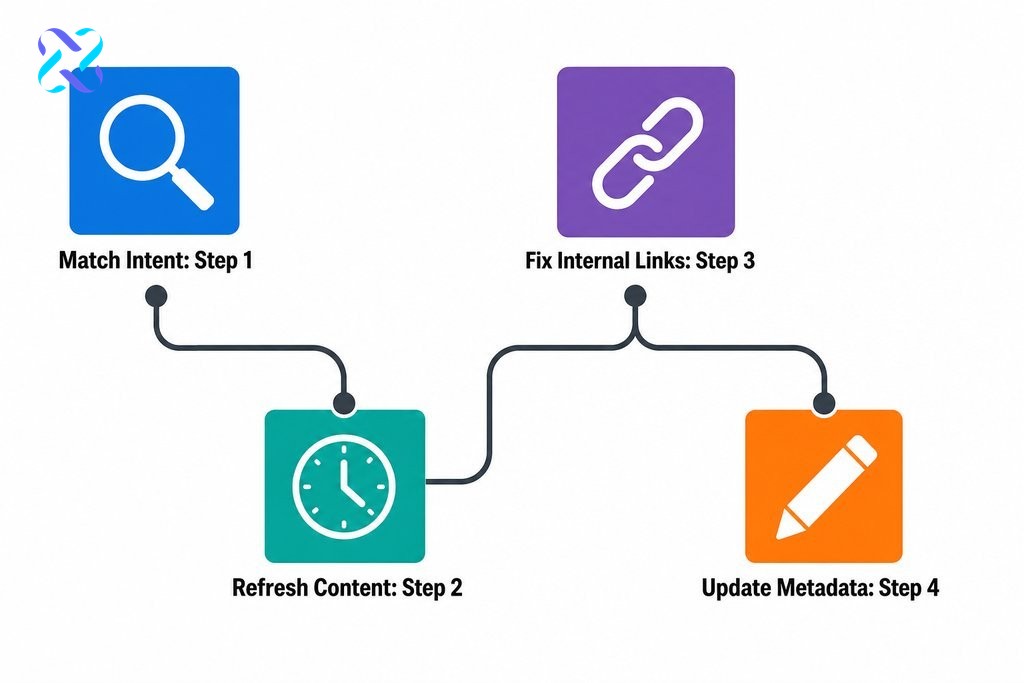
A repeatable content optimization workflow follows a logical sequence: review search intent, close keyword gaps, restructure the content, fix internal linking, then update metadata. Each step builds on the previous one with a trackable output. This is how optimization becomes a system rather than a collection of ad hoc edits.
Step 1: Match Search Intent Before Changing Anything Else
Misaligned intent is the single most common reason a well-written page fails to rank. If someone searches for a step-by-step guide and your page delivers a high-level opinion piece, Google will tend to rank a competitor’s guide above yours, regardless of how well your on-page signals are configured.
Before editing a word of body copy, open the top three ranking pages for your target keyword and assess their format, depth, and angle. Are they listicles, tutorials, or comparison pages? Are they 600 words or 2,500? Matching the intent format first removes the largest structural barrier between your page and a page-one position. An SEO content brief built around intent analysis makes this step systematic and repeatable across an entire content library.
Step 2: Update Content to Signal Freshness to Google
Recency is an increasingly important ranking factor. According to Seer Interactive, almost 90% of AI bot activity focused on content published within the past three years, with the strongest preference for pages updated between 2023 and 2025.
A strong content refresh strategy should include updating statistics and data points, replacing outdated examples, refreshing structured data markup, and revising the publication date only when substantive changes have been made. A well-executed refresh does not require rewriting an entire page. It requires targeted changes that shift the freshness signal without disrupting what is already working.
Step 3: Fix Internal Linking to Pass Authority
Pages with few internal links are being starved of the authority your existing content could be passing to them. Once you have identified your priority pages, find two or three stronger pages on your site that are topically related and add contextual links pointing to those underperforming pages. This action alone can contribute to ranking movement within weeks, though results will vary depending on your site’s overall authority and competitive landscape.
Step 4: Update Metadata to Improve Click-Through Rate
Even a page ranking in position five will underperform if its title tag and meta description do not compel a click. Write metadata that directly addresses what the searcher wants to know, uses natural language, and sets an accurate expectation for what they will find on the page.
| Optimization Step | Primary Goal | Key Action |
|---|---|---|
| Step 1: Match Search Intent | Remove the largest structural ranking barrier | Compare your page format against the top three ranking pages for the target keyword |
| Step 2: Update for Freshness | Signal recency to search engines | Refresh statistics, examples, and structured data markup |
| Step 3: Fix Internal Linking | Pass authority to underperforming pages | Add contextual links from two or three topically related stronger pages |
| Step 4: Update Metadata | Improve click-through rate from search results | Rewrite title tag and meta description to match searcher expectations |
When to Hire a Professional and What to Verify First
DIY optimization works well for owners who have time to learn Google Search Console, run keyword gap analyses, and rewrite metadata across dozens of pages. At a certain scale or level of competition, the process demands more specialisation than most business owners can maintain alongside their core operations. This is particularly true in a competitive market like Vancouver, where businesses across industries are investing heavily in organic search.
When evaluating an agency or consultant, the most important question is not “what do you do?” but “how do you measure success?” A trustworthy provider will define clear KPIs tied to organic traffic, lead volume, or revenue, not vanity metrics like domain authority or keyword count.
A peer-reviewed meta-analysis published on ResearchGate, covering 10 studies from 2022 to 2024, found that SEO implementation is consistently associated with meaningful improvements in organic rankings and traffic, with content quality, keyword optimization, and backlinks identified as the primary contributing variables. Any provider worth hiring should be able to speak directly to how they influence those three variables, with evidence.

How an Engineering Approach Changes Content Outcomes
Leadsagna approaches content optimization the way an engineer approaches a system: define the inputs, track the outputs, and iterate based on what the data returns. Every piece of content produced or improved is mapped to a revenue target, a traffic milestone, or a conversion event. Clients know what they are working toward before a single word is written or rewritten.
This matters because content without accountability produces unpredictable results. Research from Conductor found that consumers who read a brand’s educational content were 131% more likely to buy from that brand, and 48% more likely to buy even a week after reading it. That conversion potential only activates when content is strategically optimized, not just published.
Leadsagna’s approach uses data to identify which pages are closest to delivering that outcome, then applies structured optimization to close the gap. The focus is never on rankings as an end in themselves. It is on whether those rankings are driving qualified leads into the client’s pipeline.
Building a Content Optimization System That Compounds Over Time
Single-page optimization produces single-page results. A content optimization system produces compounding returns. As you improve more pages, build more internal links between them, and create thematic depth across a topic cluster, the cumulative authority of your site grows in ways that individual page edits never achieve.
A site that improves ten pages per quarter over two years will generally outperform a site that rewrites its entire content library once and then leaves it untouched. According to Databox, 62% of companies now use AI tools for content generation or enhancement, reflecting an industry-wide shift toward data-driven, multi-signal optimization processes. The businesses most likely to own their categories in search over the next few years are the ones building systems now, not reacting to ranking drops after they happen.
Your Practical Starting Point This Week
You do not need a complex plan to get started. Open Google Search Console, filter for pages ranking between positions 8 and 20, and identify the three pages with the highest impressions-to-clicks gap. Fix their intent alignment, update their metadata, and add two or three internal links from stronger pages on your site. That one action, done consistently, is what a compound content system looks like in its earliest form.
If you are ready to move beyond one-off fixes and build an optimization process that ties directly to revenue, Leadsagna’s team in Vancouver is ready to walk through your content with you. Reach out and let us show you exactly where your highest-value opportunities are sitting right now.
Frequently Asked Questions About Content Optimization
What is the difference between content optimization and content creation?
Content creation produces new pages, while content optimization improves existing ones. Optimization typically delivers faster ROI because existing pages already carry crawl history and backlink equity. Most sites with a publishing history of over a year benefit more from improving what they have than from producing additional content.
How long does it take to see results from content optimization?
Results vary depending on the page’s current position and how competitive the keyword is. Pages already ranking between positions 8 and 20 often show measurable movement within four to eight weeks of targeted optimization. Pages ranking lower or targeting highly competitive terms may take considerably longer to respond.
Which pages should I optimize first?
Prioritize pages ranking between positions 8 and 20 in Google Search Console, particularly those with a large gap between impressions and clicks. These pages are already recognized as relevant by Google and typically need relatively modest improvements, such as intent alignment, better metadata, or stronger internal links, to move into the top results.
Does updating old content really help rankings?
It can, yes. Search engines treat content freshness as a relevance signal, especially for queries where recency matters. Updating statistics, replacing outdated examples, and refreshing structured data can improve a page’s performance without a full rewrite. Only update the publication date when substantive changes have been made.
How do I know if my content matches search intent?
Open the top three ranking pages for your target keyword and compare their format, depth, and angle to your own page. If the top results are step-by-step guides and your page is an opinion piece, that format mismatch is likely a factor suppressing your rankings, regardless of your on-page optimization.
What should I look for when hiring an SEO content agency?
Ask how they define and measure success. A credible agency will set KPIs tied to organic traffic, leads, or revenue, not domain authority or keyword volume alone. They should also explain how they improve content quality, keyword alignment, and authority signals, which are the variables most strongly linked to ranking improvements according to available research.


