


Key Takeaways
An SEO content brief is the strategic document that connects every content decision to a defined search outcome, helping Canadian businesses rank and generate consistent organic traffic.
- An SEO content brief is not just a writing guide; it is a strategic document that aligns every content decision with a specific search intent, audience expectation, and business goal before a writer begins.
- Matching search intent before drafting is the most critical step. Writing a sales focused page for an informational query means the content misses its audience entirely, regardless of how well it is written.
- A strong content brief template must include the target keyword with intent, a structure based on SERP analysis, competitor content gaps, internal linking targets, and a research backed word count rationale.
- Consistency in briefing builds topical authority across an entire site over time, which compounds into stronger domain level authority and greater organic visibility well beyond individual page wins.
- DIY briefs often fall short by treating topics as queries, ignoring SERP format signals, and relying on word count as a quality proxy. A brief that genuinely ranks must answer who is searching, what they need, and what format they expect.
Most businesses invest real time and money into writing content, only to watch it disappear into the vast, untrafficked corners of the web. An SEO content brief is the structural tool that separates content built to rank from content that simply exists. It is not a formatting guide or a list of bullet points to hand a writer. It is a strategic document that connects every content decision to a defined search outcome, audience expectation, and business goal. For Canadian businesses competing in increasingly crowded search results, skipping this step is one of the most costly production mistakes they can make.
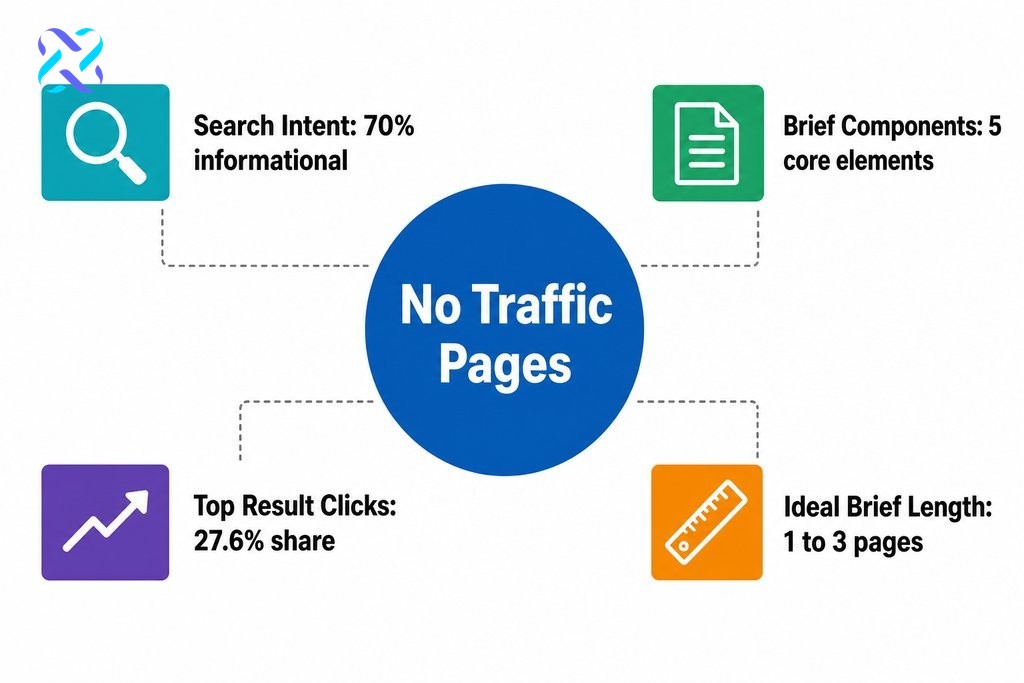
According to Ahrefs, 96.55% of pages receive zero organic traffic from Google, with weak keyword targeting and lack of backlinks identified as the primary causes. That figure is not a reflection of poor writing quality alone. It reflects what happens when content is produced without a structured, search-optimized direction guiding it from the start. A well-built brief is the mechanism that changes this outcome before a writer types a single word.
What Is an SEO Content Brief?
An SEO content brief is a strategic document that tells a writer exactly how to produce a piece of content so it can compete in search results. It defines the target keyword, the search intent behind it, the recommended structure, the competitor landscape, internal linking targets, and the depth required to satisfy the query better than competing pages.
It functions as a strategic alignment document that governs how a piece of content will be positioned in search, what it will cover, who it is written for, and how it connects to broader site goals. Every decision documented inside a brief has a downstream effect on rankings, user engagement, and conversion. When this document is built correctly, it transforms the writing process from creative improvisation into a deliberate, data-informed execution.
Canadian businesses that skip this step frequently produce content that reads well but ranks poorly. Google does not reward well-written prose in isolation. It rewards pages that answer a specific query better than competing pages in the index. Without a brief that defines the query, the intent behind it, and the depth required to satisfy it, even talented writers default to writing about a topic rather than answering a question. That distinction determines a great deal about how a page performs in organic search.

How a Content Brief Guides Writers Toward Rankings
A well-structured brief eliminates the guesswork that causes most content to underperform. Rather than asking a writer to cover a subject broadly, it specifies the signals Google tends to reward: intent alignment, structural format, topical depth, and contextual relevance. When writers receive this level of direction, they produce publish-ready content faster and with far fewer revision cycles. The brief becomes the quality control mechanism before the draft even begins.
Matching Search Intent Before the First Word Is Written
The single most common ranking mistake is writing content that answers the wrong question for a given keyword. A well-constructed brief prevents this by requiring intent to be defined before the outline is built.
Research by SE Ranking found that as of 2025, roughly 70% of web users search with informational intent, around 22% with commercial intent, and only about 1% with transactional intent. Writing a sales-focused page for an informational query, or an educational article for a commercial one, causes content to miss its audience entirely. Defining intent inside the brief ensures the angle, tone, and structure of the content match what searchers are actually looking for.
| Search Intent Type | Approximate Share of Web Searches | Content Approach Required |
|---|---|---|
| Informational | ~70% | Educational, explanatory content that answers questions |
| Commercial | ~22% | Comparison and evaluation content that supports decisions |
| Transactional | ~1% | Sales-focused content with clear calls to action |
Keyword Placement That Feels Natural, Not Forced
A strong brief specifies not just which keywords to use, but where and how to use them. This includes the primary keyword, secondary keywords, and related phrases that build topical relevance. By documenting keyword placement guidance inside the brief, the strategy removes the awkward, over-optimized phrasing that results when writers insert terms without structural guidance.
The output is content that integrates keywords naturally, reads well for users, and signals relevance clearly to search engines. Forced keyword insertion is both a user experience problem and a ranking liability. A well-written brief addresses both before writing begins.
What Should an SEO Content Brief Include?
A strong brief gives teams a repeatable starting point, but its value depends entirely on what is inside it. Every effective brief should contain the following core components:
- Target keyword and search intent: The specific query the content is built around and what the searcher actually wants to find.
- Recommended content structure: Based on SERP analysis, covering what format, headings, and depth the top-ranking pages use.
- Competitor reference points: Pages already ranking, reviewed for content gaps the new piece can fill.
- Internal linking targets: Existing pages on the site that the new content should link to and from.
- Word count rationale: Grounded in what top-ranking pages actually contain, not arbitrary targets.
| Brief Component | What It Defines | Why It Matters for Rankings |
|---|---|---|
| Target keyword and search intent | The exact query and what the searcher wants | Ensures content answers the right question for the right audience |
| Recommended content structure | Format, headings, and depth based on SERP analysis | Aligns the page with what Google is already rewarding for that query |
| Competitor reference points | Ranking pages and their content gaps | Identifies opportunities to outperform existing results |
| Internal linking targets | Pages to link to and from within the site | Distributes link equity and strengthens domain-level authority |
| Word count rationale | Depth guidance grounded in top-ranking pages | Prevents under-coverage or padding that weakens relevance signals |
A brief that lists only a topic and a word count is not a content brief. It is an instruction memo, and it produces results accordingly.
Word count targets should reflect research rather than assumption. Pages in the top ten Google search results have been observed to average around 1,447 words in some studies, and long-form content tends to earn more backlinks on average than shorter articles, according to Ahrefs. These figures can inform depth guidance in a brief, but they are a starting point, not a formula. The brief should explain why a particular length is appropriate for the specific query, not simply mandate length without context.
Why a Consistent Brief Template Builds Long-Term Authority
A repeatable brief template does more than speed up content production. When used consistently across a site, it builds topical authority over time by ensuring that each piece of content covers its subject at the right depth, links to related content purposefully, and avoids cannibalizing other pages on the same domain.
This consistency signals to Google that a site is a reliable, comprehensive source on its subject matter, which can compound into stronger domain-level authority over time. Isolated page wins are far less valuable than a coordinated content architecture built from a consistent briefing process, and a well-designed template is what makes that architecture scalable.

How Each Brief Element Connects to Organic Traffic Growth
Every component of a strong brief connects to a measurable outcome. A clear heading structure improves crawlability by helping search engines parse the page’s topic hierarchy. Competitor gap analysis increases relevance by ensuring the new content covers angles that ranking pages have missed. Internal link targets improve domain-level authority by distributing link equity purposefully rather than leaving it concentrated on a handful of pages.
Viewed through a systems lens, the brief is not simply a writing aid. It is a traffic engineering tool that influences how organic visitors arrive, which queries trigger the page, and how the content contributes to site-wide authority growth.
BrightEdge research suggests that SEO drives substantially more traffic than organic social media, which places the value of getting each piece of content right in clear perspective. A single well-briefed article that ranks on the first page can generate consistent, compounding traffic for months or years. According to Backlinko, the top organic result captures approximately 27.6% of all clicks, with very few searchers clicking beyond the first page. A thorough brief is what positions content to compete at that level.
Where Most DIY Content Briefs Fall Short
Businesses that build their own briefs without SEO expertise tend to make the same predictable mistakes. Over-relying on word count as a proxy for quality produces long content that lacks the structural precision to match search intent. Ignoring SERP structure means that if the top-ranking results for a query are all listicles and the new content is a narrative essay, it is unlikely to rank regardless of its quality. Writing for a topic instead of a query produces content that tries to be comprehensive rather than relevant, which typically satisfies no one, including the search engine.
The difference between a brief that organizes content and one genuinely built to rank lies in how precisely it answers three questions: who is searching, what they want to know, and what format they expect to find it in.

When to Build Your Own Brief and When to Bring In a Specialist
Businesses with in-house writers and access to basic keyword tools can use a template-based approach effectively, particularly for low-competition terms in local or niche markets. Vancouver businesses targeting neighbourhood-specific queries, such as services in Kitsilano, Burnaby, or the North Shore, often fall into this category, where intent is clear and competition is more manageable. When queries are specific, competition is modest, and intent is well defined, a structured template with honest SERP research can produce briefs that perform.
However, competitive industries, multi-location businesses, and sites carrying existing ranking problems all require a more diagnostic approach before new content is produced. In these situations, the brief cannot be built in isolation from broader site analysis. Keyword cannibalization, poor internal linking architecture, thin content patterns, and technical indexing issues all affect how a new page performs, regardless of how well it is briefed. A content optimization strategy that does not account for these factors will produce diminishing returns even with excellent briefs. This is where specialist input, grounded in data analysis and technical site review, can shift outcomes materially.
How Leadsagna Builds Briefs That Connect Content to Revenue
Leadsagna approaches SEO content briefs the way engineers approach system design. Each brief is grounded in data analysis, search intent research, and a clear understanding of where a piece of content fits within the client’s broader content architecture. The goal is not to produce articles that check SEO boxes. It is to build content that serves a defined business function, whether that means ranking for a high-value query, capturing qualified leads at the right stage of the buyer journey, or strengthening a content cluster that supports the client’s topical authority in their market.
This approach means that every element of the brief connects to a revenue-relevant outcome. Leadsagna clients do not receive generic templates with keyword lists and approximate word counts. They receive structured briefs that reflect a thorough understanding of their competitive landscape, their audience’s search behaviour, and the specific gaps their content can credibly fill.
For Vancouver businesses and organizations operating across British Columbia and Canada, this level of precision is what separates content that ranks from content that sits. If you are ready to build content that drives real organic growth rather than simply adding pages to your site, reach out to Leadsagna to see how a brief built around your business can change your results.
Frequently Asked Questions About SEO Content Briefs
What is the difference between a content brief and a content outline?
A content outline lists the headings and sections a writer will cover. An SEO content brief goes further. It defines the target keyword, search intent, competitor gaps, internal linking targets, and structural rationale before the outline is built. The brief informs the outline; the two are not the same document.
How long should an SEO content brief be?
There is no fixed length, but an effective brief typically covers one to three pages. It should be detailed enough to guide a writer without ambiguity, while remaining focused on the specific page being produced. Briefs that run excessively long often include information better suited to an editorial style guide.
Can small businesses benefit from using SEO content briefs?
Yes. Small businesses competing in local or niche markets benefit significantly from briefs because they focus limited content resources on queries with achievable ranking potential. A well-built brief prevents wasted effort on content that will never rank for the intended terms.
How often should an SEO content brief be updated?
Briefs are built per piece of content, so they do not require ongoing updates. However, the brief template and the research process behind it should be reviewed periodically, particularly when search behaviour in your industry shifts or when Google makes meaningful updates to how it evaluates content quality.
Does every page on a website need its own SEO content brief?
Every page intended to rank in organic search should have its own brief. Pages serving only navigational or administrative functions, such as privacy policies or contact pages, do not require the same level of SEO briefing, as they are not typically built to capture organic traffic.


