


Key Takeaways
Keyword mapping assigns specific keywords to specific pages so every piece of content has a clear purpose and a real chance of ranking on Google.
- Without keyword mapping, multiple pages on your site can compete against each other for the same search terms, splitting your ranking potential and reducing visibility for all of them.
- Every keyword must be matched to a page based on search intent. Informational, commercial, and transactional searches require different page types, and misaligning them signals confusion to Google.
- A keyword map template should include the page URL, primary keyword, two to five supporting keywords, the intent type, and the current ranking status to bring structure to sites of moderate size.
- Before mapping any keyword to a page, confirm the page is indexed by Google, check for existing cannibalization, and validate that the keyword reflects genuine Canadian search demand rather than volume driven by other regions.
- Keyword mapping reduces wasted content effort by giving every new page a defined role and a realistic path to visibility, building topical authority that compounds over time rather than producing short term spikes.
Publishing more content without a plan is one of the most common and costly mistakes in SEO. Many Vancouver business owners invest time writing blog posts and service pages, only to find that their rankings stagnate or their pages quietly compete against one another. Keyword mapping solves this problem. It is the process of assigning specific keywords and search intent to specific pages on your website so that every piece of content has a clear purpose, a defined audience, and a real chance of ranking on Google.
For businesses in Vancouver and across British Columbia aiming to turn organic search into a reliable source of qualified leads, this approach is not optional. It is the foundation on which a functioning SEO content strategy is built. Without it, even well-written content tends to underperform because Google cannot determine which of your pages deserves to rank for a given term.
What Is Keyword Mapping?
Keyword mapping is the process of assigning specific keywords to individual pages on your website based on search intent and relevance. Rather than simply collecting a list of search terms, you decide which page should rank for each keyword and why. This turns raw keyword research into a structured content architecture where every page has a defined role, a target audience, and a clear path to visibility in search results.
In practical terms, each page receives a primary keyword, a set of supporting terms, a defined intent type, and a connection to a specific stage in the buyer journey. This level of specificity is what separates sites that accumulate consistent organic traffic from those that plateau after an initial content push.

Why Most SEO Pages Compete Against Each Other
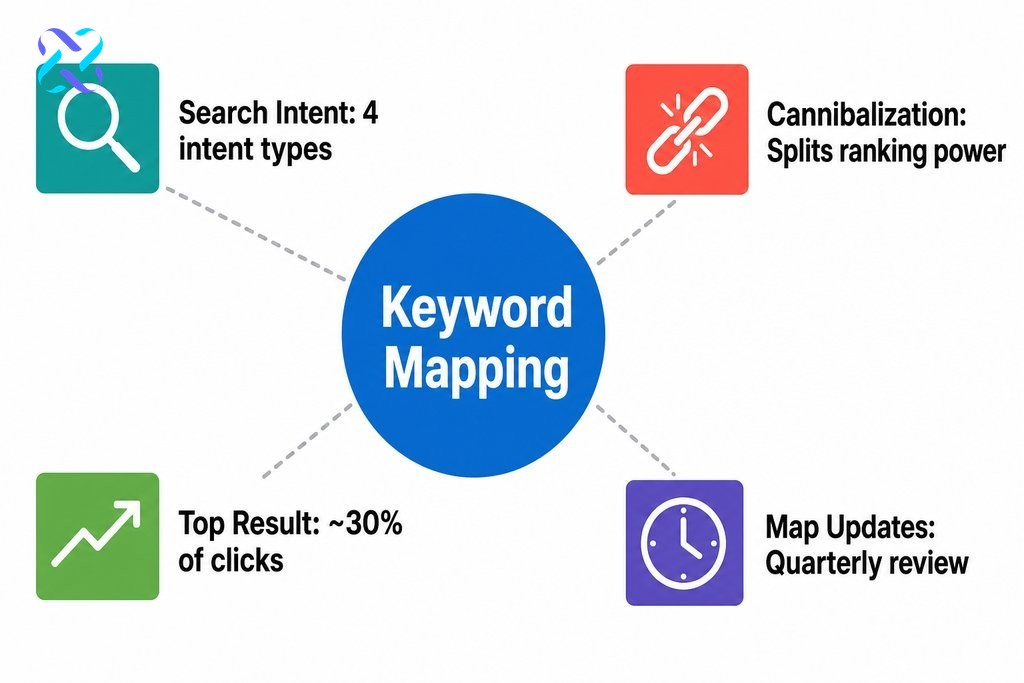
When a website publishes multiple pages targeting similar or identical keywords without a deliberate structure, those pages end up splitting ranking potential rather than building it. This is called keyword cannibalization, and it is far more common than most business owners realise.
Google is forced to choose between pages that appear to serve the same purpose, and the result is typically that neither ranks as well as a single, well-optimised page would. The damage is quiet and cumulative, making it difficult to diagnose without a proper audit.
The stakes are genuinely high. According to Infront, the first Google result captures almost 30% of clicks for that search. Splitting your own authority across competing pages can effectively cost you visibility you already earned. For Vancouver businesses competing in sectors where search demand is real and consistent, whether in Gastown, Mount Pleasant, or the North Shore, this is a problem worth solving before publishing another word.
Keyword Mapping vs. a Keyword List
Many businesses stop at building a keyword list and assume that is enough. The distinction matters:
- A keyword list tells you what people are searching for.
- A keyword map tells you which page on your site should answer each search, and why that page is the right one.
A list might tell you that “Vancouver digital marketing agency,” “SEO for small businesses,” and “lead generation services” are all relevant to your business. A keyword map decides whether those terms belong on your homepage, a dedicated service page, or a blog article, based on search volume, competition, and, crucially, search intent. Without that assignment layer, pages are written based on instinct rather than structure, which is where cannibalization and wasted effort begin.
| Feature | Keyword List | Keyword Map |
|---|---|---|
| What it shows | Terms people search for | Which page should rank for each term |
| Includes search intent | No | Yes |
| Prevents cannibalization | No | Yes |
| Guides content creation | Partially | Yes, with defined page roles |
| Supports content architecture | No | Yes |

How Search Intent Determines Which Page Gets Which Keyword
Every search query reflects one of four broad intent types:
- Informational — the user wants to learn something (e.g., “what is keyword mapping”)
- Navigational — the user is looking for a specific site or brand
- Commercial — the user is researching options before making a decision
- Transactional — the user is ready to take an action (e.g., “hire SEO agency Vancouver”)
Matching intent to page type is not a refinement you add later. It determines whether Google ranks that page at all. A service page optimised for a transactional keyword should not also be competing for an informational keyword. Those two searches reflect completely different needs, and a page that tries to serve both will likely satisfy neither.
| Intent Type | What the User Wants | Best Page Type | Example Query |
|---|---|---|---|
| Informational | To learn or understand something | Blog article or guide | “What is keyword mapping” |
| Navigational | To find a specific site or brand | Homepage or brand page | “Leadsagna Vancouver SEO” |
| Commercial | To compare options before deciding | Comparison or category page | “Best SEO agencies in Vancouver” |
| Transactional | To take an action or make a purchase | Service page or landing page | “Hire SEO agency Vancouver” |
Reading Intent Before Assigning a Keyword
Before assigning any keyword to a page, examine what already appears in search results for that term. If the top results are long-form guides and educational articles, Google has determined the intent is informational. If results are dominated by service listings or product pages, the intent is commercial or transactional.
For Vancouver business categories like legal services, home renovation, or professional consulting, this distinction is especially important. Competition between local service providers is often decided at the intent-matching stage, long before on-page optimisation comes into play.
The Keyword Mapping Process: Step by Step
- Audit your existing pages. Identify what keywords they currently rank for, which pages overlap, and which have no clear keyword focus. This often reveals strong content that is simply misdirected.
- Group keywords by intent and topic. Use keyword clustering principles to organise terms into topic groups. Each cluster should map to one primary page.
- Assign a primary keyword to each page. Include two to five supporting keywords, the intent type, and the current ranking status.
- Identify genuine content gaps. Determine where new pages are truly needed versus where improving existing content is the better move.
- Document everything in a keyword map. Treat it as a living document you update as your site grows and search trends shift.
What a Keyword Map Template Should Include
A keyword map template works well for most businesses managing a site of moderate size. At minimum, it should capture the page URL, the primary keyword, two to five supporting keywords, the intent type, and the current ranking status.
This structure brings clarity to a site with ten to thirty pages and a relatively focused topic set. However, when a site has hundreds of pages, overlapping content sections, or a history of publishing without clear architecture, a template alone is unlikely to surface the full scope of the problem. In those cases, a structured audit is the right starting point.
What to Check Before You Start Mapping
- Your pages are indexed. A page blocked by a robots.txt rule or marked noindex will not benefit from any optimisation effort.
- No existing cannibalization. Search your own domain for the primary keyword you plan to assign. If multiple pages appear, resolve that conflict first.
- Keywords reflect Canadian search demand. Global search volume data does not always translate to regional intent. A keyword that appears valuable in aggregate may be driven largely by US searches, making it less useful for a Vancouver-focused business.
- Each page has a realistic ranking path. Consider its current authority, content depth, and the competition it faces.

When DIY Mapping Works and When to Seek Professional Help in Vancouver
DIY keyword mapping works well within defined limits. If your site is small, your industry is not highly competitive, and your existing content was built with some structure in mind, working through a template is a reasonable first step.
The process becomes significantly more complex when cannibalization is already widespread, the site was built across multiple campaigns without a unified content plan, or the competitive landscape requires a precise understanding of how topical authority accumulates over time.
The signal that professional help is warranted is usually a pattern, not a single problem: traffic that does not respond to new content, pages that rank briefly and then drop, or an inability to determine which page on your site should own a given keyword. At that point, a structured SEO audit or professional strategy session will surface what a template cannot.
How Keyword Mapping Connects to Real Traffic Growth
A well-structured keyword map improves both user experience and search engine crawlability. When Google can clearly identify what each page is about and how those pages relate to one another, it is better positioned to surface the right page for the right search. This translates directly into more efficient use of crawl budget, stronger internal link equity, and topical authority that sustains rankings over time rather than producing short-term spikes.
From a business perspective, the mapping process also reduces wasted content effort. Instead of publishing articles that dilute your own authority or serve no clear ranking purpose, every new page has a defined role and a realistic path to visibility. Competitor keyword analysis adds another layer of opportunity by surfacing terms your competitors rank for that your site has not yet addressed.
This is the systems-oriented approach that drives measurable outcomes: not more content for its own sake, but the right content in the right place, built on a structure that compounds over time.
If you are ready to build a keyword map that drives qualified traffic to your site, Leadsagna’s SEO team in Vancouver can help you audit what you have, identify what is missing, and put a structured plan in place. Reach out to start a conversation about what a precision-built content architecture could do for your business.
Frequently Asked Questions About Keyword Mapping
What is keyword mapping and why does it matter for SEO?
Keyword mapping is the process of assigning specific keywords to individual pages based on search intent and relevance. It gives each page a clear purpose, prevents multiple pages from competing for the same terms, and helps Google understand which page on your site should rank for a given search.
How is keyword mapping different from keyword research?
Keyword research identifies which terms people search for. Keyword mapping takes that research further by deciding which specific page on your website should target each term and why. Research gives you the raw material; mapping turns it into an actionable content structure.
What is keyword cannibalization and how does mapping prevent it?
Keyword cannibalization happens when two or more pages on the same site target the same keyword, splitting ranking potential between them. Keyword mapping prevents this by assigning each keyword to exactly one page and flagging conflicts before new content is published, so pages build authority rather than undercut each other.
How do I know which intent type to assign to a keyword?
Look at what currently ranks in Google for that keyword. If results are mostly guides and articles, the intent is informational. If results show service pages or product listings, the intent is commercial or transactional. Let the existing search results guide your assignment before writing a single word.
Do Vancouver businesses need a different approach to keyword mapping?
Local context matters. Global search volume figures can be misleading for Vancouver-based businesses because much of the volume may come from US searches. Effective keyword mapping for a Vancouver audience focuses on terms with genuine regional demand, considers local competitors and neighbourhood-level searches, and applies Canadian spelling conventions.
How often should a keyword map be updated?
Review your keyword map whenever you publish new content, restructure your site, or notice significant ranking changes. For most small to mid-sized businesses, a quarterly review is sufficient. Treat it as a living document so it stays aligned with how your audience and your site both evolve.


