


Key Takeaways
Content opportunity analysis helps Vancouver businesses find untapped keyword opportunities where real search demand exists and competition is manageable enough to win.
- Most businesses lose ground in SEO by chasing high competition keywords while lower difficulty terms with strong commercial intent sit completely untouched and ready to capture.
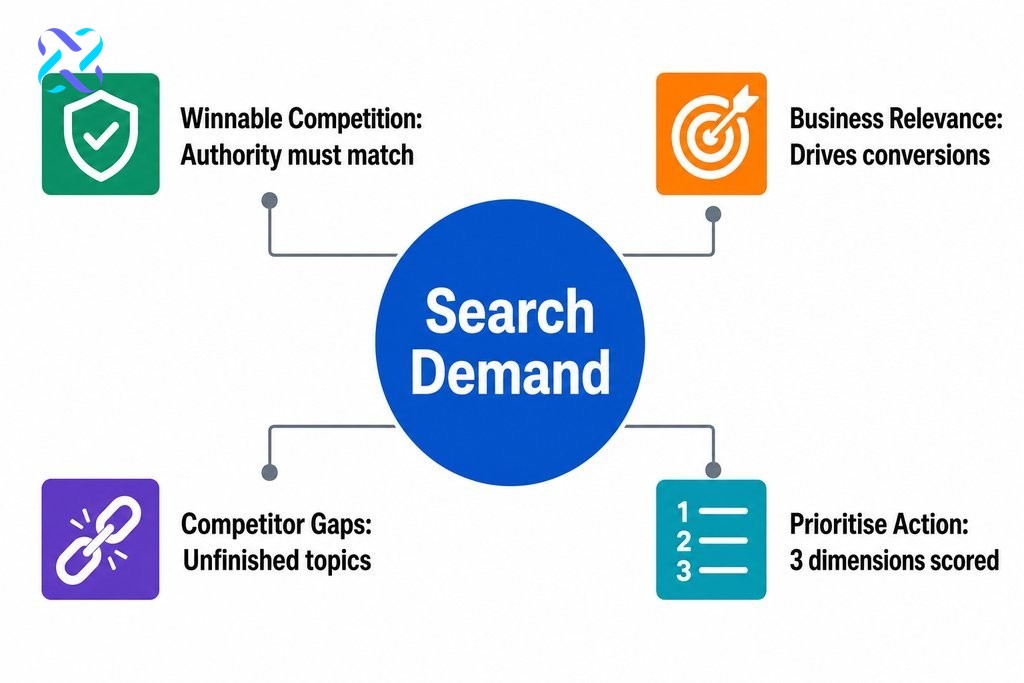
- True content opportunity analysis goes beyond keyword tools; it finds the specific intersection of search demand, winnable competition, and genuine business relevance before any content is created.
- Auditing competitor content reveals shallow coverage, outdated pages, and missing subtopics that represent real organic traffic opportunities your site can claim with focused, well structured content.
- Google search results including People Also Ask and related searches are underused validation tools that confirm audience intent and surface adjacent questions worth building content around.
- Before creating new pages, review what you have already published; expanding or updating an existing page that ranks on page two is often more effective than starting from scratch.
Most businesses investing in SEO are working harder than they need to. They target the same high-competition keywords as every major player in their space, then wonder why their content never gains traction. Content opportunity analysis offers a smarter path. Instead of guessing which topics might perform, it gives you a structured method to identify where search demand exists, where competition is manageable, and where you have a realistic chance to rank and convert.
For Vancouver-based businesses and marketers building consistent organic traffic, this approach can be the difference between a content calendar full of wishful thinking and one grounded in real, data-backed direction. This guide walks through how to find untapped keyword opportunities, how to validate them before committing, and how to turn your findings into a prioritised plan that moves the needle.
Why Most Vancouver Businesses Miss Their Best Content Opportunities
The most common SEO mistake is not technical. It is strategic. Businesses anchor their content plans around the most obvious, highest-volume keywords in their industry. Those keywords are almost always dominated by well-resourced competitors with years of authority behind them.
Meanwhile, lower-difficulty keywords with strong commercial intent sit completely untouched, attracting real search demand with little or no competition. This is especially pronounced in a market like Vancouver, where local and regional search queries often go unaddressed despite consistent demand from residents across neighbourhoods like Kitsilano, Mount Pleasant, and Burnaby. These are the untapped opportunities that content opportunity analysis is designed to surface.
The problem is not a lack of tools. Keyword platforms are widely available. The real gap is in approach. Without a systematic process for evaluating search intent, competition, and business relevance together, keyword research becomes little more than chasing numbers. A structured framework replaces that guesswork with a repeatable method for finding what competitors have overlooked.

What Is Content Opportunity Analysis?
Content opportunity analysis is the process of identifying specific topics and search queries where your business can realistically compete, where audience intent aligns with what you offer, and where existing content either falls short or is missing entirely.
It is not the same as running a keyword tool and exporting a spreadsheet. The goal is not a long list of keyword ideas. It is finding the right ones: the ones that connect real search demand to genuine business outcomes.
A true content gap differs from a topic with no audience. This research involves comparing your existing content against competitor content across shared keyword segments to find where they rank and you do not, or where neither party is serving the topic adequately. That makes it distinct from a broader SEO audit, which focuses on technical health, site speed, and link profiles. Content opportunity research is specifically about the intersection of what people search for and what has not yet been answered well enough to satisfy them.
How to Identify Untapped Keyword Opportunities in Your Niche
Start by understanding the language your audience uses when looking for solutions, not just products. Search intent matters enormously. A page that answers an informational question will not perform well if the searcher is ready to buy, and vice versa.
Before any keyword qualifies as a genuine opportunity, it should pass three tests:
- Search demand exists — people are actively searching for it.
- Competition is winnable — your site’s current authority can realistically compete.
- Business relevance is clear — the topic connects directly to what you do or sell.
With that filter in place, uncovering organic traffic opportunities becomes far more manageable. Search volume is a useful prioritisation signal, but it should always be read alongside intent and competition data, never in isolation.
Reading Competitor Content to Spot Gaps
Auditing what your competitors rank for is one of the highest-leverage activities in any content research process. The goal is not to replicate what they have done. It is to find where they have covered topics shallowly, where their content is outdated, and where relevant subtopics are missing entirely.
When multiple competitors skip the same subject, that absence is often a signal of opportunity rather than evidence the topic lacks value. Competitive content analysis, done systematically, turns competitor research from a defensive exercise into an offensive strategy.
Look specifically for questions your audience is likely asking that competitor pages either ignore or answer poorly. Topics covered in a single paragraph, or mentioned briefly inside a broader article without their own dedicated page, are strong candidates for focused content that can outrank them. This is the core logic behind effective competitor keyword analysis: you are not trying to beat competitors at what they do well. You are finding what they have left unfinished.
Using Search Results to Validate an Opportunity
Google’s search results page is one of the most underused research tools available. Before committing to a content direction, reviewing what currently ranks for your target keyword tells you a great deal about what Google believes the searcher actually wants.
If the top results are thin, poorly structured, or clearly outdated, that is a strong signal that a well-produced, intent-matched page could displace them. If results are dominated by large editorial publications with deep authority, that tells a very different story.
Pay close attention to these on-page features:
- People Also Ask — surfaces adjacent questions Google has already validated as relevant to the primary query.
- Related searches — reveals how the topic branches into subtopics worth covering.
- Featured snippets — often awarded to pages that answer a specific question clearly and concisely, even from sites with modest overall authority.
These signals represent confirmed demand you can incorporate directly into your content planning.

Turning Content Ideas Into a Prioritised Action Plan
Identifying opportunities is only half the work. The other half is deciding what to act on first, because most businesses cannot pursue every content idea at once.
A practical prioritisation framework evaluates each opportunity across three dimensions:
- Traffic potential — how much organic traffic could this realistically generate?
- Business relevance — how directly does it connect to your products or services?
- Production effort — how much work will it take to create something competitive?
High-traffic, low-effort, high-conversion topics go to the top of the list. High-effort, low-conversion topics go to the bottom or get cut entirely.
Quantitative signals such as search volume and keyword difficulty give you the traffic ceiling and barrier to entry. Qualitative signals, including the quality of existing results and the specificity of search intent, tell you whether your content can genuinely serve the searcher better than what already exists. When both dimensions point in the same direction, you have found a content idea worth investing in.
| Prioritisation Dimension | What It Measures | Signal Type | Priority Weight |
|---|---|---|---|
| Traffic potential | How much organic traffic could this realistically generate | Quantitative (search volume, keyword difficulty) | High |
| Business relevance | How directly it connects to your products or services | Qualitative (intent match, conversion likelihood) | High |
| Production effort | How much work is required to create something competitive | Qualitative (content depth, existing results quality) | Medium |

Where Content Opportunity Research Often Goes Wrong
The most frequent mistake is targeting volume without understanding intent. A keyword with thousands of monthly searches may look attractive until you realise everyone searching it wants something your business does not provide. That wastes production time, dilutes your site’s topical focus, and attracts visitors who will never convert.
Three additional pitfalls are worth watching for:
- Keyword cannibalization — multiple pages targeting the same or very similar keywords compete against each other in search results rather than reinforcing each other.
- Ignoring existing content — a page already ranking on page two may only need expansion or updating to reach page one. Publishing a new page on the same topic can split your authority instead of concentrating it.
- Unrealistic timelines — organic growth in a competitive market like Vancouver takes time. A well-researched content plan may require several months to show meaningful results, but that growth tends to compound in ways paid traffic does not.
| Common Pitfall | What Goes Wrong | How to Avoid It |
|---|---|---|
| Targeting volume without intent | Attracts traffic that will never convert | Always evaluate search intent alongside volume data |
| Keyword cannibalization | Multiple pages compete against each other in search results | Map keywords to unique pages before publishing |
| Ignoring existing content | Authority is split rather than concentrated | Audit and update page-two rankings before creating new content |
| Unrealistic timelines | Strategy is abandoned before results compound | Set expectations for a multi-month organic growth curve |
In-House Execution vs. Working with a Vancouver SEO Specialist
Some businesses have the internal capacity to manage content opportunity analysis on their own, particularly those with a dedicated marketing team, access to quality SEO tools, and time to maintain a consistent publishing process. The frameworks in this article provide a practical starting point. The content gap analysis process is learnable, and the required tools are available at various price points. The challenge is rarely access to information. It is the discipline to implement consistently and the experience to interpret signals accurately.
For Vancouver businesses without that internal capacity, or those who have tried in-house SEO without seeing meaningful results, working with a specialist changes the equation. At Leadsagna, content opportunity research is approached methodically, with clear inputs, measurable outputs, and a focus on what actually drives revenue. Every content direction is evaluated for its potential business value, not just its traffic ceiling. The process uses data analysis to identify patterns and priorities that manual research can easily miss, and every recommendation ties to a specific business outcome rather than a generic growth target. If you are ready to stop guessing and start building a content strategy around real opportunities, reach out and let us identify what your competitors have been missing.
Frequently Asked Questions About Content Opportunity Analysis
What is content opportunity analysis and how does it differ from standard keyword research?
Content opportunity analysis goes beyond listing keywords. It evaluates each topic against search demand, competition difficulty, and business relevance simultaneously to identify where you can realistically rank and convert. Standard keyword research typically outputs volume data; content opportunity analysis tells you which of those keywords are actually worth pursuing and why.
How do Vancouver businesses benefit from a local content opportunity approach?
Many neighbourhood-level search queries in Vancouver, such as service searches tied to Kitsilano, Mount Pleasant, or Burnaby, attract consistent demand but are rarely addressed by competitors. A locally focused content opportunity process surfaces these queries specifically, giving Vancouver businesses an advantage that broader national strategies routinely overlook.
How long does it take to see results from a content strategy built on opportunity analysis?
Organic results typically begin to show within three to six months, depending on your site’s existing authority, the competitiveness of your target keywords, and how consistently new content is published. Results tend to compound over time rather than stopping when a budget runs out.
What tools are commonly used for content opportunity analysis?
Most practitioners use a combination of keyword research platforms such as Ahrefs, Semrush, or Moz alongside direct review of Google’s search results, People Also Ask boxes, and related searches. The tools surface the data; the analytical process determines which data points represent genuine opportunities versus noise.
Can content opportunity analysis help fix underperforming existing content?
Yes. Reviewing existing pages is a core part of the process. A page already ranking on page two is often a stronger investment than creating something new, because it already has some authority. Expanding, updating, or refocusing that page can push it to page one more efficiently than starting from scratch.


