


Key Takeaways
Competitor keyword analysis helps website owners find proven ranking gaps and turn competitor search data into a focused content plan that grows organic traffic.
- Competitor keyword analysis replaces guesswork with verified data by showing you exactly which terms your competitors rank for and where your site is absent from search results.
- Identifying your true SEO competitors means looking at who actually appears in search results for your target terms, not just the businesses you compete with commercially.
- Ranking gap analysis surfaces high value opportunities by comparing your keyword rankings against competitors and prioritizing gaps based on search volume, difficulty, and business relevance.
- Every keyword gap you identify should map to either a new page to create or an existing page to strengthen, with content that goes deeper than what competitors have already published.
- Competitor keyword data from tools is an estimate, so always cross reference it with your knowledge of your market, your audience location, and the services you can credibly deliver.
Most businesses spend months guessing which keywords to target, building content around terms they assume their audience searches, then wondering why organic traffic refuses to grow. Competitor keyword analysis cuts through that guesswork entirely. Instead of starting from a blank page, you begin with verified data: the exact terms your competitors already rank for, the pages earning them traffic, and the gaps your site has not yet filled. For website owners and marketers trying to grow organic visibility in a competitive market, this approach is not just efficient. It is one of the most reliable ways to close the distance between where your site ranks today and where it needs to be.
At Leadsagna, a Vancouver-based digital marketing agency, we treat this process as a core growth decision rather than a routine SEO task. This article walks you through how it works, what it reveals, and how to turn those findings into a content and optimization plan that produces measurable results.
What Is Competitor Keyword Analysis?
Competitor keyword analysis is the process of identifying which keywords your competitors rank for in organic search and comparing that against your own rankings to find gaps, opportunities, and priority targets. Rather than hypothesizing about what your audience searches, you observe it directly through the search performance of sites already earning visibility in your space.
The business implications are significant. Every keyword a competitor ranks for that you do not represents organic traffic flowing to someone else’s website and potentially customers choosing their service over yours. According to Neil Patel, this is among the quickest keyword research methods available and is especially effective in saturated markets, allowing businesses to reverse-engineer competitors’ SEO success and identify overlooked high-value keywords. For British Columbia businesses operating in competitive local or national markets, that speed and precision matters.

What Organic Competitor Analysis Actually Reveals
A thorough analysis goes well beyond a simple keyword list. It surfaces the architecture of a competitor’s search success, including which pages drive the majority of their organic traffic, which content themes Google consistently rewards them for, how they structure content to match searcher intent, and where confirmed ranking gaps exist that your site has not filled.
A thorough content gap analysis at both the domain and page level, as described by Moz, identifies attainable ranking opportunities where competitors appear in search results but your site does not. These are not theoretical opportunities. They are confirmed gaps where search demand exists and your site is simply absent.
Understanding search intent is equally important. Whether a keyword triggers an informational article, a service page, or a product listing tells you exactly what type of content you need to compete for that term.
Keywords You Think Matter vs. Keywords That Drive Traffic
There is often a significant disconnect between the keywords a business assumes are important and the ones that actually bring qualified visitors to a competitor’s site. Internal assumptions are shaped by how a business describes itself, not by how customers search.
A roofing company in Burnaby or Surrey might optimise for “residential roofing services” while their competitors earn consistent traffic from “roof replacement cost” or “how long does a roof last.” Competitor data corrects this assumption gap quickly. It replaces internal vocabulary with the language real searchers use, which is where rankings and traffic are actually won.
| Keyword Type | Source | Based On | Accuracy | Traffic Potential |
|---|---|---|---|---|
| Assumed keywords | Internal team | How the business describes itself | Often misaligned with real search behaviour | Uncertain |
| Competitor-verified keywords | Competitor rankings | How customers actually search | Confirmed by live search data | Proven demand exists |
How to Identify Your Real SEO Competitors in Vancouver
Your SEO competitors are not necessarily the businesses you compete with commercially. A local rival in North Vancouver or Richmond might have a weak online presence while a national content publisher dominates the same keywords. The right way to identify true SEO competitors is to look at who actually appears in search results for the terms you want to rank for.
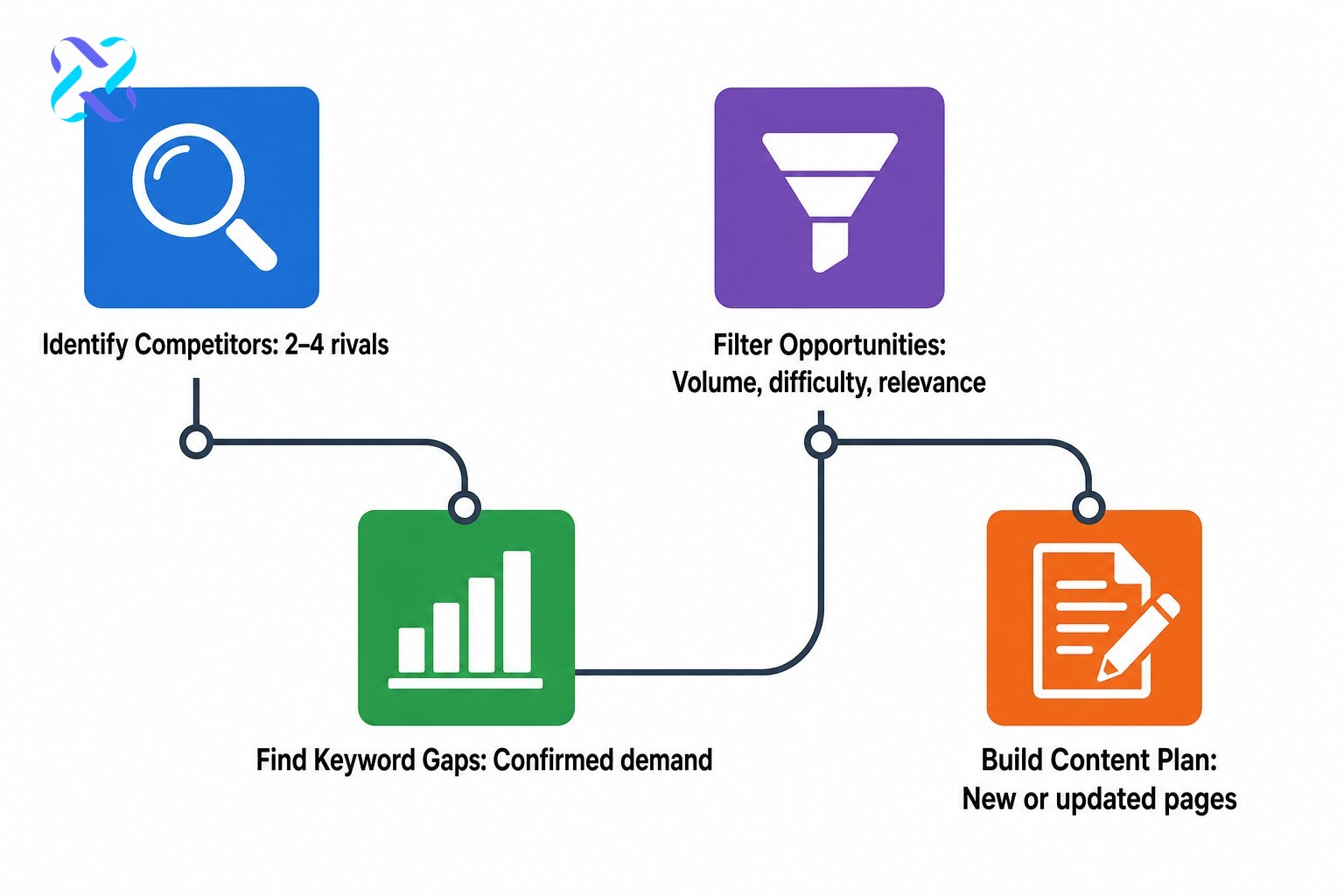
Once you have identified candidates, narrow the field by focusing on sites that rank for a substantial number of your target keywords, operate in the same geographic market where relevant, and serve an audience similar to yours. Analysing a large national competitor when you serve Metro Vancouver or a specific neighbourhood can introduce noise into your data and pull your strategy in the wrong direction. Precision in choosing who you analyse directly improves the quality of what you learn.
Ranking Gap Analysis: Finding Where You Are Missing Traffic
Ranking gap analysis compares your site’s keyword rankings against a competitor’s to find terms where they appear and you do not, or where you rank far below them. This is the core of the process. The output is a prioritised list of opportunities sorted by potential traffic and difficulty to close.
According to a structured methodology outlined by SE Ranking, covering keyword collection, gap identification, and prioritisation enables businesses to secure higher-quality organic traffic rather than chasing volume indiscriminately. When evaluating gaps, consider three key filters:
- Search volume: Is there enough demand to justify the effort?
- Keyword difficulty: Can your site realistically compete for this term?
- Business relevance: Does the keyword connect to your actual offer and audience?
High-Value Gaps vs. Low-Return Keywords
Not all ranking gaps are worth pursuing. High-value gaps share three characteristics: your audience realistically searches for them, they reflect services or topics you can credibly cover, and they sit within a difficulty range where new or mid-authority content can compete. Low-return keywords often require considerable resources to rank for without producing meaningful traffic or conversion impact. Filtering your gap list with these criteria keeps your effort focused where it can actually move results.
| Characteristic | High-Value Gap | Low-Return Keyword |
|---|---|---|
| Audience relevance | Your actual audience searches for it | Attracts an unrelated or mismatched audience |
| Topic credibility | Reflects services or topics you can genuinely cover | Outside your area of expertise or offer |
| Keyword difficulty | Within reach for new or mid-authority content | Requires high authority and significant resources |
| Conversion potential | Connects to a business goal or conversion path | High traffic but low conversion impact |
How to Turn Competitor Keywords Into a Content Plan
Identifying gaps is only useful if those findings translate into action. The next step is mapping each priority keyword to either a new page you need to create or an existing page you need to strengthen. Your content plan should not simply replicate what a competitor has written. It should go further, answer questions more completely, and reflect your own positioning and expertise.
A content opportunity analysis at this stage helps you identify not just what topics to cover but how thoroughly to cover them. Every piece of content in your plan should connect to a specific keyword, a specific searcher intent, and a specific business goal.
When to Update Existing Pages vs. Create New Ones
The decision depends on what your site already has. Update an existing page when you already have content that partially addresses the gap but ranks poorly. Improving its structure, depth, and keyword alignment is often faster than starting from scratch. Create a new page when no relevant content exists, or when an existing page serves a different audience or intent entirely. The key question is whether your current content, once improved, could realistically satisfy the search intent behind the keyword. If not, a new page is the cleaner solution.

What to Verify Before Acting on Competitor Keyword Data
Competitor keyword data from tools is an estimate, not a direct read from a competitor’s analytics. Search visibility figures and traffic projections are modelled based on available data. Acting on inflated or misread data can lead to investing time in keywords that do not perform as expected. Always cross-reference tool data with your own knowledge of the market, and apply these filters before acting:
- Geography: For Vancouver-based businesses, competitor data reflecting national or out-of-region traffic may not represent local search behaviour accurately. A competitor ranking well across Canada may be drawing most visits from Toronto or Calgary, not from searchers in your service area.
- Industry relevance: Targeting a keyword simply because a competitor ranks for it, without confirming it connects to your services, dilutes your strategy and wastes production effort.
- Audience fit: A high-traffic keyword that attracts the wrong audience will not convert, regardless of how well you rank for it.
The goal is not to copy a competitor’s keyword profile. It is to selectively pursue the gaps that are genuinely relevant to your business context.
Why a Structured Approach Produces Better Results
Surface-level research often produces a long list of keywords with no clear path to action. What separates a useful analysis from an overwhelming spreadsheet is the methodology behind it. At Leadsagna, we apply a systematic, data-backed approach tied directly to ROI. Rather than generating keyword lists for their own sake, our analysis identifies the specific gaps that represent achievable organic growth for your business, given your current authority, content structure, and competitive environment.
Research cited by SEOmator suggests that targeting competitor keywords can contribute meaningfully to organic traffic growth when applied with discipline and precision. Our focus on qualifying every opportunity against business relevance, search intent, and realistic difficulty means our clients move forward with a clear plan rather than chasing every gap a tool surfaces.
If you are ready to stop guessing and start building organic growth on a solid foundation, we would be glad to walk you through how a competitor keyword analysis could work for your specific situation.
Frequently Asked Questions About Competitor Keyword Analysis
How is competitor keyword analysis different from standard keyword research?
Standard keyword research starts from scratch using seed terms and brainstorming. Competitor keyword analysis starts with verified data, specifically the terms your competitors already rank for, so you skip theoretical guesswork and focus on keywords with proven search demand. It is faster and more precise, especially in competitive markets like Vancouver.
How many competitors should I analyse at once?
Analysing two to four direct competitors is usually sufficient to surface meaningful gaps without creating data overload. Choose competitors who rank for a substantial share of your target keywords and serve a similar audience or geography. Adding too many competitors dilutes your focus and can introduce irrelevant keyword targets.
Do I need expensive SEO tools to run a competitor keyword analysis?
Not necessarily. Platforms such as Google Search Console, Ubersuggest, and Semrush all offer keyword gap features, including free tiers. Paid plans provide deeper data and more accurate volume estimates, but meaningful analysis is possible without enterprise-level investment.
How often should a Vancouver business revisit its competitor keyword data?
Every three to six months is a practical baseline for most businesses. Search landscapes shift as competitors publish new content, update pages, or change their targeting. In fast-moving industries or competitive local markets, quarterly reviews help you stay ahead of emerging gaps.
What should I do if a competitor ranks for keywords that are not relevant to my business?
Ignore them. Not every keyword in a competitor’s profile is worth pursuing. Apply relevance and intent filters before adding any keyword to your content plan. A keyword is only valuable if it connects to your services, attracts your actual audience, and supports a business goal you are actively working toward.


