


Key Takeaways
Refreshing outdated pages with a structured content refresh strategy consistently delivers stronger ranking recoveries and organic growth than publishing new content from scratch.
- Pages sitting between positions six and twenty in Google Search Console are your highest priority targets because they already hold partial authority and need only a quality boost to climb into positions where users click.
- A genuine content refresh means replacing outdated statistics, fixing broken links, updating references, and aligning headings with how your audience currently searches, not simply changing the publication date.
- Quarterly content updates deliver 42 percent better results than annual ones, so building a refresh cycle into your workflow separates businesses that hold rankings from those that lose ground steadily.
- Freshness now affects AI visibility too. Tools like ChatGPT and Google AI Overviews favour recently updated content, making a consistent update schedule essential beyond traditional SEO.
- Thin pages with no backlinks and no impressions should be consolidated with stronger related content rather than refreshed individually, since refreshing them will not address the underlying lack of authority.
A content refresh strategy is one of the most underused levers in SEO, and for most business websites it consistently delivers better returns than publishing brand-new posts. If your organic traffic has been quietly declining, the problem is rarely a lack of content. More often, the pages you already have are losing relevance, falling behind competitors who update more frequently, and slipping further down search results each quarter. For businesses across Metro Vancouver, from Burnaby and Richmond to North Vancouver and the Fraser Valley, this is a pattern that comes up regularly. The good news is that it is fixable without starting over from scratch.
This guide walks through exactly how to identify which pages deserve attention first, what a genuine content update involves, and how to measure whether your efforts are producing real ranking improvements. Whether you manage your site in-house or are considering outside support, this framework is practical, repeatable, and grounded in how search engines behave today.
What Is a Content Refresh Strategy?
A content refresh strategy is a structured approach to updating existing pages so they rank higher, satisfy current search intent, and stay competitive. Rather than publishing new content from scratch, you improve what you already have by correcting outdated information, strengthening keyword alignment, filling topic gaps, and improving internal linking. The goal is to revive pages that have lost rankings or traffic over time and restore their visibility in search results.

Why Updating Old Content Outperforms Publishing New Posts
Every page you publish accumulates something valuable over time: backlinks, indexing history, engagement signals, and at least partial keyword authority. A new post starts from zero on all of those. When you refresh an existing page, you are building on a foundation Google already recognises, and that matters enormously for how quickly a page can recover or climb in rankings.
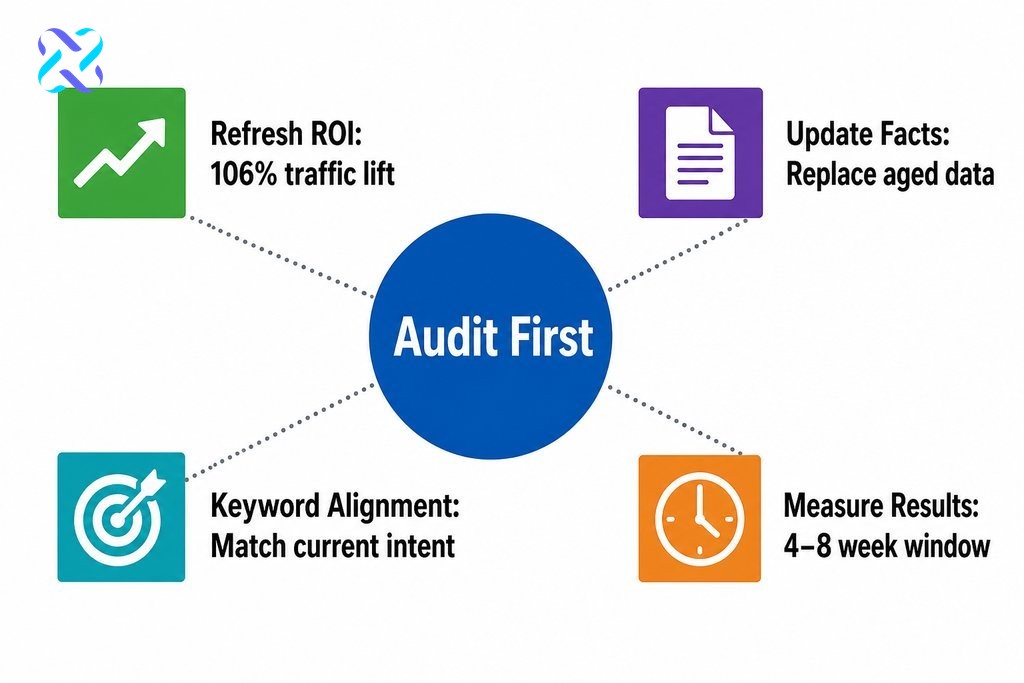
The business case is well-documented. HubSpot’s content refresh programme increased monthly organic visits to old posts by 106 percent and doubled monthly leads. A page already ranking on page two for a competitive term has the relevance signals in place. It simply needs quality and freshness signals to catch up. Refreshing that page is a far shorter path to page one than writing something entirely new on the same topic.
There is also an AI visibility dimension to consider. Research from Ahrefs found that AI-cited content tends to be notably fresher than traditional Google results, and that tools like ChatGPT appear to favour more recently updated URLs. As AI search tools become a meaningful source of referral traffic, content freshness is no longer just a traditional SEO concern. It is increasingly a factor in whether your content appears in the answers that tools like ChatGPT and Google AI Overviews serve to users.
| Approach | Authority Foundation | Time to Ranking Impact | AI Visibility Advantage | Effort Required |
|---|---|---|---|---|
| Refreshing existing content | Builds on existing backlinks and indexing history | Faster, as the foundation is already recognised by Google | Higher, since freshness signals improve AI citation likelihood | Medium, with targeted improvements only |
| Publishing new content | Starts from zero | Slower, as authority must be built from scratch | Lower, as new pages lack accumulated signals | High, with full creation required |
How to Identify Which Old Blog Posts Are Worth Updating First
Not every old page deserves your time. The goal of a content audit is to find pages where a modest improvement will produce a meaningful ranking gain. These are pages that already have some authority, some search impressions, and some proximity to positions where users actually click.
According to a Siege Media study analysing 17,805 keywords, the average page-one result was last updated around 730 days prior. Competitive content ages faster than most website owners act on, and that creates a real opportunity to outpace competitors who are not maintaining their content. In a market as active as Vancouver’s, where local businesses compete across densely contested categories like real estate, professional services, and retail, this gap is particularly worth addressing. Your starting point is Google Search Console, where you can filter pages by impressions and average position to find posts sitting between positions six and twenty. Those are your highest-priority candidates.
Signals That a Page Needs a Refresh
Three patterns consistently indicate that a page is decaying and ready for a structured update:
- Declining impressions: A drop over a rolling 90-day period compared to the same window last year signals content decay.
- Keyword position slippage: Pages that ranked in the top five but have since drifted past position ten.
- Rising bounce rate: Users leaving immediately often means the content no longer matches current search intent.
When all three signals appear together, a structured refresh is likely to produce a measurable improvement.
Pages to Skip or Consolidate Instead
Some pages should not be refreshed because updating them will not solve the underlying problem. Thin posts with no backlinks and no impressions in Search Console are not decaying assets. They simply never had traction. These are candidates for consolidation with a stronger, related piece. When two or three posts address the same search intent, they create internal competition that dilutes authority. Merging them into one comprehensive, well-structured page consistently produces better results than maintaining several weak versions of the same idea.

What a Content Refresh Actually Involves
A genuine content refresh is not cosmetic. Changing the publication date, rewording a few sentences, or swapping one image for another does not signal meaningful freshness to search engines. A real update improves the page’s ability to fully satisfy the search intent behind its target keyword, addresses gaps that competitors are currently filling, and ensures that every claim, statistic, and reference reflects current reality. Improving existing content at this level means treating each page as something that needs to earn its ranking through demonstrated usefulness, not assumed authority from an earlier era.
According to the Content Marketing Institute, companies that prioritise content updates based on business impact tend to see significantly higher ROI compared to ad hoc refresh approaches. The order in which you refresh outdated content matters as much as the quality of the refresh itself.
Updating Facts, Data, and Outdated References
Statistics age faster than any other type of content. A post written in 2021 citing industry data from that year may now be misleading readers with figures that have shifted significantly. Every data point should be traced back to its original source and either confirmed as current or replaced with a more recent figure. Dead links, discontinued products, and references to tools or services that no longer exist all need to be corrected. This is not just a credibility issue. It is a direct quality signal that search engines and AI systems use to evaluate whether a page deserves to rank.
Strengthening Keyword Alignment Without Overstuffing
Search language evolves. The way users phrased a question in 2020 may differ meaningfully from how they phrase it today, and your content needs to reflect that shift. Refreshing old content involves reviewing the secondary and related terms appearing in top-ranking pages on the same topic, then weaving those phrases into your existing content where they fit naturally. This is not about forcing keywords into every paragraph. It is about ensuring your content matches the language your audience is currently using. Adjusting headings, subheadings, and the opening paragraph to reflect current search language can produce noticeable position improvements without structural rewriting.
Content Update Checklist: A Repeatable Step-by-Step Process
A structured workflow keeps the refresh process efficient and ensures no important element is overlooked. Work through these steps in sequence for each page you update:
- Run a Search Console audit to identify pages with declining impressions or positions between six and twenty.
- Prioritise pages with existing backlinks, partial rankings, and high-volume target keywords.
- Review current top-ranking pages for your target keyword to identify gaps in your existing content.
- Replace outdated statistics, fix broken links, and update product or service references.
- Revise headings and the introduction to reflect current search language and intent.
- Add internal links to and from related pages on your site to strengthen topical authority.
- Update the meta description to reflect the revised content and improve click-through rate.
- Republish with a revised date and submit the updated URL through Search Console for faster reindexing.
| Step | Action | Purpose |
|---|---|---|
| 1 | Run a Search Console audit | Identify pages with declining impressions or positions six to twenty |
| 2 | Prioritise high-value pages | Focus effort on pages with backlinks, partial rankings, and high-volume keywords |
| 3 | Analyse top-ranking competitors | Identify topic gaps your existing content is not covering |
| 4 | Update facts, data, and links | Replace outdated statistics, fix broken links, remove discontinued references |
| 5 | Revise headings and introduction | Align content with current search language and intent |
| 6 | Strengthen internal linking | Build topical authority across related pages on your site |
| 7 | Update the meta description | Improve click-through rate by reflecting revised content |
| 8 | Republish and resubmit via Search Console | Signal freshness and accelerate reindexing |
Building this checklist into a quarterly review cycle, rather than treating it as a one-time project, is what separates businesses that maintain their rankings from those that rebuild from scratch every few years.
How to Measure Whether Your Content Improvements Are Working
After publishing a refresh, rankings typically take four to eight weeks to reflect the full impact, and sometimes longer for competitive keywords. The most useful early signal is impressions in Google Search Console. If impressions begin rising within two to three weeks of republishing, that is a strong indicator that Google is crawling and reassessing the page positively. Average position and organic clicks are the metrics to watch over the following six to eight weeks.
Time on page and bounce rate tell you whether users are engaging with the updated content or still leaving quickly. A refresh that improves rankings but does not improve engagement often means the search intent alignment still needs work. Tracking these metrics together gives you a clear picture of whether the page is genuinely serving its audience better, which is ultimately what determines whether it holds or continues to climb.
When Vancouver Businesses Should Bring in Professional SEO Support
Many business owners can execute a content refresh strategy independently for lower-competition keywords and straightforward updates. The point where in-house efforts tend to stall is when competitive keywords require deep topical coverage, when technical SEO issues such as crawl problems or page speed are suppressing the impact of content improvements, or when the volume of pages needing attention exceeds what a small team can realistically maintain without a system behind it.
At Leadsagna, we approach SEO and content work methodically, with clear inputs, measurable outputs, and a focus on what actually drives revenue. Our SEO and content services are designed for Vancouver businesses that want consistent organic growth tied to qualified leads, not just impressions and rankings that do not translate to customers. Whether you operate in downtown Vancouver, Kitsilano, Yaletown, or across the broader Lower Mainland, if your content improvement efforts have plateaued or you are working toward a more competitive market position, we would be glad to review your current situation and show you where the opportunity is.
Reach out to the Leadsagna team in Vancouver to start a conversation about what a structured content refresh strategy could look like for your business.
Frequently Asked Questions
How often should I refresh existing content on my website?
For most business websites, a quarterly review cycle works well. Pages in fast-moving industries or competitive local markets may need attention every two to three months, while evergreen content in lower-competition niches can often hold with a twice-yearly update. The key trigger is performance data. If Search Console shows declining impressions, that page needs attention regardless of when it was last updated.
Does updating old content really help with Google rankings?
Yes, consistently. Google evaluates content freshness as part of page quality assessment, particularly for topics where accuracy and currency matter. Refreshing a page that already has backlinks and indexing history gives it a meaningful advantage over starting a new post on the same topic. Ranking improvement is typically faster because the page’s authority foundation already exists.
What is the difference between a content refresh and rewriting a page completely?
A content refresh preserves the page’s existing URL, structure, and authority while updating facts, improving keyword alignment, and strengthening internal links. A full rewrite risks losing the accumulated signals that help the page rank. Refreshing is almost always preferable unless the original content is so poor or off-topic that no amount of updating can salvage it.
Which pages should I prioritise for a content refresh?
Start with pages ranking between positions six and twenty in Google Search Console that show declining impressions over a 90-day period. These pages already have enough authority to reach page one with targeted improvements. Pages with existing backlinks and high-volume keywords should move to the top of your list ahead of thin or zero-impression content.
How long does it take to see results after refreshing a page?
Most refreshed pages begin showing impression gains within two to three weeks of republishing, once Google recrawls the updated content. Meaningful ranking improvements typically take four to eight weeks. Submitting the updated URL through Google Search Console immediately after republishing can help accelerate the reindexing process.


