


Key Takeaways
Reputation management SEO directly shapes Google rankings and buyer trust by turning reviews, citations, and brand signals into measurable organic growth for Canadian businesses.
- Reputation management SEO is a structural ranking input, not a soft add-on; review quality, citation consistency, and branded search volume all directly influence where your business appears in Google results.
- A well-optimized review profile includes responses to every review, accurate business information across all directories, and fresh activity across multiple platforms, each of which Google reads as evidence of a credible and active business.
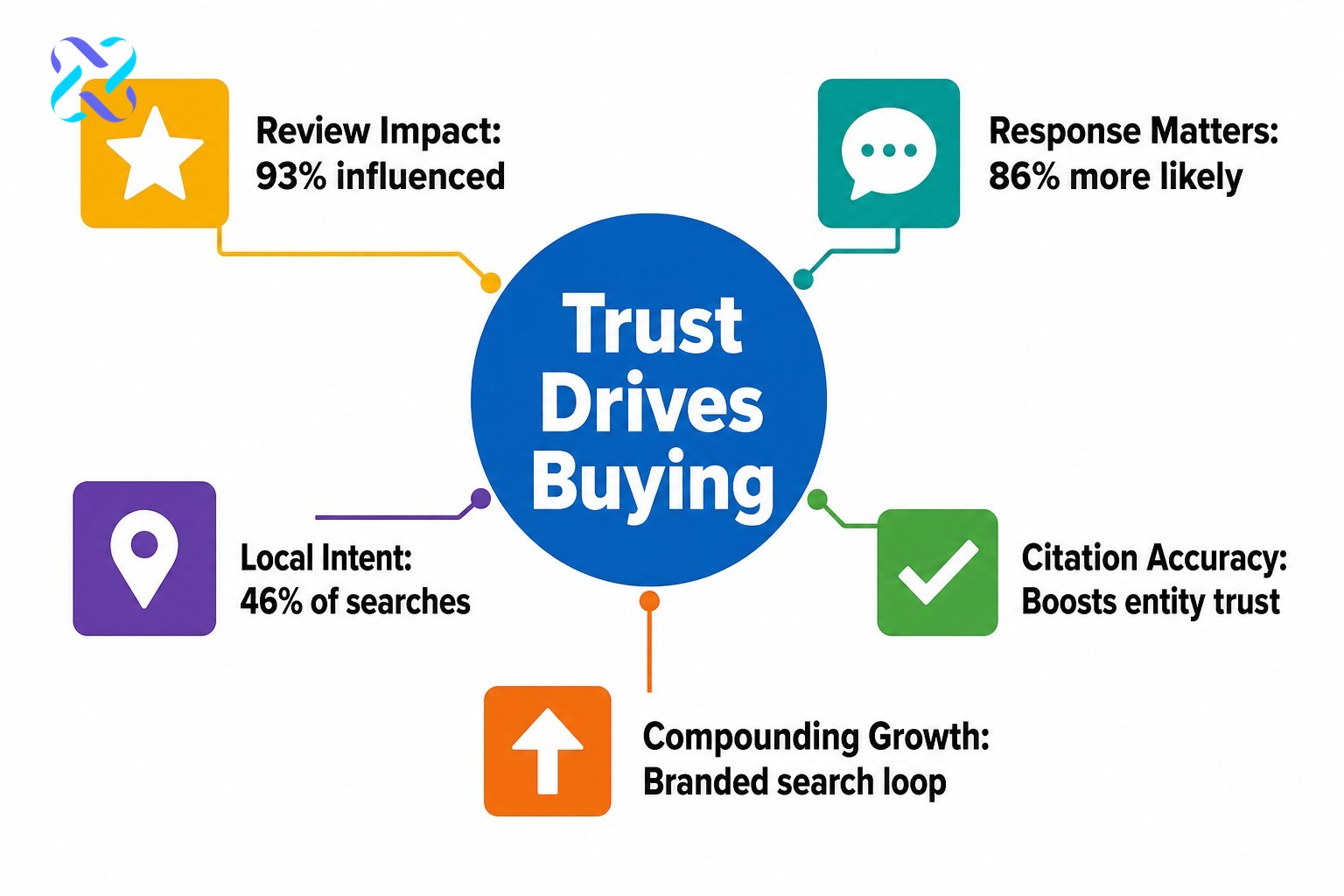
- Local reputation management is one of the most direct ways to win Google map pack visibility, since 46% of all searches carry local intent and geographic trust signals give businesses a genuine competitive edge.
- Brand reputation in search compounds over time; as more people search for your business by name, Google interprets that as growing authority, which feeds back into higher rankings and more qualified traffic.
- Proactive reputation management is far easier than crisis recovery; businesses that wait for a public incident to act typically face a significantly longer and more difficult path back to strong search visibility.
Most businesses treat their online reputation as a separate concern from their SEO strategy. Reviews go in one folder, keyword rankings go in another, and the two rarely meet in a meaningful conversation. But for Canadian businesses competing in search results today, that separation is a costly mistake. Reputation management SEO is the practice of actively shaping how search engines and real customers interpret your brand’s credibility, and it has a direct, measurable effect on where you rank and how often people choose you.
This article walks through how the system works, why trust signals carry so much weight in Google’s algorithm, and what a structured approach to online reputation SEO actually looks like for businesses that want organic growth they can measure rather than simply hope for.
What Is Reputation Management SEO?
Reputation management SEO is not simply keeping an eye on your star rating or asking customers to leave a review when things go well. It is an active, structured strategy that shapes how Google reads your brand and how potential buyers feel when they encounter you in search results.
Every mention, every rating, and every piece of content connected to your business name is a signal that search engines process and weigh. Ignoring that process does not make it go away. It simply means someone else, or something else, is shaping the narrative for you.
For business owners competing in Vancouver’s geographically defined markets, from Kitsilano and Mount Pleasant to North Vancouver and Burnaby, this matters at a practical revenue level. According to Edelman, 67% of customers will not buy from a brand unless they trust it, and a breach of that trust typically ends the relationship entirely. That is not about branding in the abstract. It is about whether someone clicks your listing or your competitor’s, and whether your search presence reinforces or undermines the case for doing business with you.

How Trust Signals Affect Search Visibility
Google does not rank websites based on how professional they look. It ranks them based on signals that indicate whether a business is credible, relevant, and trustworthy in a given context. Businesses that perform well on these dimensions consistently outperform competitors with similar on-page SEO but weaker trust profiles.
Key trust signals Google measures include the volume and quality of your reviews, the consistency of your business information across the web, the authority of websites that mention or link to you, and the number of people who search for your brand by name. A Local SEO study published by Chatmeter via Alchemer found that review signals, ratings, and business profile completeness each function as direct ranking inputs in Google’s local search algorithm. Your online reputation work is not a soft complement to your broader SEO. It is a structural component of it.
Looking Trustworthy vs. Being Trusted by Google
A polished logo and well-designed website can make a business look credible to a casual observer. Google, however, evaluates structural signals rather than aesthetics. Surface-level branding contributes to how users feel once they land on your site, but it does not determine whether they find you in the first place.
What Google actually measures includes entity recognition across the web, consistent citations across authoritative directories, a pattern of genuine and responded-to reviews, and branded search volume over time. The gap between looking trustworthy and being trusted by Google is closed through sustained, system-level reputation work.
| Signal Type | Looking Trustworthy | Being Trusted by Google |
|---|---|---|
| Visual branding | High impact on user perception | Low direct ranking influence |
| Review profile | Builds social proof | Direct local ranking input |
| Citation consistency | Minimal visible effect | Strengthens entity confidence |
| Branded search volume | Not user-facing | Signals growing authority |
| External mentions & links | Indirect credibility cue | Builds entity recognition |
How Online Reviews Drive Organic Traffic
Online reviews are not just about social proof. They are a direct source of ranking signals that Google reads as evidence of relevance and authority. Review profile optimisation, covering quality, recency, keyword-rich review text, and consistent response patterns, directly affects how Google scores a listing.
Research from PMC at the National Library of Medicine confirms that 93% of consumers say online reviews affect their purchasing decisions, and 82% read reviews before making a choice. According to Uberall, 86% of consumers are more likely to shop at a business that responds consistently to reviews. A thoughtful review response strategy signals to Google and prospective buyers that there is an active, accountable business behind the listing, which strengthens both trust and ranking performance over time.
What a Well-Optimised Review Profile Looks Like
A well-optimised review profile is not simply one with a high star average. It includes reviews distributed across multiple relevant platforms, recent reviews that signal ongoing business activity, genuine and contextually appropriate responses from the business, consistent business name and contact details across all listings, accurate business categories, and current photos. Each of these elements contributes to how Google scores the profile and how users decide whether to trust you enough to make contact.
| Profile Element | Why It Matters | Impact on Rankings |
|---|---|---|
| Review volume & recency | Signals ongoing business activity | High |
| Star rating quality | Influences click-through and trust | High |
| Business response pattern | Demonstrates accountability to Google and users | High |
| Multi-platform distribution | Broadens citation and trust footprint | Medium |
| Consistent NAP details | Strengthens entity confidence in Google | High |
| Accurate categories & photos | Improves relevance signals for local queries | Medium |

Why Local Reputation Management Is an SEO Growth Strategy for Vancouver Businesses
Local reputation management is one of the most direct levers a Vancouver business can pull to improve visibility in Google’s map pack and neighbourhood-level search results. Google reports that 46% of all searches carry local intent, meaning nearly half of all searches are moments where a business with a strong local reputation has a genuine competitive advantage.
In a city as geographically varied as Vancouver, where someone searching in Gastown behaves differently from someone searching in Richmond or the North Shore, localised reputation signals carry real weight. The map pack, which sits above standard organic results for most local queries, is heavily influenced by the same reputation signals discussed throughout this article.
Citation accuracy is foundational. If your business name, address, or phone number appears differently across directories, Google’s confidence in your entity drops and so does your ranking. Consistent listings, combined with localised review signals that mention specific neighbourhoods or services, reinforce your relevance to the geographic queries you most want to win. Local reputation management is not a set-and-forget task. It requires regular auditing and maintenance to remain effective as the web changes around you.
How Brand Reputation Builds Compounding Search Presence
One of the most commercially valuable aspects of this approach is that it compounds over time. When branded search volume grows, meaning more people are searching for your business by name, Google interprets that as a signal of growing authority and preference. That signal feeds back into your rankings, which increases visibility, which generates more branded searches. The loop reinforces itself, but only if the underlying reputation signals remain consistently strong.
Content strategy and earned PR mentions also play an important role. When credible external sources reference your business, those mentions build entity recognition in Google’s knowledge systems. When your own content consistently addresses relevant topics with accuracy and depth, it compounds your authority in the same search landscape where your reviews and listings already appear.
Research cited by Electroiq suggests that a meaningful share of consumers may be willing to pay a premium for products or services from a business with a stronger reputation. While the exact figures vary across studies and industries, the commercial logic is consistent: stronger reputation signals can translate into real pricing power, not just higher traffic numbers.
The Limits of Reputation Management SEO
Reputation management SEO is a long-term system, and that is both its strength and its main constraint. Reversing negative sentiment, suppressing damaging content, or rebuilding trust after a public incident takes sustained effort measured in months, not days. Businesses that wait until a crisis forces their hand typically find the path back significantly harder than it would have been with proactive management already in place.
It is also worth noting that perfection is not the goal. Research from Trustpilot and Canvas8 found that a large share of global consumers view suspiciously perfect review scores as a sign of manipulation. They tend to place more trust in high yet imperfect ratings, around four stars, because they appear more authentic. The aim is a credible, genuine, and well-maintained presence.
Fake review schemes carry serious risks, including Google penalties that can remove a profile from search entirely. Shortcuts that inflate review counts artificially tend to backfire in ways that are difficult to repair. When a business faces coordinated negative attacks, a sudden drop in review scores, or reputational damage affecting sales in measurable ways, the situation typically requires professional intervention. Precision matters more than speed.
A System-Driven Approach That Turns Reputation into Measurable Results
At Leadsagna, reputation management SEO is treated as an engineering problem, not a cosmetic one. The starting point is a structured audit of existing reputation signals: review profiles across all relevant platforms, citation consistency across directories, branded search volume trends, sentiment patterns in customer feedback, and gaps between current search presence and target visibility for high-intent local queries.
Every finding is mapped to a specific intervention with a projected impact on organic visibility and lead generation. From there, the system combines AI-powered analysis with hands-on execution across business listings, content development, and review profile optimisation. The goal is always measurable: more organic traffic, stronger map pack visibility, and more customers who arrive already convinced they are in the right place.
If your Vancouver business is ready to treat its reputation as the SEO asset it actually is, Leadsagna’s local team is ready to show you exactly what that looks like in practice. Reach out today to start with a no-pressure audit of where your reputation signals stand and what a structured improvement plan would mean for your organic growth.
Frequently Asked Questions About Reputation Management SEO
What is the difference between reputation management and reputation management SEO?
Traditional reputation management focuses on monitoring and responding to public sentiment through reviews, mentions, and media coverage. Reputation management SEO goes further by treating those same signals as ranking inputs. It connects trust-building activities directly to search visibility goals, so every review response, citation update, and content piece contributes to measurable organic growth rather than brand perception alone.
How long does it take to see results from reputation management SEO?
Meaningful improvement in local rankings and review profile strength typically becomes visible within three to six months of consistent, structured effort. Recovering from a reputational crisis takes longer. The timeline depends on how active your existing reputation signals are and how competitive the local search landscape is in your specific Vancouver neighbourhood or industry.
Can negative reviews actually hurt my Google rankings?
A pattern of unaddressed negative reviews can reduce your local search ranking, particularly in Google’s map pack. Google weighs review recency, volume, and response patterns as part of its local algorithm. A single negative review rarely causes lasting damage on its own, but a declining average with no business responses signals low engagement and reduces Google’s confidence in your listing.
Which review platforms matter most for Vancouver businesses?
Google Business Profile carries the most weight for local search rankings. Beyond that, the most relevant platforms depend on your industry. Yelp and TripAdvisor matter for hospitality, Houzz for home services, and Healthgrades for medical providers. Maintaining accurate, active profiles on the platforms your customers actually use strengthens both your reputation and your citation footprint.
Is it possible to remove or suppress negative search results about my business?
Outright removal is only possible in specific circumstances, such as content that violates platform policies or legal standards. In most cases, the practical approach is suppression: building authoritative positive content and signals that push negative results lower in rankings over time. This is a gradual process that requires sustained effort rather than quick fixes.


