

Key Takeaways
A consistent review response strategy turns your Google reviews into a trust building and lead generating system that improves local search rankings.
- Responding to reviews consistently signals to Google that your Business Profile is actively managed, which directly supports your visibility in local search and Maps results.
- Positive review responses should reference specific details from the customer’s feedback rather than using generic replies, since personalized responses build credibility with future buyers reading the exchange.
- A calm and professional negative review response can increase buyer confidence by showing accountability, and businesses that respond well to reviews convert at a measurably higher rate than those that respond poorly.
- Scheduling a weekly review monitoring routine keeps your profile active, prevents unanswered feedback from building up, and creates compounding visibility gains over time.
- A review response strategy works best when it is integrated into your broader local SEO system, connecting review activity to Google Business Profile optimization and lead generation outcomes.
Every time a potential customer searches for a business like yours on Google Maps, they are not just reading your star rating. They are watching how you respond. A well-built review response strategy transforms your review section from a passive display of ratings into an active sales tool that works around the clock. For local businesses in Vancouver, whether you operate in Kitsilano, the West End, Burnaby, or the North Shore, the difference between a business that gets the call and one that gets skipped often comes down to whether someone bothered to reply thoughtfully to their reviews.
This is not about crafting the perfect five-star reply once in a while. It is about building a repeatable system that treats every response as both a customer service moment and a marketing opportunity. When done consistently, responding to online reviews sends trust signals to prospective buyers, reinforces your brand voice, and feeds the engagement signals that Google uses to rank local businesses. The businesses that understand this early are the ones that pull ahead in local search results while their competitors wonder why the phone stopped ringing.
Does Responding to Reviews Help Your Local Rankings?
Yes, and the reason matters. Google’s local search algorithm surfaces businesses that appear active, trustworthy, and engaged with their community. Review activity is one of the clearest signals Google has access to, and your responses are a direct part of that signal.
When you reply to reviews consistently, you signal to Google that your Google Business Profile is actively managed. That contributes directly to how your listing performs in Maps and local pack results. It is a foundational element of online reviews for SEO that many local business owners overlook entirely.
Beyond the algorithm, responding to reviews serves two audiences simultaneously. The original reviewer receives acknowledgment, which can strengthen loyalty or recover a frustrated customer. Every prospective buyer reading that exchange also sees exactly how your business handles real situations. According to BrightLocal’s Local Consumer Review Survey, 66% of consumers continue researching after reading a positive review, while 34% are ready to convert immediately. Your replies influence buyers at multiple stages of their decision.
Review engagement also connects to the broader practice of reputation management SEO, where consistency across platforms compounds over time. A Google Business Profile that shows regular, thoughtful replies is treated as a more credible business entity, and the more credible your profile appears, the more likely Google is to show it to the right people at the right moment.

What a Review Response Strategy Actually Looks Like
A real review response strategy is not something you do when you remember. It is a structured system with defined timing, a consistent tone, and clear guidelines for every type of review your business might receive.
A strong strategy includes:
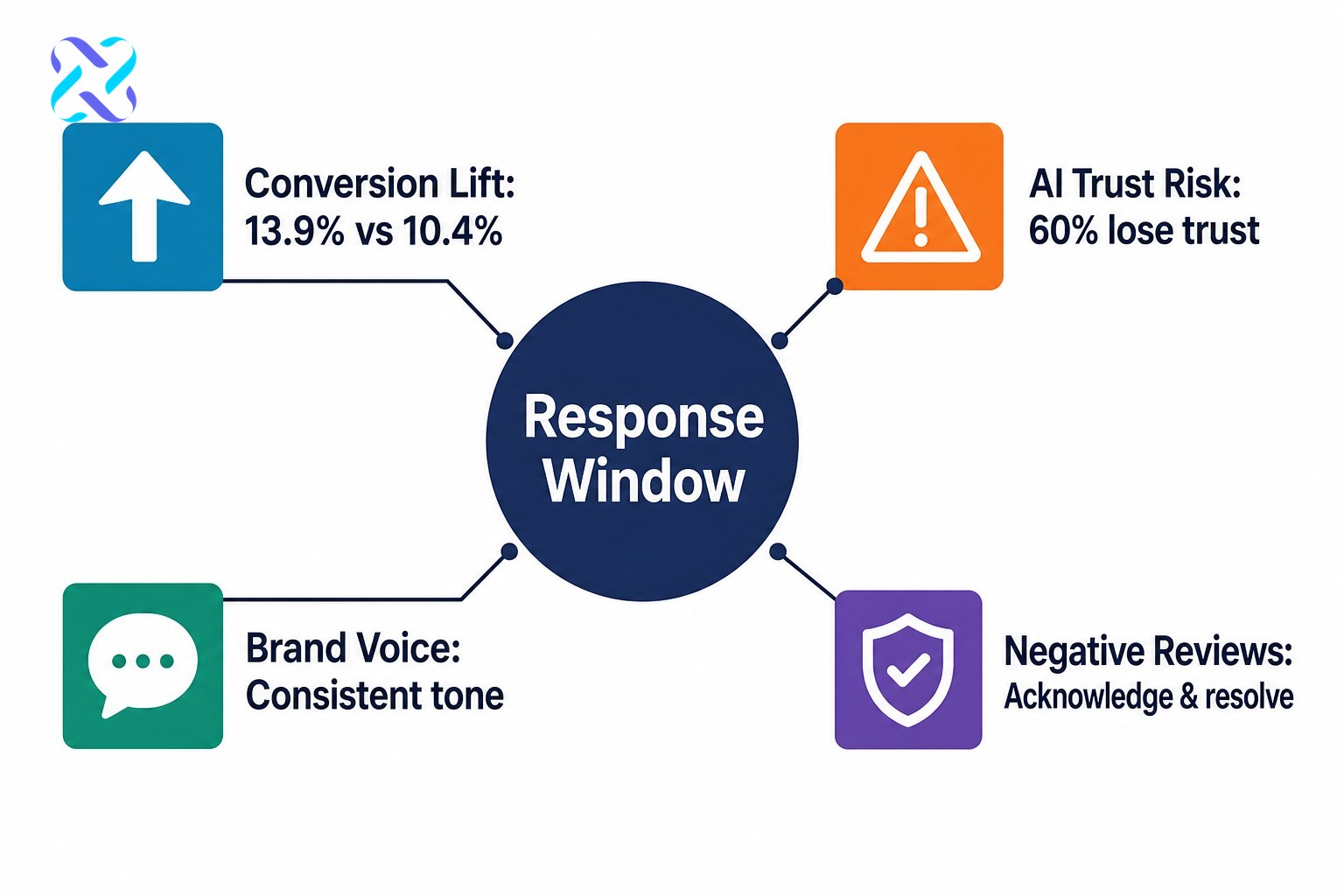
- A response window — typically within 24 to 48 hours for all new reviews.
- A defined brand voice — consistent whether you are thanking someone or addressing a complaint.
- Cross-platform coverage — applied consistently across Google, Yelp, and any other directory where your business appears.
Research from the Journal of the Academy of Marketing Science, which analysed over 150,000 online reviews, found that responding to both positive and negative reviews influences future customer ratings and financial outcomes. When competitors all respond, engagement becomes an expectation rather than a differentiator. Getting your system in place before that point matters.
Consumer research compiled by Opensend found that nearly two-thirds of consumers prefer businesses that reply to reviews, and that preference shapes decisions before a customer ever calls your number or walks through your door.
| Strategy Element | What It Involves | Why It Matters |
|---|---|---|
| Response window | Reply within 24 to 48 hours of each new review | Signals an actively managed profile to Google and customers |
| Defined brand voice | Consistent tone across all review types and platforms | Builds a recognisable, trustworthy business identity |
| Cross-platform coverage | Respond on Google, Yelp, Facebook, and relevant directories | Strengthens overall reputation signal and leaves no feedback unaddressed |
How to Write a Positive Review Response That Reinforces Trust
Positive review responses are often treated as formalities, but they are one of the most underused tools in a local business’s marketing toolkit. A strong response does three things: it acknowledges the specific feedback the customer left, reflects the tone and character of your brand, and reinforces the reason someone should choose you over a competitor.
Generic thank-you replies miss all three. When a customer mentions a specific team member, a particular service, or a detail about their experience, reference it directly. If someone praises the speed of your service, your response might acknowledge that efficiency is something your team genuinely prioritises. That specificity shows future readers that your reply is real, not templated.
According to consumer research compiled by Opensend, around six in ten shoppers lose trust when they detect AI-generated review responses. Human oversight and personalisation matter even when drafting tools are involved.
Turning Happy Vancouver Customers Into Visible Social Proof
Well-crafted responses to positive reviews also encourage more reviews. When customers see that a business engages genuinely with feedback, they feel more motivated to leave their own. This creates a compounding effect where visibility, credibility, and review volume grow together. For local businesses building their presence in Google Maps across Metro Vancouver, this cycle is one of the most cost-efficient forms of growth available.

How to Handle a Negative Review Response
A negative review handled poorly can cost you far more than the original complaint ever would have. Defensive replies, dismissive language, or silence all send the same message to prospective buyers: this business does not take customer concerns seriously.
A calm, professional negative review response, on the other hand, can increase buyer confidence. It shows that your business is accountable, that issues get addressed, and that the customer experience matters beyond the transaction.
The essential structure for responding to a negative review:
- Acknowledge the feedback without necessarily agreeing with it.
- Express empathy and note that their experience does not reflect your usual standard.
- Invite a direct conversation to resolve the situation offline.
As Miriam Ellis, Local SEO Associate at Moz, puts it: “I consider review responses to be a core customer service responsibility. This vital vehicle defends brand reputation and revenue, offering companies a means of transforming dissatisfied consumers into satisfied ones, supporting retention so that less has to be spent on new customer acquisition.” A Location3 study cited by Moz found that brands responding well to reviews achieved a conversion rate of 13.9% compared to 10.4% for poor responders, a gap that adds up quickly at scale.
| Review Type | Recommended Approach | Key Goal | What to Avoid |
|---|---|---|---|
| Positive review | Reference specific details from the feedback; reflect your brand tone | Reinforce trust and encourage more reviews | Generic, templated thank-you replies |
| Negative review | Acknowledge, express empathy, invite offline resolution | Demonstrate accountability and recover confidence | Defensive or dismissive language; silence |
| Unfair or inaccurate review | Respond calmly with factual context; flag for removal if policy is violated | Protect reputation without escalating the situation | Public arguments or accusatory replies |
What to Say When the Complaint Is Unfair or Inaccurate
Not every negative review reflects reality. When a misleading or false complaint appears publicly, respond in a way that protects your reputation without escalating the situation. Acknowledge the review professionally, offer factual context where appropriate, and keep the tone measured. Future readers will notice the contrast between a calm reply and an accusatory review, and that contrast usually favours the business. If a review violates platform policies, you can flag it for removal while still responding for the benefit of prospective customers reading the thread.

How to Build Review Responses Into Your Weekly Routine
Consistency is what separates a working review engagement strategy from occasional good intentions. The most effective local businesses treat review monitoring as a scheduled task rather than a reactive one.
A simple weekly review routine:
- Check Google Business Profile, Yelp, and any relevant directories for new reviews.
- Respond to all new reviews within the same session, prioritising negative ones first.
- Use a saved tone guide to keep replies consistent with your brand voice across platforms.
- Note recurring feedback themes to share with your team for operational improvements.
Over time, this kind of consistent engagement compounds into measurable local visibility gains. Platforms reward active profiles. Customers reward attentive businesses. The two outcomes reinforce each other, and that reinforcement builds the kind of reputation that brings in leads without additional ad spend.
When Review Management Becomes Part of a Larger Vancouver Local SEO System
A review response strategy does not exist in isolation. It connects directly to how your Google Business Profile is optimised, how consistent your business listings are across directories, and how your broader local SEO performance develops over time. Each of these elements feeds the same goal: making your business the most credible and visible option when someone in Vancouver, or a neighbouring community like Richmond, Coquitlam, or Surrey, is ready to buy.
At Leadsagna, the approach to reputation management is built with precision, measurable outcomes, and a clear connection to lead generation. The system tracks response timing, monitors sentiment trends, and ties engagement activity back to profile performance and conversion data. This is how review activity stops being a customer service task and becomes a documented part of your growth strategy. If you are ready to turn your online reviews into a consistent source of qualified leads, reach out to the Leadsagna team and let us build the system that does exactly that.
Frequently Asked Questions About Review Response Strategy
How quickly should a local business respond to a Google review?
Responding within 24 to 48 hours is the recommended standard. Fast responses signal to both Google and potential customers that your business is actively managed. For negative reviews, responding promptly is especially important because it limits the window during which an unaddressed complaint shapes first impressions for other readers.
Does responding to reviews directly affect Google Maps rankings?
Google treats consistent review engagement as a signal that your Google Business Profile is active and credible, which contributes to how your listing ranks in local pack and Maps results. It does not guarantee a top position on its own, but it is a recognised factor within the broader local SEO framework alongside citations and profile completeness.
What should a Vancouver business include in a positive review response?
A strong positive response references something specific from the customer’s feedback, reflects your business’s tone, and reinforces a reason to choose you. Avoid copying a template word for word across every reply. Specificity signals authenticity, which matters to future readers and platforms that flag repetitive or AI-generated content.
Can responding to negative reviews actually help your business?
Yes. A well-handled negative review response demonstrates accountability and professionalism. Research cited by Moz found that businesses responding effectively to reviews achieved a 13.9% conversion rate compared to 10.4% for those responding poorly. Prospective customers often find a composed, empathetic reply more reassuring than a perfect star rating with no engagement.
Should businesses respond to reviews on platforms other than Google?
Yes, especially on platforms relevant to your industry and location. In Vancouver, Yelp remains active for certain sectors, and profiles on platforms like Facebook can influence buyer decisions. A consistent response approach across all active platforms strengthens your overall reputation signal and ensures no customer feedback goes visibly unacknowledged.
What is the risk of using AI tools to write all your review responses?
The main risk is a loss of perceived authenticity. Consumer research from Opensend found that around 60% of shoppers lose trust when they detect AI-generated replies. Using tools to assist with drafting is reasonable, but human review and personalisation remain essential to ensure responses feel genuine and relevant to each customer’s experience.


