


Key Takeaways
Search intent analysis helps Canadian businesses target keywords that match buyer readiness, turning organic traffic into actual revenue rather than empty rankings.
- High search volume means nothing without intent alignment; targeting keywords that do not match your buyer’s stage wastes budget and produces traffic that never converts.
- The four intent types (informational, navigational, commercial, and transactional) each signal a different stage in the buyer journey and require a different content format and call to action.
- Reading SERP layouts before creating content is a free and reliable way to confirm intent; product listings signal transactional intent while guides and featured snippets signal informational intent.
- Intent is not static; seasonal shifts, AI Overview expansions, and algorithm changes mean intent reassessment must be an ongoing part of your SEO workflow, not a one time setup task.
- Matching content format to intent stage is the baseline standard for pages that earn both rankings and conversions; mismatches are one of the most common reasons well ranked pages still fail to convert.
Most Vancouver businesses investing in SEO make the same costly assumption: that ranking for a high-volume keyword automatically means more customers. In practice, traffic without intent alignment rarely converts into revenue. A Vancouver retailer ranking for “running shoes” may attract thousands of visitors who are browsing product reviews, reading training guides, or looking for a brand they already have in mind — none of them ready to buy from that retailer today. Search intent analysis is the discipline that closes this gap, sitting between raw keyword data and the business outcome you actually want.
Understanding why someone types a particular query into Google reveals what kind of content they expect to find and, more importantly, whether they are anywhere close to making a decision. When intent is ignored during keyword research, even technically strong SEO campaigns can produce traffic that bounces without converting. Building intent into your strategy from the start is what separates rankings that generate leads from rankings that simply inflate a vanity metric on your monthly report.
Why Most Keyword Strategies Miss the Point
Traditional keyword research focuses heavily on two numbers: search volume and keyword difficulty. Both matter, but neither tells you what the person behind the query is actually trying to accomplish. A business chasing high-volume keywords without understanding intent is essentially spending marketing budget to attract the wrong audience at scale. For small and mid-sized businesses competing across Metro Vancouver, from Burnaby and Surrey to North Vancouver and Richmond, that is a real and expensive problem, not just a theoretical concern.
The missing layer is intent. When you add search intent analysis to your keyword research process, you stop asking “how many people search for this?” and start asking “what do people who search for this actually want, and does my content or offer match that expectation?” That shift changes which keywords you target, what content you create, and which pages you optimise for conversions. Without it, keyword strategy feels like guesswork dressed up in data.
The Four Intent Types and What They Signal About Your Buyer
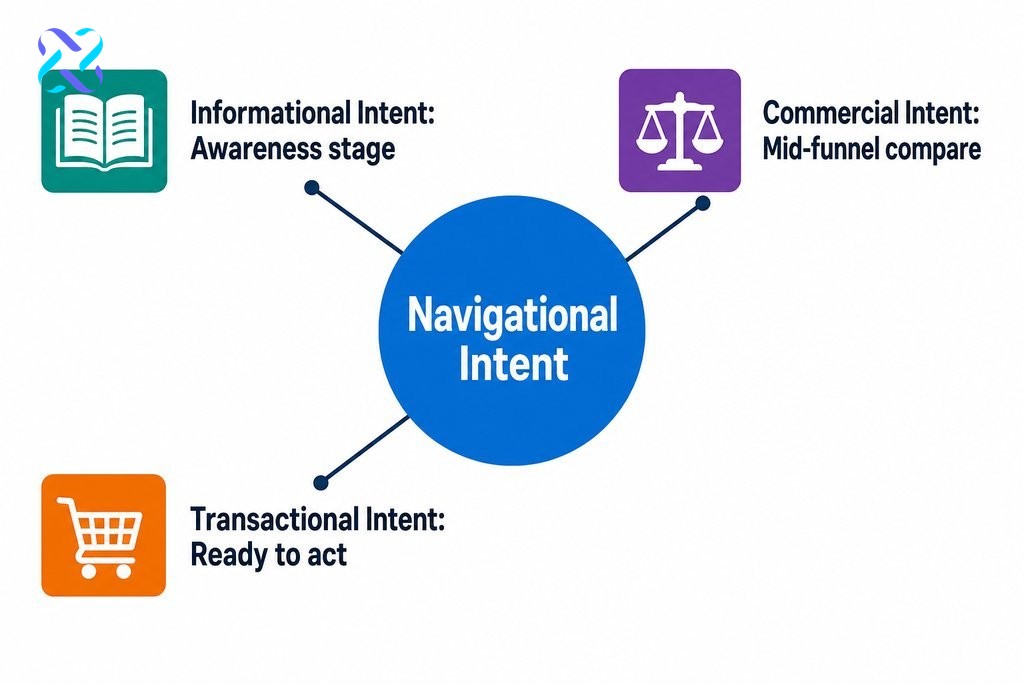
Search intent falls into four categories: informational, navigational, commercial, and transactional. Each corresponds to a different stage of the buyer journey. Knowing which type applies to a keyword tells you what content format to build, what call to action to include, and how far from a purchase decision that visitor likely is.
Navigational intent is the simplest to handle. A user searching “Leadsagna Vancouver” or “RBC online banking login” already knows where they want to go. These queries are brand or destination specific and rarely represent acquisition opportunities for businesses that are not already the target of the search. Understanding navigational intent helps you protect your branded keywords and ensure your own pages rank for your business name, but it is not where growth strategy tends to live.
How Informational Queries Build the Top of Your Funnel
Informational intent covers queries where a user is learning, not yet buying. Questions like “how does SEO work,” “what is a landing page,” or “why does my website rank low on Google” all signal a research phase. According to Ahrefs, informational searches account for a majority of all Google queries, with “how to,” “what is,” and “why does” formats growing significantly year over year. That dominance makes informational content strategically important, even when it does not convert immediately.
The value of informational content is trust-building over time. A Vancouver business owner who reads your well-structured guide on local SEO today may return weeks later when they are ready to hire an agency. That connection between a helpful first touchpoint and a later conversion is the foundation of effective content funnels. Ahrefs data also indicates that AI Overviews now appear in a substantial share of informational search results, which is shifting how organic clicks flow on these queries. Informational content still earns authority and brand awareness, but the click-through dynamic has changed and your strategy needs to account for that.
Spotting Commercial and Transactional Intent Before Your Competitors Do
Commercial intent sits in the middle of the funnel. Queries using modifiers like “best,” “top,” “vs,” “alternative,” or “review” signal that someone is comparing options before making a choice. A search like “best SEO agency in Vancouver” or “Semrush vs Ahrefs for small business” is not a casual browse. It is active evaluation. Targeting commercial intent with well-structured comparison content, honest positioning, and clear differentiators can intercept buyers at the precise moment they are forming a shortlist.
Transactional intent signals readiness to act. Queries such as “hire SEO consultant Vancouver,” “buy Google Ads management plan,” or “book a website audit” indicate that the user has finished comparing and wants to take a next step. These keywords require a focused landing page with a clear offer, social proof, and a direct path to conversion, not a long educational article. BrightLocal research has found that a large proportion of consumers search for local businesses online on a regular basis. Across a dense urban market like Greater Vancouver, that volume of local transactional intent represents a significant and ongoing opportunity for businesses that have aligned their pages to match what those searchers expect to find.
| Intent Type | What the User Wants | Example Queries | Funnel Stage | Best Content Format |
|---|---|---|---|---|
| Navigational | Reach a specific site or brand | “RBC online banking login,” “Leadsagna Vancouver” | Any stage | Branded pages, login pages |
| Informational | Learn or research a topic | “how does SEO work,” “what is a landing page” | Awareness (top of funnel) | Blog posts, guides, FAQs |
| Commercial | Compare options before deciding | “best SEO agency in Vancouver,” “Semrush vs Ahrefs” | Consideration (mid-funnel) | Comparison pages, reviews, roundups |
| Transactional | Take action or make a purchase | “hire SEO consultant Vancouver,” “book a website audit” | Decision (bottom of funnel) | Landing pages with clear CTA |
How to Read SERP Signals During Intent-Based Keyword Research
Before writing a single word of content, look at what Google is already serving for your target keyword. The search results page is a direct reflection of how Google has classified the dominant intent behind that query. Each SERP feature carries a clear signal:
- People Also Ask boxes, featured snippets, and long-form guides indicate informational intent.
- Product listings, shopping ads, and pricing tables indicate transactional intent.
- Comparison articles and review sites indicate commercial intent.
- Local packs signal transactional or commercial intent with a geographic dimension, particularly relevant for Vancouver businesses targeting customers in areas like Kitsilano, Yaletown, or the North Shore.
Research published by STAT Search Analytics confirms that People Also Ask boxes, featured snippets, and knowledge graphs are among the most common SERP features for informational intent keywords, providing a practical and free signal available to any marketer without a specialised tool. Reading these layouts accurately is a core skill in intent-based keyword research and one that takes practice to develop well.
| SERP Feature | Intent Signal | What It Means for Your Content |
|---|---|---|
| People Also Ask boxes | Informational | Cover related questions within your content; use FAQ formats |
| Featured snippets | Informational | Structure answers concisely with clear headings and definitions |
| Knowledge graphs | Informational / Navigational | Ensure your entity information is accurate across the web |
| Product listings and shopping ads | Transactional | Optimise product pages with pricing, reviews, and clear CTAs |
| Comparison articles and review sites | Commercial | Create structured comparison or “best of” content with clear differentiators |
| Local packs | Transactional / Commercial (local) | Optimise your Google Business Profile and local landing pages |

Applying Search Intent Analysis at Each Stage of Keyword Research
Layering intent into keyword research means going beyond volume and difficulty scores to ask what stage of the buyer journey each keyword represents. The three stages map cleanly to intent types: awareness-stage keywords tend to be informational and broad; consideration-stage keywords lean commercial, featuring comparison and review language; and decision-stage keywords are transactional and specific. When you map your keyword list to these stages, you are effectively building a content plan that mirrors how your audience actually moves toward a purchase.
This is where keyword mapping becomes a structural tool rather than a cosmetic exercise. Assigning each keyword to a specific page, funnel stage, and intent type ensures your site architecture matches the journey your buyers take. At the same time, keyword clustering helps you group semantically related keywords so that one page can serve multiple related queries without diluting focus. Together, these practices turn intent analysis from a conceptual framework into an executable system.
Matching Content Format to Intent Stage
Intent does not just guide which keywords to target. It tells you what kind of content to build. Informational intent calls for well-researched blog posts, guides, FAQs, and explainer articles that answer the question fully and build credibility. Commercial intent calls for comparison pages, “best of” roundups, case studies, and structured reviews that help users make a confident decision. Transactional intent calls for landing pages with minimal friction, clear service descriptions, strong social proof, and a single obvious next step.
Mismatching format to intent is one of the most common reasons pages fail to convert despite ranking well. A landing page that reads like a blog post loses the visitor’s trust immediately. A blog post that ends with no comparison or opinion fails to give the reader what they came for. Matching format to intent is not an advanced technique. It is the baseline standard for content that earns both rankings and results.
Where Intent Analysis Breaks Down and What to Watch For
Search intent is not always clean or consistent. Mixed-intent queries can trigger very different SERP layouts depending on the day, the user’s location, or recent shifts in how Google is interpreting a keyword. A query like “Vancouver marketing agency” might surface local listings one day and comparison articles the next, depending on how Google is currently weighting the signals behind it.
Research from Authoritas found that problem-solving queries trigger AI Overviews at a notably high rate, meaning even well-classified intent types are experiencing significant SERP layout changes as AI features expand.
Seasonal intent shifts add another layer of complexity. A keyword that carries informational intent in January may shift toward transactional intent in November as purchase season approaches. In a market like Vancouver, local events, seasonal tourism patterns, and regional industry cycles can also influence how intent shifts over time. Intent analysis is not a one-time audit. It requires ongoing review as search behaviour evolves, SERP features change, and new content competitors enter your keyword space. Building a process for regular intent reassessment into your SEO workflow is far more reliable than treating it as a setup task you complete once and archive.

Turning Intent Into a Repeatable System
At Leadsagna, search intent analysis is treated as a data problem with a structural solution, not a content exercise. Using AI-assisted tools to classify keywords by intent at scale, map them to funnel stages, and align them with the specific pages most likely to convert means the strategy is built on a repeatable, auditable process rather than instinct or convention. That engineering mindset is what allows intent mapping to connect meaningfully with broader SEO and content strategy, rather than existing as a standalone checklist item.
The goal is always the same: revenue outcomes, not traffic volume. A keyword that ranks well but attracts visitors who are nowhere near a buying decision has limited value to a business with real growth targets. By prioritising commercial and transactional queries within the keyword strategy, while still building informational content that earns trust and supports the funnel, Leadsagna’s approach ensures that every piece of content serves a measurable purpose. That is what turning clicks into customers looks like in practice, whether you are serving clients across Downtown Vancouver, the Broadway corridor, or the wider Lower Mainland.
What to Do Before Acting on Intent Data
Before making significant content or targeting decisions based on intent signals, a few verification steps will protect you from acting on misleading data:
- Cross-reference multiple SERP layouts for the same keyword across different sessions and devices to check for mixed-intent inconsistencies.
- Review query volume trends over time rather than relying on a single monthly snapshot, as intent and volume can shift together.
- Confirm that the intent you have identified actually aligns with your business’s real offer. Targeting a transactional keyword you cannot fulfil creates traffic without conversion and erodes user trust.
If you find yourself working through dozens of keyword clusters across multiple funnel stages with inconsistent SERP signals and overlapping page assignments, that is a reasonable point at which to bring in an SEO specialist. Building a reliable intent framework from scratch requires both technical understanding and strategic judgment. Getting the foundation right matters far more than moving quickly. If you are ready to build a keyword strategy that connects intent data to real business outcomes, Leadsagna’s Vancouver-based team is here to walk through exactly how that works for your market and your goals.
Frequently Asked Questions About Search Intent Analysis
What is search intent analysis and why does it matter for SEO?
Search intent analysis is the process of identifying what a user actually wants to accomplish when they enter a query into a search engine. It matters because Google ranks content based on how well it satisfies the dominant intent behind a keyword. A page optimised for intent alignment is more likely to rank, engage visitors, and convert them into customers than a page built purely around keyword volume.
How do you identify the intent behind a keyword?
The most reliable method is to examine the SERP directly. Look at the types of pages Google is already ranking. If you see guides and FAQs, the intent is informational. If you see product pages and pricing, the intent is transactional. If you see comparison articles and reviews, the intent is commercial. Keyword modifiers like “best,” “buy,” or “how to” also provide strong directional signals.
Can a single keyword have more than one type of intent?
Yes. Some keywords carry mixed intent, meaning Google serves a blend of content types in the results. A query like “Vancouver marketing agency” may surface both local business listings and comparison articles at the same time. When you encounter mixed-intent keywords, monitor the SERP across multiple sessions and consider which intent type your content is best positioned to serve before committing to a format.
How does search intent analysis affect content creation?
Intent determines both the topic and the format of the content you build. Informational intent calls for educational articles and guides; commercial intent calls for structured comparisons and reviews; transactional intent calls for focused landing pages with a clear conversion path. Publishing the wrong format for a given intent, even with strong keyword targeting, typically results in high bounce rates and low conversions.
How often should you revisit your intent analysis?
Intent is not static. Seasonal behaviour, new SERP features such as AI Overviews, and shifts in competitor content can all change how Google interprets a keyword over time. Revisiting your intent classifications when you update content, conduct quarterly keyword audits, or notice significant traffic or ranking changes is a sound practice. Treating intent analysis as an ongoing process rather than a one-time setup produces more consistent results.


