

Key Takeaways
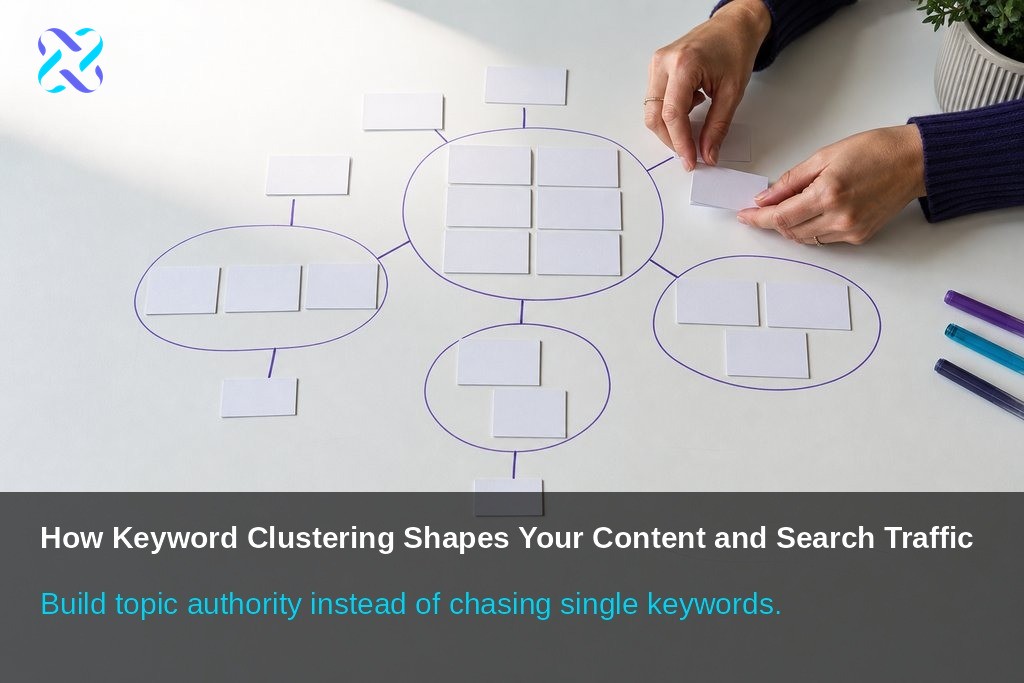
Keyword clustering groups related search terms into purposeful topics so each page builds authority across multiple queries and turns content into a compounding business asset.
- Publishing content without a clustering structure causes keyword cannibalization, where multiple pages compete for the same queries and cancel each other out rather than building authority together.
- Semantic keyword grouping aligns your content with how people actually search at different stages of awareness, allowing a single well built page to rank for dozens of related queries instead of just one phrase.
- A keyword group strategy becomes a business tool when clusters are mapped to audience intent and buying stage, connecting each piece of content to a specific moment in the customer journey.
- Search query clustering reveals genuine content gaps by analysing what your audience is actively searching for, producing a more accurate content roadmap than keyword volume reports alone.
- A reliable keyword cluster tool should validate groupings using live SERP data rather than surface level similarity, ensuring each cluster reflects real search intent and not just shared vocabulary.
Most websites accumulate content over time without a deliberate structure behind it. Pages get published, keywords get targeted one at a time, and the result is a site that covers a lot of ground without actually owning any of it. Keyword clustering changes that dynamic entirely. Instead of treating every search phrase as its own isolated opportunity, clustering groups related terms into purposeful topics so each page earns authority across a full set of queries rather than chasing a single phrase. For businesses in Vancouver and across British Columbia trying to grow organic traffic in a measurable way, this shift in thinking is not a minor adjustment. It is the difference between content that compounds and content that stagnates.
This article walks through what keyword clustering means in practice, how it connects to real business outcomes, and what a structured approach looks like when it is built to drive leads rather than just rankings.
What Is Keyword Clustering?
Keyword clustering is the process of grouping related keywords that share the same search intent so they can be targeted together on a single page, rather than scattered across multiple pages. The goal is not to stuff more phrases onto one page. It is to build pages that answer a complete topic thoroughly enough that both search engines and readers find them genuinely useful.
This is meaningfully different from basic keyword research, which typically produces a list of terms ranked by search volume. Clustering takes that list and imposes structure on it, revealing which terms belong together and which require their own dedicated content.
That structural distinction changes how content gets planned. Instead of asking “what keyword should this page target,” the question becomes “what topic does this cluster represent, and what does someone need to fully understand it?” The planning process aligns with how your audience actually thinks, producing content that serves readers at every stage of their journey, not just at a single search entry point.

Why Most Content Strategies Miss the Mark Without Keyword Clustering
The most common content strategy mistake is not publishing too little. It is publishing without a system. When businesses create separate pages for every keyword variation they want to rank for, they end up with dozens of overlapping pages that confuse search engines about which one to rank. Whatever authority the site has earned gets split across too many targets. This is keyword cannibalization, and it is more widespread than most site owners realize.
The business cost is real. Traffic plateaus because no single page accumulates enough relevance signals to rank well. Time and budget invested in content does not build on itself. Each new article starts from zero rather than contributing to a growing topical presence.
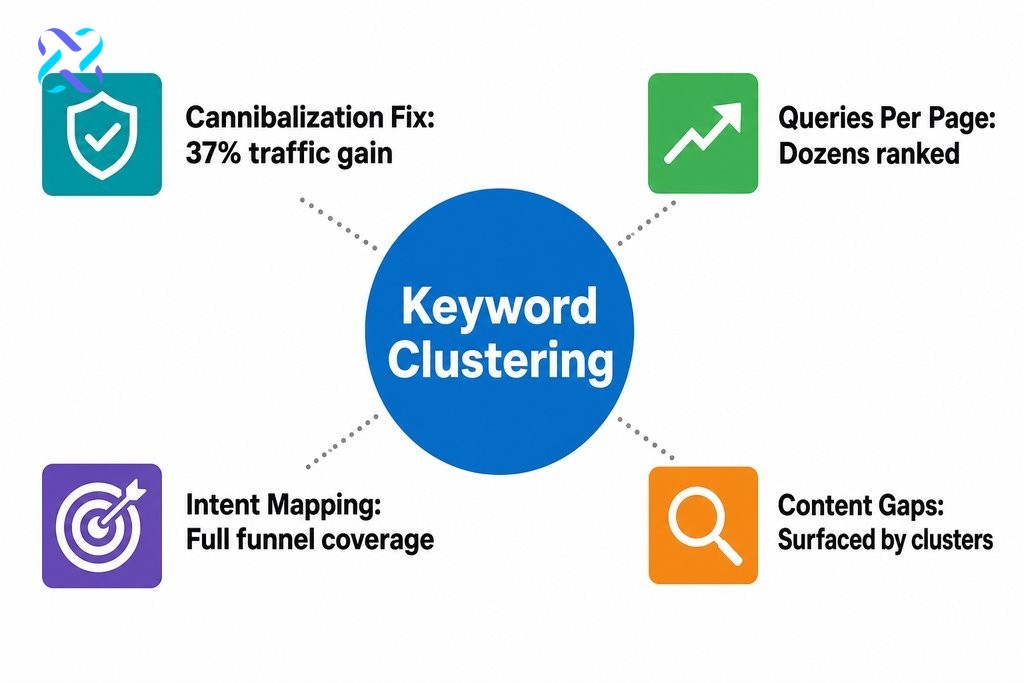
Research from Nightwatch found that consolidating cannibalized pages resulted in an average 37% increase in organic traffic to the surviving page, illustrating how much ranking potential gets trapped inside fragmented content strategies. A keyword clustering approach helps prevent this by ensuring each topic is covered once, thoroughly, with the full range of related intent served on a single coordinated page.
How Semantic Keyword Grouping Reflects the Way People Search
Modern search engines do not simply match keywords to pages. They evaluate pages for topic relevance and intent coverage. A page that genuinely addresses a subject can earn visibility across many related queries, not just the one phrase it was optimised for.
Semantic keyword grouping aligns your content with this reality. By identifying the range of phrases your audience uses to explore a topic at different stages of awareness, you can build pages that speak to the full conversation rather than a single entry point.
Someone early in a buying process might search very differently from someone ready to make a decision, even if both are researching the same underlying topic. Semantic keyword grouping captures both ends of that spectrum and maps them to content that meets each intent appropriately.
Research published through PubMed Central confirms that keyword extraction algorithms fall into three categories: semantic-based, machine learning-based, and statistical model-based, each offering different methods for identifying relatedness between terms. This helps explain why semantic grouping tends to produce more accurate topic maps than manually sorting keywords by surface-level similarity.
| Algorithm Type | How It Groups Keywords | Best Used For |
|---|---|---|
| Semantic-based | Groups terms by meaning and conceptual relatedness | Mapping intent and topic relevance accurately |
| Machine learning-based | Learns patterns from data to identify related clusters | Processing large keyword datasets with nuanced groupings |
| Statistical model-based | Uses frequency and co-occurrence signals to group terms | Identifying surface-level patterns across broad keyword lists |
Topic-Based Keyword Grouping vs. One Keyword Per Page
The older one-keyword-per-page model made sense when search engines were less sophisticated. Targeting one exact phrase per page was a reliable way to signal relevance. That model no longer reflects how rankings are earned.
Topic-based keyword grouping replaces it with a structure where each page is built around a cluster of related terms that share intent. A single well-built page can rank for dozens of queries rather than one. The result is fewer pages doing more work, which is both more efficient and more effective for building topical authority.
If your current site was built on the one-keyword-per-page model, you will likely find pages that cannibalize each other, thin content that never ranks, and a site structure that feels comprehensive to you but fragmented to a search engine. Recognizing which model your site reflects is the first step toward understanding why organic visibility may have plateaued despite consistent publishing effort.
| Factor | One Keyword Per Page | Topic-Based Keyword Clustering |
|---|---|---|
| Queries ranked per page | Typically one or a few | Potentially dozens of related queries |
| Risk of cannibalization | High — overlapping pages compete with each other | Low — each topic has a single authoritative page |
| Authority accumulation | Dispersed across many thin pages | Concentrated at the cluster level |
| Content efficiency | Low — many pages doing little work | High — fewer pages covering more ground |
| Alignment with modern search | Weak — search engines evaluate topic relevance | Strong — pages reflect how search engines rank content |

How to Build a Keyword Group Strategy Tied to Real Business Goals
A keyword group strategy becomes genuinely useful when it is built around business intent, not just SEO mechanics. Grouping keywords by search volume is a starting point, but the more important dimensions are intent, audience stage, and content format.
- A cluster of informational queries around a service you offer should map to educational content that builds trust.
- A cluster of comparison or decision-stage queries should map to content that clearly positions your offering.
- A cluster of high-intent transactional queries should connect directly to conversion-focused pages.
When keyword mapping is done with those distinctions in mind, your content plan starts to look like a sales funnel rather than a publishing calendar. Each cluster represents a segment of your audience at a specific moment of need. A structured keyword group strategy identifies which segments are underserved, which content formats fit each cluster, and which topics are most likely to convert traffic into leads.
Using Search Query Clustering to Find Content Gaps
Search query clustering works by grouping the actual queries your audience is already typing into search engines, not just the phrases you think they are using. This process often reveals significant gaps between what your site currently covers and what your audience is actively looking for.
A gap might be a topic you have never addressed, a question that appears across many related clusters but has no clear home on your site, or a high-intent query buried inside a page optimised for a different purpose.
Search intent analysis sits closely alongside this process. Understanding why someone is searching, not just what they are searching for, determines whether a gap represents a genuine content opportunity or a keyword that already has a better home elsewhere on your site. Surfacing these gaps through search query clustering produces a more accurate content roadmap than keyword volume reports alone, because it reflects actual audience behaviour rather than projected demand.
What to Look for in a Keyword Cluster Tool
A keyword cluster tool should do more than sort a list alphabetically or group terms by shared words. The most reliable tools group keywords based on which pages actually rank together in search results, not just semantic similarity. Two phrases that look related on the surface may target completely different intents, and only SERP analysis catches that distinction reliably.
Processing capacity also matters. According to GlobeNewswire, retrained machine learning models in keyword cluster tools can now handle entire keyword research datasets in a single batch, with some tools processing up to 200,000 keywords at a time using live, country-specific SERP data.
Prioritize actionable output. A feature-rich tool that produces reports no one acts on is not an advantage. Before choosing a platform, confirm that the output is clear enough for your content team to use, that it distinguishes intent reliably, and that it fits your planning workflow.

When to Handle This In-House and When to Bring in a Specialist
Keyword clustering is not technically complex, but it requires analytical judgment, familiarity with your audience’s search behaviour, and the capacity to translate cluster outputs into a coherent content plan. Teams with dedicated SEO or content strategists can often manage this work effectively in-house, especially with a capable tool to handle data processing.
The challenge is that clustering is only one step in a larger content strategy system. Without the surrounding structure, a well-built cluster map still produces no traffic. The signals that suggest working with a specialist include:
- A content library that has grown without a clear structure
- Organic traffic that has not responded to consistent publishing effort
- A team with capacity to create content but not the time or expertise to build the underlying strategy
When keyword clustering needs to connect directly to lead generation outcomes rather than just ranking improvements, the systems involved become more specific. That is the context where working with a partner who combines SEO expertise with AI-assisted analysis and a focus on measurable business results tends to produce a more reliable return.
How a Systems-Based Approach Turns Keyword Clusters Into Measurable Traffic
Keyword clusters are most valuable when they function as the structural foundation for a coordinated content system. A primary page covers the topic comprehensively, supporting pages address adjacent queries and intent variations, and those pages interlink within a topical silo architecture that signals to search engines which content owns each subject area on your site. Authority accumulates at the cluster level rather than being dispersed across unrelated pages.
At Leadsagna, this systems-based thinking shapes how keyword cluster strategy is built and executed for clients across Vancouver and the Lower Mainland. Rather than treating clustering as a one-time research exercise, it is used as the foundation for a content architecture where every page has a defined role, every cluster connects to a business goal, and performance is measured against traffic and lead outcomes rather than activity metrics.
AI-assisted data analysis helps identify the clusters with the highest commercial relevance, prioritise content development based on intent and competitive opportunity, and monitor how authority builds across each cluster over time. The goal is not to publish more content. It is to build a content system that grows more effective with every addition.
Working With a Vancouver SEO Specialist
If your website is not earning the organic traffic your business deserves, the issue is likely structural rather than a matter of effort. Leadsagna works with businesses in Vancouver, from Gastown and Mount Pleasant to the North Shore and Surrey, to build content systems grounded in precise keyword mapping, intent-driven planning, and measurable outcomes. Reach out to start a conversation about what a structured approach could look like for your site.
Frequently Asked Questions About Keyword Clustering
What is the difference between keyword research and keyword clustering?
Keyword research produces a list of terms and their search volumes. Keyword clustering takes that list further by grouping terms that share the same search intent, so you can plan content that covers a full topic rather than targeting one phrase at a time. Clustering adds strategic structure to raw keyword data.
How many keywords should be in a single cluster?
There is no fixed number, but a practical cluster typically contains between 5 and 20 related terms. The right size depends on how closely the terms align in intent. A tightly focused cluster with fewer keywords is more useful than a large cluster where intent varies widely.
Can keyword clustering help with an existing website, or is it only for new sites?
Clustering is often most valuable for existing sites. It helps identify cannibalization between current pages, surfaces content gaps, and provides a clear framework for consolidating or restructuring content that has accumulated without a deliberate strategy.
Does keyword clustering replace the need for individual keyword targeting?
No. Each cluster still has a primary keyword that anchors the page’s focus. Clustering ensures that related supporting terms are addressed on the same page rather than spread across competing pages. Individual targeting happens within a cluster, not instead of one.
How often should keyword clusters be reviewed or updated?
Review clusters when you add significant new content, when organic performance changes noticeably, or when your offerings shift. Search behaviour evolves, and clusters built a year ago may no longer reflect how your audience is currently searching. An annual review is a reasonable starting point for most sites.


