


Key Takeaways
Content gap analysis helps businesses find and fill the missing topics their audience searches for, turning overlooked opportunities into consistent organic traffic and leads.
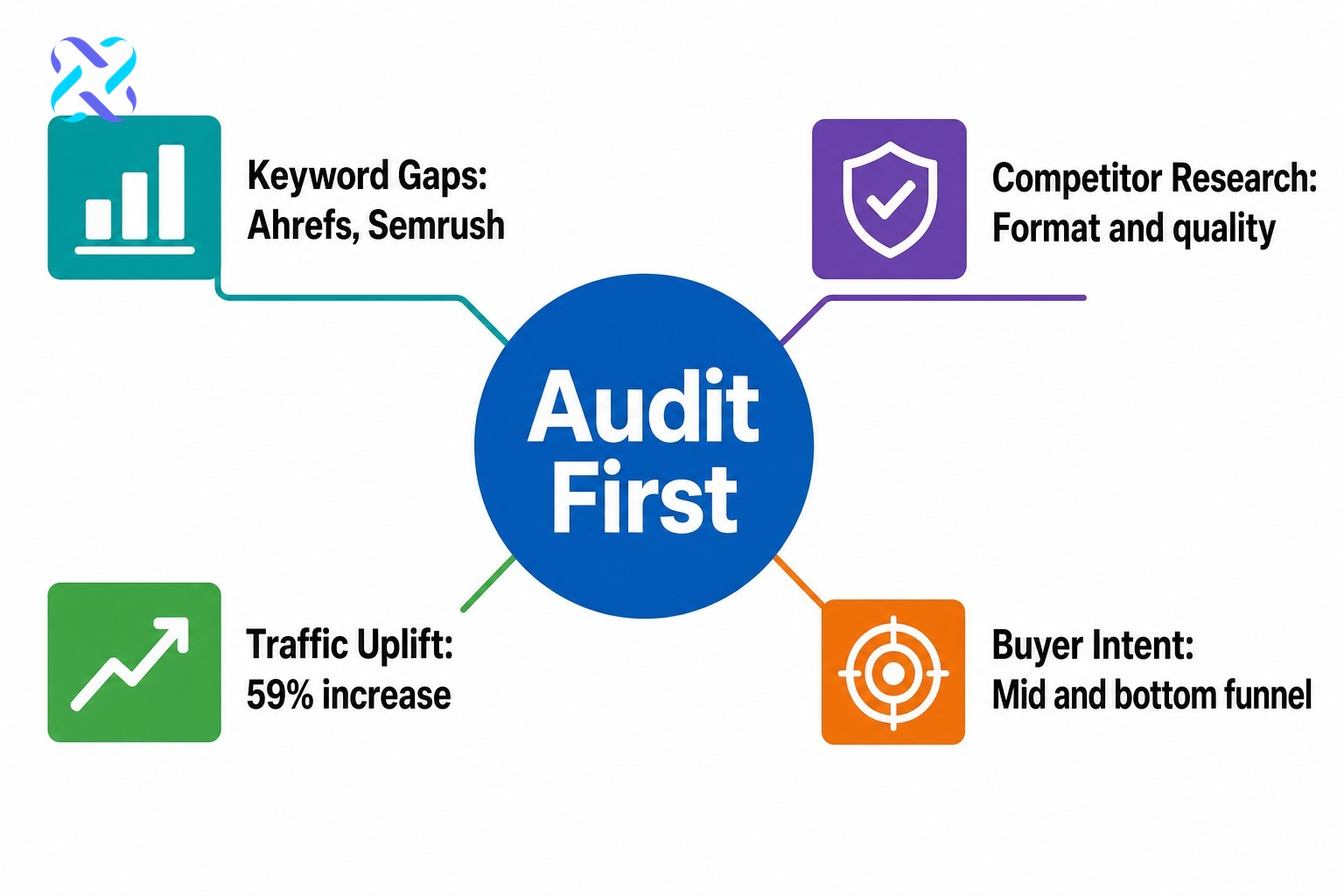
- Auditing pages ranked between positions 8 and 20 in Google Search Console reveals content gaps that are already close to top placements and can deliver faster results than creating entirely new content.
- Keyword gap analysis using tools like Ahrefs or Semrush uncovers search terms your competitors rank for that your site does not yet address, giving you a prioritized list of missing content opportunities.
- Not every competitor ranking is worth pursuing; each gap should be evaluated by whether closing it would attract visitors who can realistically become your customers.
- Prioritize content gaps by combining search volume, buyer intent, and realistic ranking potential so that your efforts connect directly to leads and sales rather than just traffic.
- Middle and bottom of the funnel content such as comparisons, pricing guides, and case studies are the most commonly missed gaps and the most valuable for converting high intent visitors.
Most websites are not losing organic traffic because of a technical problem. They are losing it because their content does not cover what their audience is actually searching for. Content gap analysis is the process of identifying exactly those blind spots: the topics, questions, and search terms your potential customers are typing into Google that your website simply does not address. For businesses in Vancouver and across the Lower Mainland, closing those gaps is one of the highest-return moves available within any serious SEO content strategy.
This article walks through the full process, from understanding what a content gap really is, to auditing your own site, to turning your findings into a prioritized plan that connects directly to leads and sales. If you have been publishing content without seeing consistent organic growth, the answer likely lies not in publishing more but in publishing what is actually missing.
What Is Content Gap Analysis?
Content gap analysis is a structured examination of the distance between what your audience needs and what your website currently delivers. That distance shows up as lost rankings, visitors who leave unsatisfied, and potential customers who find a competitor’s answer before they find yours.
This is also where it differs meaningfully from general keyword research. Keyword research tells you what people search for. Content gap analysis tells you which of those searches your site is failing to serve, and why. That distinction shifts your focus from chasing search volume toward genuine audience coverage. The goal is not to rank for every keyword in your industry. It is to own the specific territory where your ideal customers are looking for answers, comparisons, and solutions that lead them to buy.
| Approach | What It Shows | Primary Focus | Best Used For |
|---|---|---|---|
| Keyword Research | What people search for across a market | Search volume and demand | Discovering topic opportunities broadly |
| Content Gap Analysis | Which searches your site fails to serve and why | Audience coverage and missing pages | Prioritizing what to create or improve |

How to Identify SEO Content Gaps on Your Own Site
Auditing your existing content is the logical starting point. Begin by exporting your current rankings from Google Search Console and mapping them against the topics your audience searches for at each stage of their decision process. Pay particular attention to pages ranking between positions 8 and 20. These are your most revealing signals. Google already considers you relevant, but your content has not earned a top placement yet. Improving these pages often delivers faster results than creating something entirely new.
From there, identify missing topic clusters. If your site covers a broad subject but skips the specific sub-questions your audience asks along the way, those unanswered questions funnel traffic directly to competitors. Flag thin or outdated content as well. Pages with little depth, old statistics, or no clear answer to a real user question are equally problematic.
According to Backlinko, improving existing content to close SEO content gaps can increase organic traffic by more than 59%, making your underperforming pages one of the most valuable assets in your entire content plan.
Using Keyword Gap Analysis to Find What You Are Missing
Keyword gap analysis compares your site’s current keyword profile directly against search demand in your market. Tools such as Ahrefs, Semrush, and Google Search Console surface terms that are actively driving search volume in your category but do not appear anywhere in your current rankings.
The output is a clear, prioritized list of terms your content strategy has not yet claimed. For Vancouver businesses targeting local visibility, whether in neighbourhoods like Mount Pleasant, Kitsilano, or Yaletown, or across broader British Columbia markets, this comparison often reveals entire topic areas where local demand exists but no Vancouver-focused content competes effectively. Working through this process systematically is what makes content opportunity analysis actionable rather than theoretical.
How to Use Competitor Content Gaps to Your Advantage
Analyzing competitor content is one of the most direct ways to find missing opportunities on your own site. Identify which pages on competitor websites are generating organic traffic, then determine whether your site addresses those same topics. When a competitor consistently ranks for searches that are directly relevant to your audience and you have no equivalent content, that is a gap with immediate commercial value.
Competitor keyword analysis is not about copying what others have done. It is about understanding the full map of demand in your space and deciding strategically where to focus your efforts. Not every competitor ranking is worth chasing. Some reflect their specific services, audiences, or geographic focus, none of which may align with your business. A ranking that drives traffic but not buyers is not an opportunity; it is a distraction. The real discipline of gap research lies in separating genuine missed opportunities from noise.
What Competitor Research Reveals Beyond Keywords
When you look closely at why a competitor outranks you, the answer is rarely just a keyword. Topic depth, content format, and page structure all contribute to ranking authority. A competitor might rank for a comparison query not because they used the right keyword, but because they built a dedicated page with real product detail, user-relevant criteria, and original perspective.
According to Yotpo, content teams that rely solely on analyzing top-ranking results tend to produce generic content that AI systems can easily replicate, creating a new category of gap defined by the absence of original data and first-hand insight. Competitor research should therefore push you toward understanding format gaps and quality gaps, not just which keywords a rival happens to rank for.
| Gap Type | What It Means | How to Identify It | How to Close It |
|---|---|---|---|
| Keyword Gap | Terms competitors rank for that your site does not | Ahrefs, Semrush gap tools, Google Search Console | Create or expand pages targeting those terms |
| Topic Depth Gap | Competitor covers a subject more thoroughly than you do | Manual review of competing pages | Expand existing content with more detail and sub-topics |
| Format Gap | Competitor uses a more effective content format for the query | Review SERP layouts for target terms | Reformat content to match user expectations (guides, comparisons, etc.) |
| Quality Gap | Competitor offers original data or first-hand insight you lack | Assess uniqueness and sourcing of top-ranking pages | Add original perspective, case studies, or proprietary data |

Turning Missing Content Opportunities Into an Action Plan
Identifying gaps is only half the work. The other half is deciding which ones to close first. Score each opportunity against search volume, buyer intent, and ranking potential relative to your current domain authority. High-intent, moderate-volume gaps with achievable competition levels almost always deserve priority over high-volume, low-intent terms that bring traffic without business value.
Sequencing also matters because content authority compounds. A well-built piece on a core topic creates the foundation for related content to rank faster. Each new article that links back to a strong pillar reinforces the authority of both. It is also worth noting that Google’s December 2025 Core Update targeted scaled content abuse, with visibility drops reported in product review segments for sites that filled keyword gaps with mass-produced, generic text. Quality and original perspective are not optional extras. They are the minimum standard for content that holds its ranking over time.

How Content Gap Research Connects to Sales, Not Just Traffic
Traffic is only useful if it converts, and gap research should always be anchored to that reality. The most commonly missed gaps are not at the top of the funnel. They appear in the middle and bottom: product comparisons, pricing guides, implementation and how-to content, and case studies or proof-of-concept pages. These are the pages that catch someone who already knows what they need and is now deciding who to trust with their purchase.
Cross-industry content audit findings cited by the AirOps Blog suggest that many strategies over-index on top-of-funnel topics, leaving the highest-intent visitors with nothing to guide their decision. Mapping your content to the awareness, consideration, and decision stages of a buyer’s journey makes this visible in a structured way. If your site answers introductory questions well but has nothing to help a prospect compare options or understand what working with you looks like, your content may be releasing potential customers back into the market at exactly the wrong moment.
HubSpot research indicates that marketers who identify and fill content gaps are better positioned to capture high-intent traffic and convert visitors into leads, connecting gap analysis directly to revenue rather than just ranking metrics.
Should You Handle Content Gap Research Yourself or Bring in Help?
Free tools like Google Search Console give you a solid starting point. Paid tools such as Semrush and Ahrefs add competitor comparison layers that significantly expand what you can see. A DIY gap audit is genuinely valuable for identifying obvious missing topics, spotting pages with low rankings on relevant terms, and flagging content that is thin or outdated, none of which requires outside help.
Professional support becomes worthwhile when you need gaps validated against actual search intent rather than just keyword volume, competitor structures cross-referenced at depth, format and quality requirements evaluated for each opportunity, and a sequenced action plan tied to measurable business goals. The deliverable should be specific enough that you know exactly what to create, why it is likely to rank, and what outcome it is designed to drive.
At Leadsagna, that kind of precision is built into every content engagement, because content that does not connect to revenue is simply not worth producing. If you are ready to stop guessing about what your site is missing and start building content that generates leads, reach out to the Leadsagna team in Vancouver to find out exactly where your opportunities are.
Frequently Asked Questions About Content Gap Analysis
What is content gap analysis in SEO?
Content gap analysis identifies topics, questions, and keywords your audience searches for that your website does not currently address. Unlike general keyword research, it focuses on what your site is missing relative to both audience demand and competitor coverage, helping you prioritize content that closes real ranking and conversion gaps.
How is content gap analysis different from keyword research?
Keyword research identifies what people search for across a market. Content gap analysis goes further by showing which of those searches your site fails to rank for, why that is happening, and what type of content would close the gap. It uses your existing content as a baseline and builds a targeted improvement plan from there.
Which tools are best for running a content gap analysis?
Google Search Console is the most accessible starting point, showing which terms you already rank for and where you are underperforming. Ahrefs and Semrush both offer dedicated gap analysis features that compare your keyword profile against competitors. For Vancouver-focused businesses, layering local search data into these tools adds meaningful precision.
How often should I run a content gap analysis?
A thorough audit is worth running every six to twelve months, or whenever your market shifts significantly, such as after a major Google algorithm update, a change in your service offering, or notable competitor activity. Smaller checks on underperforming pages can be done more frequently as part of a regular content review.
Can content gap analysis improve leads, not just traffic?
Yes, and that is often the more important outcome. The highest-value gaps are usually mid- and bottom-funnel: comparisons, pricing guides, and how-to content that serve buyers close to a decision. Filling those gaps targets visitors with strong purchase intent, which tends to improve lead quality and conversion rates, not just raw traffic volume.
How long does it take to see results after closing content gaps?
Timelines vary based on domain authority, competition level, and content quality. Improvements to pages already ranking between positions 8 and 20 can show results within weeks. New pages targeting competitive terms may take three to six months to gain traction. Consistent internal linking and content quality both help accelerate the process.


